European responses to the events of 1857 ranged from disbelief to anger to a more judicious appraisal of English rule. Benjamin Disraeli, the future prime minister of Britain, thought the Indians had adequate cause to be angry. Historians were divided as to whether the Hindus or Muslims initiated the rebellion.Karl Marx believed the sepoys' actions were a 'reflex' version of British brutality. Charles Dickens was furious and wanted to massacre all Indians. Christina Rossetti and Lord Tennyson wrote poems on 1857. French commentators accused England of turning India into a prison. They also expressed great anxiety over the brutality of British reprisals.
American newspapers carried regular reports of the events in India. Their responses were also, like European ones, ambivalent. Commentaries in newspapers such as the New York Daily News, Harper's, the United States Democratic Review and the North American Review often pointed to British policy in India as a culprit. Mark Twain, who toured India and visited Kanpur, saw the British annexation policy as provoking native discontent. Several American commentators believed that Britain required more Christian evangelizing in India to thwart any uprising, ignoring the fact that evangelizing was a prime cause of sepoy discontent.
Essays on this theme appeared in the Princeton Review, New Englander and Yale Review. 'Christian religion,' declared an essayist in the St Louis Christian Advocate on October 1, 1857, 'is not in the least responsible for the mutiny.' A commentator said in the New York Daily Times on July 6, 1857: 'As long as it humors the superstitions and prejudices that benight the Hindoo mind, so long will its power in India be jeopardised by the mutinies and rebellions of the natives.'
Another argued that the Indian caste system must be destroyed by Christian religion. There was some doubt about the nature of the rebellion -- was it a truly national revolt, or did it just involve the sepoys? The Brooklyn Daily Eagle called it 'the Indian Rebellion', giving it a national character. The New York Times of August 13, 1857 titled one of its India updates 'A Mohammedan Conspiracy for the Sovereignty of India.' The Southern Literary Messenger published a poem titled The Martyr Missionaries of Futtehgurrh, showcasing the killing of Christian missionaries by the Sepoys.
The Rediff Special: 1857, the First War of Independence
Amrita Lal Roy, an Indian who was asked to write a piece by the North American Review, published his 'English Rule in India' (Volume 142, Issue 353, 1886) in which he was in no doubt about the exploitative nature of the Raj: 'England has brought upon India penury and shame. Instead of being a means of civilisation, English rule in India is almost an excuse to keep up barbarism in the nineteenth century.' He argued that the English had degraded the natives, and went to plead that Americans stand by the Indians. He concluded: 'Let us hope that the American people, at least, will not let considerations of race, language or commerce weigh against the eternal rights of man which they wrote in the Declaration of Independence.'
1857 was a mix of the military, civilian and popular rebellion -- as argued by a leading scholar on the subject, Rudrangshu Mukherjee. Landlords and local kings used the revolt as a chance to retrieve their lost lands -- they really had no concept of a 'national' movement. For many Indian interpreters, from V D Savarkar to Jawaharlal Nehru, it was not 'mutiny' but the 'first war of Indian independence'. The debate is unresolved, irresolvable.
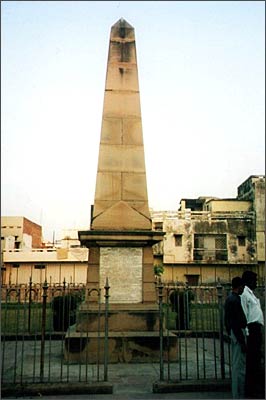
Image: The Havelock Memorial in Lucknow, with the remains of Sir Henry Havelock
Also see: A family story
 Advertisement