Delhi began paying the price of mutiny. Never since Nadir Shah had an Indian city been so plundered. Never had there been such massacre of civilians. Muslims were sought out and killed, those who could, escaped from the city only to starve to death in the bitter winter of 1857. Mirza Ghalib records: 'In the entire city of Delhi, it is impossible to find one thousand Muslims.' He expressed his anguish in verse: 'Every grain of dust in Delhi, thirsts for Muslims' blood. Even if we were together, we could only weep over our lives.'
The Europeans rampaged through the city, destroying, looting and killing. One estimate puts the number of dead inside Delhi at 30,000. 'Many a time has Delhi been the theatre of war and bloodshed, but never more so than during the Sepoy Rebellion.' Thus wrote a traveler, Bholanauth Chunder, in his account published in 1869. Today, it would be termed genocide -- then, the concept did not exist.
Campbell then moved into Awadh. He defeated rebel forces at various places, even as Jhansi battled on. Rani Lakshmibai, the queen of Jhansi, had known Nana Sahib and his trusted assistant, Tatya Tope (real name Ramachandra Pandurang) since childhood.
When rebellion broke out, Jhansi had been besieged by neighboring kingdoms. She wrote to the British for help, but there was none forthcoming. Under pressure from her subjects, Rani Lakshmibai joined forces with the rebels, and emerged as one of the great legends of 1857. 'We fight for independence', declared the Rani, a battle cry echoed by her subjects.
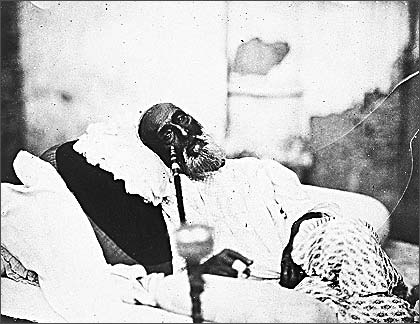
In Delhi, another tragic drama began to unfold. Inside the palace's Diwan-I-Khas, Bahadur Shah Zafar was put on trial by the British government. The tragedy was, he was not only old, but technically still Emperor of Hindustan, and the British his vassals.
The Rediff Special: 1857, the First War of Independence
The trial opened on January 27, 1858 and went on for 21 days. On March 9, 1858, Zafar was ruled guilty of massacring Europeans and abetting the mutiny. He was exiled to Rangoon, where he died in 1862.
On April 3, 1858, Hugh Rose's army entered Jhansi, and the bloodshed began once more. According to one account, 5,000 people died inside Jhansi. Two images would forever remain associated with the place.
The first -- of women throwing their children into wells and jumping in after them to prevent themselves from falling into European hands.
The second -- Rani Lakshmibai, her young son strapped to her back, racing out of her beloved Jhansi to escape British soldiers and live to fight another day. 'I will never yield Jhansi', she declared. It would come to symbolise native courage: a queen and her son riding through the night surrounded by enemy soldiers, young mothers drowning themselves and their children, scenes unparalleled in the history of empire.
Rose would not give up: a native woman thwarting the British Empire? Never. On June 6, 1858, he met Rani Lakshmibai's forces at Kalpi. The Rani knew this would be her most decisive battle, even though she could foresee the end. Dressed in a man's clothes, holding the horse's bit between her teeth and using her sword with both hands, she Rani went into battle. Unseated by a saber cut and then shot, Rani Lakshmibai finally died on the battlefield.
A later historian would say of her: 'She possessed the genius, the daring, the despair necessary for the conception of great deeds'. Hugh Rose himself would compare her to Joan of Arc.
Tatya Tope proved to be exceptionally brilliant in evasive tactics. He was caught -- by a patented British system: getting insiders to betray their leaders -- April 1859 and hanged. He is said to have put the noose around his neck himself. However, the most wanted man in British India, Nana Sahib, was never caught. The British desperately wanted to make an example of him. But the Nana proved smarter, evading capture, until his death somewhere in Nepal, in 1859.
The Sepoy Mutiny was over.
Image: Bahadur Shah Zafar in 1858, just after his trial in Delhi
Also see: Revisiting 1857: Satyajit Ray's vision
 Advertisement