What is significant is that both Hindus and Muslims united under a Muslim king to fight the Raj. Both Hindus and Muslim sepoys, in fact, declared that the rebellion was a holy war. Zafar, the guardian of the faith for both Hindus and Muslims, was an unusual king: he banned beef so as to not hurt Hindu subjects, and viewed the annual Dussehra procession.This feature of 1857 is something special and relevant to contemporary India. The use of the term 'Hindustan' in the proclamations of both Hindu and Muslim leaders suggests a pan-Indian nationalism, as 'Hindustan' suggests a pre-British geographic/territorial entity.
1857 may have been ineffective in throwing out the British. Yet, it has to be seen as the first moments of Indian nationalism, as later leaders like Subhas Chandra Bose recognised. It may have produced the idea of a nation. It revealed the illegitimacy of British rule to the people. It threw up leaders all over the country. These features would later be harnessed with greater efficacy in the freedom struggle.
The Rediff Special: 1857, the First War of Independence
Thus, it is useful to see 1857 less as an event complete in itself than as a moment of something larger. What is supremely ironic, of course, is that the first major but relatively unsuccessful armed rebellion against the Raj was the opening moment of a hugely successful non-violent battle.1857's armies metamorphosed into Satyagraha. There were to be no more massacres of the European-as-enemy.
If 1857 produced legends like Nana Sahib and Rani Lakshmibai in gun battles and sieges, later decades would produce a miracle -- a man with a walking stick, of whom it was said that future generations would scarce believe such a one ever walked upon the earth.
That miracle would be named Gandhi.
Pramod K Nayar teaches at the Department of English, University of Hyderabad, India. He is the author of India 1857: The Great Uprising (Penguin, 2007), editor of The Penguin 1857 Reader and The Trial of Bahadur Shah Zafar (forthcoming from Orient Longman).
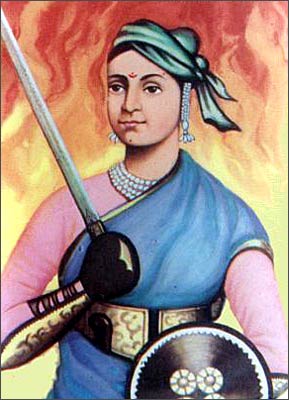
Image: Rani Lakshmibai of Jhansi, whose seal read: 'To God only belongs the world, and the command of it rests with Him.'
Also see: Lessons from 1857: Don't forget the past
 Advertisement