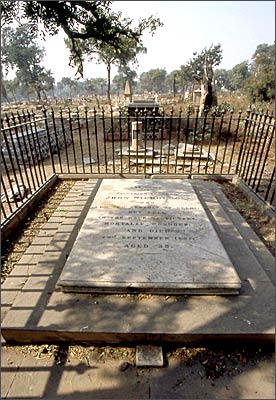
At one point, it looked as though Delhi would never be won. European soldiers went through sniper-covered streets, being shot down at will. And then, charging to take Lahore Gate so his troops could enter, out stepped into the street in full view of every rebel's sightline, John Nicholson.Unafraid for his life, seeking a hero's death, waving his sword in the air, Nicholson urged his men onward. Shot, as expected, Nicholson contemptuously refused treatment -- he would not, he promised his men, die before Delhi was taken. Inspired by his courage, the Europeans drove through, street by bloody street, house by bloody house, massacred and massacring.
By September 20, Delhi was cleared of rebels. 3,850 men from the British forces -- including 2,140 Europeans -- were killed in the battle. Neville Chamberlain went to inform the dying Nicholson: 'Delhi is British again'. Nicholson, with his last ounce of strength, fired a celebratory shot from his revolver. September 23, having fulfilled his promise, John Nicholson, hero-psychopath-soldier, died.
Zafar, with his wife Zeenat Mahal, fled to the tomb of his illustrious ancestor Humayun, on the outskirts of Delhi. September 21, he surrendered to W S R Hodson, commander of legendary battalion Hodson's Horse.
It was a sad day as Zafar and his family returned prisoners to the Red Fort, from where his forefathers had ruled with such pride and authority. The streets were lined with natives, weeping at a sight they recognised too well: The end of a dynasty.
The Rediff Special: 1857, the First War of Independence
A day later, Hodson returned for Zafar's sons and grandson, who had headed the rebel army. Once again, a procession headed back to the Fort. En route, Hodson ordered the princes to strip, in public, and shot them dead. The spot is today memorialised as Khooni Darwaza. No enquiry was ordered into Hodson's actions. He would die later in the battle for Lucknow, in the midst of looting a palace.
The Lucknow Residency was beleaguered beyond belief. English women who had never toiled before, worked at nursing the injured, caring for the children, and even stocking ammunition. Maria Germon's Journal of the Siege of Lucknow records her performing 'labour that I never could have been equal to, especially in this country'.
Finally, on September 25, the first relief of Lucknow arrived. In the wake of much rejoicing, Outram, Havelock and others planned evacuation, even as Colin Campbell, the new Commander-in-Chief, made his way towards Lucknow. On November 19, the first lot of women and children left Lucknow, a scene captured poignantly by Abraham Solomon in his painting, The Flight from Lucknow.
Image: Monument at the Nicholson Cemetery, Delhi
Photograph: Patrick Horton, courtesy indian-cemeteries.org
Also see: Marching on history's path to Red Fort
 Advertisement