Worldwide responses came in, shocked and angry. Many offered to go to India to put down the rebellion. The Tipperary Artillery Militia offered its services to 'maintain the honor of England and avenge the sufferings of her sons and daughters in the East'.Lord Canning, the man in charge of India, however, refused to order revenge killings, and acquired, as a result of his attitude, the notorious epithet, 'Clemency Canning'. 'I will not govern in anger', he declared.
On May 30, Lucknow erupted. Henry Lawrence, the man in charge of Lucknow, quickly made arrangements for the British to be shifted into the Residency. Then, a shell hit Lawrence. He never recovered and died on July 4. Lucknow would see the longest siege of the Mutiny. The conditions inside were appalling, with decreasing provisions, injury, and the backdrop of the Kanpur massacres to instill fear into residents.
Many women's accounts, like Katharine Bartrum's A Widow's Reminiscences of the Siege of Lucknow (1858) have provided searing accounts of the siege. 'Let us go then, in God's name!' cried James Outram hearing of conditions inside the Residency and the first relief of Lucknow was on its way.
On August 15, accompanied by about 400 men, Havelock moved against a rebel force of over 4,000 men at Bithur, Nana Sahib's stronghold.
The Rediff Special: 1857, the First War of Independence
Elsewhere, Delhi was in confusion. On August 14, the force to relieve Delhi amassed on Delhi Ridge. The man on whom much of the responsibility rested was perhaps the most brutal, blood-thirsty and indomitable figure of British India.
John Nicholson, who is reputed to have cleaved a man in two with one stroke of his sword, was already a legend -- revered as 'Nikal Seyn' by his sepoys. 'The punishment for mutiny is death', he declared when asked to conduct court-martials. He, therefore, simply executed those whom he suspected of mutiny. Nicholson believed the British outside Delhi would be the saviors: he was the man of the moment, the hero an empire could depend on.
Inside the city, the Mughal princes exploited the citizens for funds to pay the army of rebel soldiers. Businessmen hid their wealth and the poor starved. The city was on the verge of collapse. Zafar had absolutely no control. In fact, according to one account, the soldiers treated the emperor very badly, addressing him as 'Arre, Badshah! Arre, Buddhe!' in his palace. The greatest poet of the age, Mirza Ghalib, who lived through Delhi 1857, mourned the city's collapse.
Rebels across northern India were taking a beating at the hands of the furious British. On August 24, Nicholson defeated a rebel army at Najafgarh -- he took no prisoners. On September 14, the most significant battle Britain would fight before Normandy and Berlin was launched: the battle for Delhi, the city that once symbolized the reign of the most cultured empire, the Mughals, and then the power of imperial Britain. Delhi would demonstrate, once again, an empire's fury.
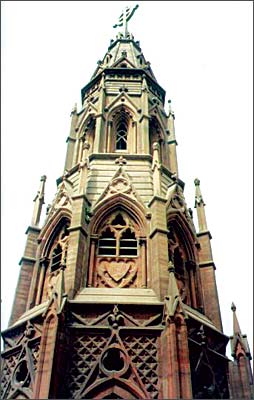
Image: The Mutiny Memorial on The Ridge overlooking Delhi
Photograph: John Kendall, courtesy indian-cemeteries.org
Also see: CPI-M to counter India's official history
 Advertisement