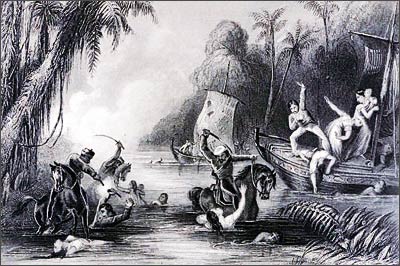
The Nana received news of Neill's bloody march and was shaken and incensed, even as the embattled Wheeler surrendered. On June 27, the weary, injured British set out from the entrenchments to Satichaura Ghat to embark on the boats to safety.But, something went wrong -- either a premeditated massacre by Nana, or a tragic misunderstanding by native sepoys lining the banks of the Ghat. A massacre ensued.
Wheeler was cut down, and only four men survived. One of them, Mowbray Thomson, went on to write The Story of Cawnpore. Two Eurasian girls, Amelia Horne and Margaret (Ulrica) Wheeler, were supposedly captured by the sepoys. Amelia cohabited, voluntarily or as a prisoner, with a soldier. She wrote two accounts -- one published in 1859, the other in 1913. Margaret, in a story that was never proved, apparently killed her captor and his family and then threw herself into a well. A steel engraving, 'Miss Wheeler defending herself against the Sepoys' was reproduced in Charles Ball's The History of the Indian Mutiny (1858-59). Another story is that she survived well into the twentieth century, living as a Muslim woman in Kanpur.
The Rediff Special: 1857, the First War of Independence
125 women and children survived Satichaura and were imprisoned in a small house, the Bibighar. Later, more prisoners were added. The conditions were horrendous, and about 25 died of cholera in a week. July 15, five assassins, some of them butchers by profession, went into the Bibighar. When they emerged, most of the 191 people inside were dead. Next morning, the bodies were dumped into a disused well.
Havelock's men marched into Kanpur on July 17, joined soon after by Neill and his forces. They confronted the Bibighar walls imprinted with bloodied hands, matted hair, limbs strewn across the floor and blood everywhere. The soldiers then arrived at the well, and looked in. 'This is a sight I wish I have never seen', recorded Major Bingham. The British soldiers swore that every single death at Bibighar would be avenged. And the natives would pay, horribly, slowly, for Kanpur. 'Every stain of that innocent blood shall be cleared up and wiped out...the task will be made as revolting to each miscreant's feelings as possible. After properly cleaning his portion the culprit is to be immediately hanged', swore Neill.
While European histories of 1857 often centre around Nana Sahib's cruelties, very few mention that Neill's massacres at Allahabad and Benares preceded Kanpur, and indeed may have provoked Satichaura Ghat and Bibighar.
Image: Period painting of the massacre at the Satichaura Ghat, Kanpur
Also see: The British lie quietly in Meerut
 Advertisement