Many native leaders emerged out of the chaos that was India, 1857. Begum Hazrat Mahal of Awadh was a prime mover in the incidents of that year. Awadh, incidentally, was the 'cradle' of sepoys -- the largest number of soldiers in the East India Company army came from there. Kunwar Singh, the Raja of Jagdishpur, was to be one of the great heroes -- he cut off his injured hand and offered it as a sacrifice to the river Ganga.
Ahmedullah Shah, the Maulvi of Faizabad, proved an influential leader and was, at one time, the most wanted man in the British Empire. Liaquat Ali, a maulvi from Allahabad, termed the mutiny a jihad. Such leaders appealed to the natives, pointing out the ill-effects of the Raj. Proclamations were issued, calling upon Hindus and Muslims to fight for their faith.
The world watched, and listened: newspapers and magazines from May 1857 onwards carried special reports on the 'war in India'. Karl Marx, who had noted the exploitative conditions of the empire, had predicted as early as 1853 that things would go terribly wrong there.
Jhansi, Kanpur, Ambala, Lahore, Muzzafarnagar, Lucknow and dozens of places saw the British routed by belligerent sepoys. By mid-June, most of northern India was out of British control. But it was Kanpur that would become the major site.
General Wheeler at Kanpur did not believe the native Raja, Dhondu Pant, would attack him, even though all signs of a strike were plainly visible. Eventually, Wheeler moved all the British into barracks in the middle of an open field -- as a military tactic this was absolutely ridiculous, as they were to discover.
The Rediff Special: 1857, the First War of Independence
Dhondu Pant launched his attack, and a siege ensued. Dozens of Europeans inside the barracks died, and corpses rotted in the sun. They ran out of water, medicines, ammunition and hope. Wheeler sent messages for help. 'Surely we are not to die like rats in a cage', he pleaded. Dhondu Pant was about to enter British history as the greatest Indian criminal of all time -- and we today recognise him by the name he popularly used: Nana Sahib, or simply, The Nana.
Wheeler's pleas roused the British administration. Henry Havelock, one of the British heroes of 1857, whose statue adorns Trafalgar Square, London, was dispatched to rescue Kanpur.
But Kanpur had reserved its place in history and neither Havelock nor James Neill was to change that. On Neill's route to Kanpur lay Benares, the holiest of Hindu cities. At Benares, and later at Allahabad, Neill went berserk. He hanged natives in hundreds, and the highway was decorated with corpses hanging from trees. News of Neill's actions spread far and wide -- greeted as proper justice by the shocked British and with awe and revulsion by the natives. Neill's bloodletting may have, in fact, given rise to the events at Kanpur.
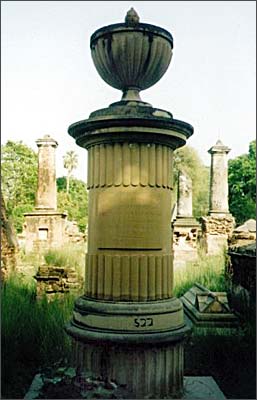
Image: The Christian Cemetery in Kanpur
Photograph: John Kendall, courtesy indian-cemeteries.org
Also see: The glorious example of the heroes of 1857
 Advertisement