One of them, Mangal Pandey, shot at his white officers, was caught, tried and hanged. During his trial, Pandey admitted he was high on bhang, but refused to name his fellow-conspirators. Pandey becomes the first major Indian player in the drama: his name encrypted as 'pandies' to refer to all native sepoys.It was also significant that native sepoys heavily outnumbered British/European soldiers [there were 875 Europeans to 20,000 native sepoys in Awadh alone]. And when the sepoys turned against their European officers, the latter had no chance of fighting back.
The unrest spread and, May 10, 1857, the sepoys at Meerut freed their imprisoned comrades, who had been convicted for refusing the suspect cartridges.
Soon, sepoys all over northern India turned against their officers. Delhi became the center of sepoy activity when the Meerut 'rebels' crowned the 82-year-old Bahadur Shah Zafar, the last of the great Mughals -- who really only wanted to write poetry and be free of family squabbles -- as 'Emperor'.
The Rediff Special: 1857, the First War of Independence
Zafar's sons, despite lacking military experience, assumed command of the rebel army. Delhi was transformed into a conflagration -- Europeans and Christians were sought out and killed, their belongings looted and buildings burnt. Many, however, escaped through the help of faithful native servants.A massacre of about 50 British men, women and children took place within the palace premises on May 16 -- an event that would have crucial consequences when the British retrieved Delhi.
The next day, John Lawrence, Commissioner of the Punjab, ordered the creation of a Delhi Field Force. It was given one task: retrieve Delhi, at all and any cost. The empire must not fall to a bunch of illiterate sepoys who, looked after by the British, had rebelled against their own masters. Archdale Wilson and Henry Barnard began operations to retrieve Delhi.
Indian landlords discovered an opportunity to retrieve their lands -- annexed by the British through a mix of military strength and cunning political moves -- and their former power. Local kings who had lost their glory found the chaos -- law and order had collapsed, the administrative system was in shambles -- suitable enough to side with the sepoys.
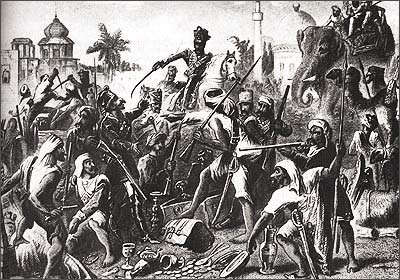
Image: An engraving titled 'Sepoy Indian troops dividing the spoils after their mutiny against British rule.'
Also see: Heroes of a historic march
 Advertisement