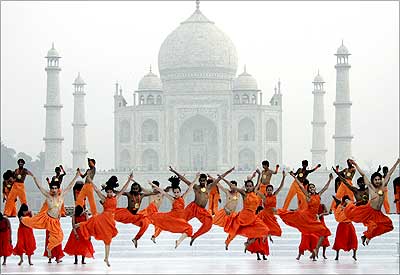
A glittering ceremony was held at Lisbon on Saturday to present the New Seven Wonders of the World, who were voted in by a massive online and SMS campaign conducted across the world.
You now know who the winners are!
Did you know anything about the 21 finalists?
Come, meet them:
The Taj Mahal, Agra
Commissioned by Mughal emperor Shah Jahan in memory of his wife Mumtaz Mahal, who died giving birth to their 14th child, the Taj Mahal was completed in 1648.
One thousand or more elephants lent their heft to the 16-year project. Workmen, sculptors and artists came from Turkey, Syria, Baluchistan, Persia and Bukhara to work on the Taj.
The marble was sourced from Rajasthan, the jade and crystal from China, the lapis lazuli from Afghanistan, the sapphires from Sri Lanka, the turquoise from Tibet and the carnelians from Arabia.
Nearly every inch of the entire 55-metre high Taj Mahal is decorated.
Dubbed a masterpiece of world heritage by UNESCO, Rabindranath Tagore called the Taj 'a tear on the face of eternity.'
Some facts you probably didn't know:
During World War II a scaffolding was built around the Taj to protect it from possible Japanese bombing. Scaffolding was again erected during the 1965 and 1971 India-Pakistan wars.
By the First War of Independence in 1857 the Taj was in a state of disrepair. Lord Curzon, the British Viceroy at the turn of the 20th century, ordered it refurbished. He had the lawns redone in a more manicured British manner; originally the gardens were full of fruit trees and flowers like daffodils and roses.
More than three million people visit the Taj each year.
Compiled by Vaihayasi P Daniel. Information largely sourced from the UNESCO World Heritage Centre site and from the online encyclopedia Wikipedia. Photograph: Manpreet Romana/AFP/Getty Images
 Advertisement