Yet there remain areas where further cooperation is warranted.
Export controls on technology, while once a useful means for controlling weapons technology, now hinder developing countries in their efforts to improve the lives of their people. Much of what is termed as dual technology, in fact, has vital applications in a modern civilian society. Many special materials and complicated computer processors found in missile control systems are also found in hospital intensive care units and global telecommunication systems.
In October 1949, India's first Prime Minister Jawaharlal Nehru had stated, 'It was necessary, even desirable, and, perhaps, inevitable that India and the United States should know each other more and cooperate with each other more.' This was in 1949. Later that year, Prime Minister Nehru predicted that the next hundred years are going to be the century of America.
The Prime Minister was right. The 20th century will be known as the American century. Throughout the last 100 years of American and Indian history -- through the peaks and valleys of Indo-US relations, Nehru's words have rung true and a bond has been forged, based on affinity and understanding. The success of Indian Americans in this country reflects the understanding and mutual respect between the world's two largest democracies.
Part 1 of the series: The dawn of freedom
As India stands poised to contribute to global prosperity and peace in the next century, we look forward to continuing our partnership with America and with the American people.
India is one of the developing countries in which the process of development is firmly established. We have realised that no quick fixes are possible and that there is no substitute for hard work with full involvement of the people. The results achieved in India are commended by some, derided by others, on the basis of physical statistics. In all these appraisals, however, one crucial element that has not figured as it should, is the fact that India's progress has been achieved in a democratic set-up. This dimension, I submit, is extremely important. As an experienced activist in the Community Development process in India ever since it commenced in the early fifties, I can vividly recall the hurdles that we encountered in the path of development, for which many people blamed our democratic process.
Many scholars and experts, including some from this country, told us that we were attempting the impossible, and that at any rate, we were heading for nothing but failure and frustration by attempting development under democratic conditions. It almost became a fashion to assert that democracy was inimical to development and was not suited to developing countries in their initial stages of development. It may also be recalled that several countries had deviated from the democratic system in those years in the name of ensuring development in the first instance, as they put it. These are all facts.
Part II of the series: The crisis of civilisation
I am not merely recalling history. I would like to submit to this august assembly that the agenda for democracy is by no means over, all over the world. The principle of the system is perhaps universally accepted now, but even this acceptance is not unqualified.
In the ultimate analysis, the survival and acceptance of any system would depend crucially on its capacity to deliver the goods. This may not be so obvious in countries where democracy has become away of life and the political process has got rooted in the principle for centuries, making it normal and unquestioned. But elsewhere, the temptation to cut corners for immediate benefits and the tendency to superficialise democracy while the real wielders of power only make it a mask -- these are phenomena that should make genuine votaries of the system sit up and think.
I may be forgiven for striking this new, if discordant, note in the orchestra of prevailing opinion. I submit, that the basic and most essential agenda of the world hereafter, perhaps through the next century, is the consolidation and concretisation of democracy. On this single plank, directly or indirectly, will depend the prospects of peace, disarmament and development -- in one word, the survival of humankind. I am not referring to the processes of democracy but to its content which should, in essence, mean that the will of the ordinary citizen, as it is and not as it is manipulated for a given occasion, prevails.
I do realise that this is a tall order; yet nothing less will do, if the dangers to democracy are to be met effectively. The 21st century must prove that development is best assured when democracy is assured.
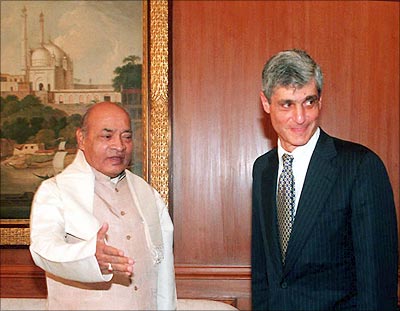
Photograph: Then prime minister P V Narasimha Rao greets then US treasury secretary Robert Rubin in New Delhi, April 18, 1995. Photograph: Raveendran/AFP/Getty Images
Also read: 'Nothing will break the country'
 Advertisement