Mr President, the last five years have seen the world become more complex. As old animosities are unleashed by the changes taking place around the world, we hear demands for self-determination. But such a cry when heard in firmly established secular and free, democracies like India is totally irrelevant. Such a cry, indeed, was attempted to be made in the United States in the year 1861 and President Abraham Lincoln in his first inaugural address on 4 March 1861 had said; 'I hold that, in contemplation of Universal Law and of the constitution, the union of these States is perpetual. Perpetuity is implied, if not expressed, in the fundamental law of all national governments. It is safe to assert that no government proper ever had a provision in its organic law for its own termination -- physically speaking, we cannot separate. We cannot remove our respective sections from each other, nor build an impassable wall between them. A husband and wife maybe divorced and go out of the presence and beyond the reach of each other, but the different parts of our country cannot do this. They cannot but remain face to face and intercourse, either amicable or hostile, must continue between them.'
Part 1 of the series: The dawn of freedom
Indeed, in 1968 your Supreme Court had to say, 'When Texas became one of the United States, she entered into an indissoluble relation -- all the obligations of perpetual union and all the guarantees of Republican Government in the union, attached at once to the State -- it was the incorporation of a new member into the political body. And it was complete and final...'
India accepts this statement as truly characteristic of a multi-cultural, multi-ethnic and multi-religious republic like India or the US and as totally unassailable.
It is the responsibility of nations to preserve the life and liberty of all their citizens under the law, regardless of race, religion and ethnicity. We in India, like you here in this great democracy, are determined in our assertion that the rights of minority groups must be protected vigorously under the rule of law. Our Constitution provides for this, our people demand this and our heritage requires this.
The task that confronts democratic governments today is to maintain protection of human rights in the face of the most dangerous threat to the violation of human rights, namely the bullets of terrorists. India is committed to protecting its citizens from terrorism and no government worth its name can shirk this responsibility. We are taking scrupulous care to protect the rights of individuals under due process of law and punish human rights violations wherever they occur. In this difficult and delicate task, we are doing all that is humanly possible.
Part II of the series: The crisis of civilisation
As regards the United Nations, it has long been a strong defender of the rights of all the world's citizens. We must therefore promote, in all possible ways, the original mandate of the United Nations -- to provide 'collective security' as a means of achieving peace. The UN framework for pursuing global security through international cooperation must be preserved, despite the problems and limitations that exist. The international community needs to strengthen the UN and provide more resources if we expect it to respond to today's challenges.
It is our strong feeling too, that the UN's decision-making bodies must more accurately reflect the regional situation of states in the world today. In order to chart a new course to navigate these troubled but exciting times, we need to recognise the role which many nations can play in the pursuit of peace.
Indo-US relations are on the threshold of a bold new era. We have seen unprecedented cooperation in a number of areas. Most recently Indian forces patrolled alongside US and UN forces in Somalia. We share common interests in addressing global environmental crises, combating international terrorism and stemming the tide of international narcotics trafficking. In these areas, the US and India have worked closely together.
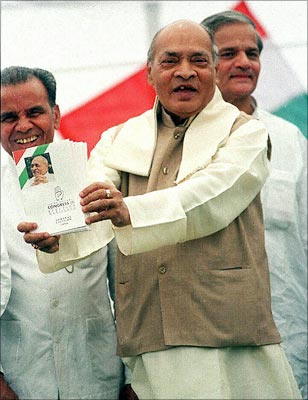
Photograph: Then prime minister P V Narasimha Rao releases the Congress manifesto for the 1996 general election. Photograph: Raveendran/AFP/Getty Images
Also read: The woman who broke the rules
 Advertisement