The crux of the matter is, how much is the real stake in democracy that has been created for all people of the world, not just some? How effective is democracy in solving the problems of the people where it has been newly adopted? This is a crucial question for the system to take root in what may be called somewhat alien soils.
In developing countries, government is a serious matter. A much larger proportion of people are affected by changes in government there, than in affluent countries. This can be easily seen. It accounts for the heavier turnout of voters in developing countries when elections are held. By the same token, one could imagine the frustration and consequent erosion of faith in the system if the system fails to deliver. The success of democracy is, therefore, a very important part of political stability everywhere.
The question therefore is: Since the bloc configuration, which did not, and perhaps could not, put any great value on democracy then, is not such a compelling necessity now, what can the established democracies do for the success of their system in the world so that governments become transparent and are run according to the common aspirations of the common people everywhere? I have no ready-made answers, but I am sure that the task is worth taking note of.
And I beseech your attention, as a tested and tempered person from the grassroots of a developing society who, in the footsteps of great stalwarts, struggled for freedom, attained freedom and has ever since been involved in consolidating that freedom -- in a vast and complex country where nothing has been easy through the long centuries, where life has been a perpetual walk on a razor's edge.
Part 1 of the series: The dawn of freedom
There is another matter in which we come face to face with the need for responsibility, in thought and in action. It is a similar sense that must inform our tending of our planet's resources. The pace of development often prompts the appropriation -- or misappropriation -- of what is not ours, this generation's alone, legitimately. I recall the felicity with which I, in my campaign to be a State legislator, promised roads to my constituents forty years ago, we built the roads but lost the forests. That, perhaps, epitomises the dilemma of a development that must sustain itself and sustain the heritage within which it is rooted. Today's easy options could prove to be tomorrow's regrets; so it is in the quest of technologies that allow development with responsibility that we have yet another critical area for the partnership between India and America and our peoples.
Mr Vice President, two years ago you authored a book which one critic, very aptly, described as remarkable for a political figure, in that you wrote it yourself. Going through it with an interest compelled as much by your style as your subject, I came across an anecdote about Mahatma Gandhi that I had not chanced upon earlier. It bears repetition, and I hope you will allow me.
Gandhiji, you write, was approached one day by a woman, concerned that her son ate too much sugar. She requested him to counsel her son about its harmful effects. The Mahatma promised to do so but asked her to return after a fortnight. This she did and Gandhiji advised the boy as he had promised. The mother was profuse in her gratitude but could not conceal her puzzlement as to why Gandhiji had insisted on the interval of two weeks. He was honest in his reply, and said, 'I needed the two weeks to stop eating sugar myself.'
Part II of the series: The crisis of civilisation
We are now in the closing years of a century ravaged by war, made heroic by the scientific, intellectual and creative attainments of man, enfeebled by want and deprivation and yet made strong by our collective cap a city to identify solutions that had eluded us in the past.We recognise those solutions, but like Gandhiji, we will have to take our two weeks to practise them before we acquire the authority to prescribe them to others. That, in a sense, is what responsibility is all about.
Lala Lajpat Rai, one of the great fighters for India's freedom, had written of the 'numberless American men and women who stand for the freedom of the world, who know no distinctions of colour, race or creed and who prefer the religion of love, humanity and justice.' The people of India count upon those numberless women and men of this great country to work together with them and their representatives to realise the vision that our shared experience and practice of democracy have made possible and the responsibilities of our times have rendered necessary.
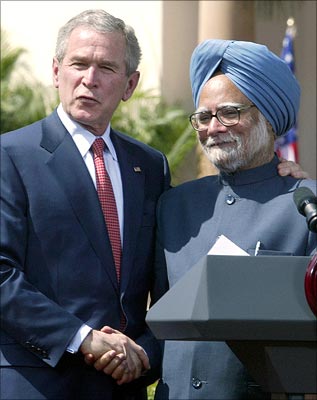
Photograph: Prime Minister Manmohan Singh with US President George W Bush on March 2, 2006. Singh was finance minister in P V Narasimha Rao's cabinet and the architect of India's economic reforms. Photograph: Raveendran/AFP/Getty Images
Also see: India@60: A special series
 Advertisement