India has undertaken the first steps to shaping of our history for the next generation. After decades of centralised economic policies, India recently embarked on a reform programme designed to modernize our economy, liberalise trade and realise our economic potential. We welcomed private investment and competition and encouraged free market growth. As a result, India is becoming globally competitive and the standard of living of her citizens is gradually on the rise. The momentum of these reforms will carry India into the next century as the single largest free market in the world.
Part 1 of the series: The dawn of freedom
Perhaps, the most impressive part of India's ambitious economic reform programme is the smoothness with which the transition from a closed, protected economy to an open export-oriented economy has occurred. Far-reaching changes have been undertaken in a short span of three years, at the same time, devising prompt and effective steps to obviate severe social consequences, which could have threatened future reforms. With these steps, coupled with popular support and a broad consensus across India's diverse political spectrum, the reform process has now acquired a momentum of its own.
The impact of the changes in India has had a profound effect on Indo-US economic relations and has benefited both the countries. American firms have been in the forefront of forging a new economic relationship. India's vast domestic market, huge educated, skilled and semi-skilled work force, sound financial institutions and time-tested and democratic system offer tremendous investment opportunities for forward-looking companies.
Part II of the series: The crisis of civilisation
In shaping our history for the next century, we must look ahead to greater trade between nations. An unfortunate by-product of the past half century was the introduction of weapons of mass destruction around the world. The difficult and complex question of nuclear weapons proliferation can be effectively addressed only when we consider their global reach, requiring similar global solutions. Every nation, large or small, rich or poor, is sovereign and possesses an inherent right and responsibility to its people to ensure their security.
I firmly believe that the way to ridding the world of weapons of mass destruction lies in creating a world order based on the universal principles of equality and non-discrimination as a means of enhancing security. The answer that we as nations choose, will shape the destiny of the world in the coming century. Progress has been made in establishing an international consensus for banning nuclear weapons testing and halting production of fissile materials for nuclear weapons purposes. India and the US have worked closely together in helping to forge this international consensus. To consolidate these gains, further meaningful steps should be taken towards de-nuclearisation, which the international situation now allows.
And so much more remains to be done. A nuclear 'no first use' agreement, indeed an agreement to outlaw the use of nuclear weapon is necessary in the short-term by way of precaution, while serious multilateral negotiations are launched for nuclear disarmament, the objective being a nuclear free world.
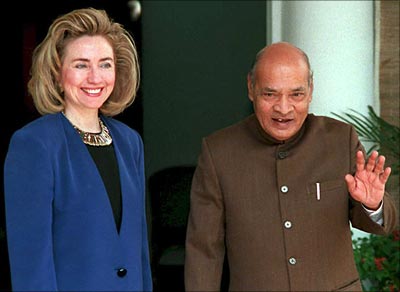
Photograph: Then prime minister P V Narasimha Rao with then US First Lady Hillary Clinton in New Delhi on March 29, 1995. Photograph: Douglas E Curran/AFP/Getty Images
Also read: 'The people are the masters of the country'
 Advertisement