The author Henry David Thoreau was influenced by the early Indian philosophy and thought, from which he drew his inspiration for the essay, 'Duty of Civil Disobedience.' He wrote, 'If the law is of such a nature that it requires you to be an agent of injustice to another, then I say, break the law, let your life be a counter friction to stop the machine.' Thoreau's essay influenced Mahatma Gandhi tremendously while he was in South Africa, and in fact gave him the inspiration for the great non-violent civil disobedience he was to practise in the subsequent years so effectively. I am sure, his spirit showers his choicest blessings on free and democratic South Africa today.
Part 1 of the series: The dawn of freedom
In turn, Gandhi inspired Dr Martin Luther King, who learned of Gandhi that 'non-violent resistance paralysed and confused the power structure against which it was directed.' Dr King wrote that 'Gandhi was probably the first person in history to lift the love ethic of Jesus above mere interaction between individuals, to a powerful and effective social force on a large scale. It was in this Gandhian emphasis on love and non-violence that I discovered the method of social reform that I had been seeking for so many months.'
Thus the United States and India have learned a great deal from each other throughout history. Distances did not matter. Indeed distances never mattered in the transmission of ideas, because their medium is the mind. They travel at what is known as mana-vega in the Indian tradition, meaning the speed of the mind, higher than anything anyone has ever imagined or can ever imagine.
So ideas, and born of them ideals, have echoed back and forth between India and America. Some perceived them, some experienced them, others did not, as often happens. Swami Vivekananda, Gandhi, Rabindranath Tagore, Thoreau, Emerson,Martin Luther King and many others, known and unknown -- all these names seemed to belong to one nation -- of human beings. Hundreds of American missionaries spread into the remotest tribal areas of India, learned their complicated languages and numberless dialects and served the people there with unparalleled devotion. I am personally acquainted with some of their sons and daughters, and a few who were born in my own district.
For over a century grew this great friendship, a relationship purely between the peoples, with no trace of domination or selfish motive of any kind. Americans rejoiced in India's political freedom. India for ever acknowledges the debt we owe to Franklin Delano Roosevelt for his role in pleading with the British for India's independence.
Everything looked fine.
Part II of the series: The crisis of civilisation
We had the unique opportunity of shaping the history of the postwar world -- a history which could have offered the peace dividend to all, East or West, North or South, by enabling countries to attain their full potential by giving their peoples the better life they deserved, but which they had been deprived of for ages.
Then came the Cold War.
That great opportunity seemed to be slipping through our fingers, even as we tried to hold it in our hands. Today, we have to worry about the fingers.
I shall now skip the Cold War. Not being a historian, I am under no obligation to recount it. Being transient, term-bound representatives of our peoples, you and I have neither the time nor the need to review what we do not wish to repeat. It is the future we have to think about, in fact worry about. And, of course, the fingers.
The fingers are simply, democracy and development. From my own personal experience, I have no doubt that this is an extremely difficult combination -- and equally essential, in India's view.
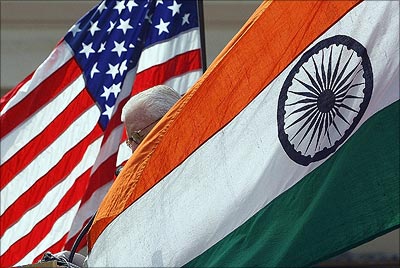
Photograph: Indranil Mukherjee/AFP/Getty Images
Also read: Meet some of India's real superheroes
 Advertisement