Guru Dutt was another wonderful actor and director whose films dealt with exploitation. Sahib Bibi Aur Ghulam (1962), about a lowly servant and his plutonic relationship with the lady of the house, dealt with social hypocrisies of the time.
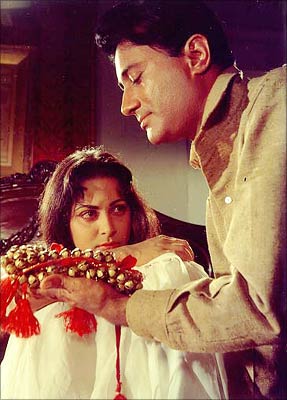
Raj Kapoor's films displayed two main concerns -- social critique and love that transcended social barriers. 1964's Sangam, a romantic musical, was one of his most popular films. Dev Anand's Guide (1965) was also one of the significant films of the decade, while Bimal Roy brought with him a new era of post WWII romantic melodrama.
These directors mastered the use of film, music and choreography. They transformed the film song into an art form and confirmed that music was Indian cinema's greatest strength. During every decade since the 1950s, a large number of films that would otherwise have been forgotten were saved by marvellous music.
The first International Film Festival of India, held early 1952 in Mumbai, had a great impact on cinema because it allowed India's filmmakers to be exposed to films from around the world. After the golden age, the form of popular films started to evolve. The transition to colour and the consequent preference for escapist entertainment and greater reliance on stars brought about a complete change.
Satyajit Ray, Ritwik Ghatak and Mrinal Sen spearheaded the New Indian Cinema -- one of social significance and artistic sincerity, presenting a modern, humanist perspective more durable than the fantasy world of popular cinema.
By the 1970s, Hindi film began to combine all genres into a single movie, with song and dance firmly at the heart of the narrative. This mixed approach is still the way the stories unfold today. In a Bollywood movie, such mixing and matching can translate into the hero fighting a sinister politician in one scene and serenading his heroine, with 40 dancers moving in unison behind him, in the next.
The English language press in India in the late 1970s popularised the term Bollywood -- which has now become the dominant global term to refer to the prolific and box office-oriented industry in Mumbai. 'Bollywood', derived by combining Bombay with Hollywood, has also been included in the Oxford English dictionary.

Image: Waheeda Rehman and Dev Anand in 1965's Guide
 Advertisement