The 1970s further-widened the gap between multi-star big budget and off-beat films. The hits of the decade include Kamal Amrohi's Pakeezah (1971), depicting the desire of a courtesan to find a place in respectable society.
Ramesh Sippy's Sholay (1975) was the first Indian movie produced on 70-millimetre film with stereophonic sound. It ran for five years to full houses, ushering in a new era of action.
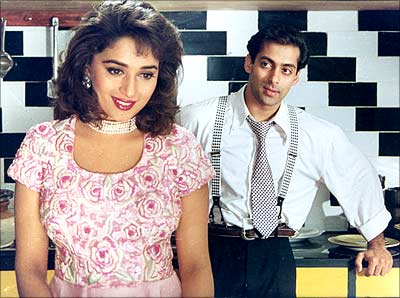
Other important films by noted directors -- Shyam Benegal, Govind Nihalani and Muzaffar Ali -- continued to hold audiences in the 1980s. The late 1980s and early 1990s saw the revival of musical love stories. The family drama Hum Aapke Hain Kaun (1994), for instance, went on to become the highest grossing Indian film of all time -- despite the fact that it has 14 songs, runs for 195 minutes, has no villain and no violence!
India produces about 800 to 1,000 films yearly, in dozens of languages. About 300 of these can be considered 'Bollywood' films as they are filmed in Hindi, the dominant Indian language. They reach nearly 3.6 billion people worldwide, claiming many followers in the Middle East, South and East Asia, Fiji Islands, Russia, the UK, North America and the Caribbean.
Indian and Western film progressed along a parallel path for some time, as Bollywood and Hollywood began at essentially the same time. Yet, a gulf emerged due to India's reluctance to change, illiteracy and the application of censorship. The censor board has finally allowed kissing on screen although, inexplicably, scantily clad women and erotically charged scenes involving women in wet clothes have always been allowed. The subject matter of most films is particularly culturally oriented and Western audiences unfamiliar with the cultural nuances may not understand the meaning of certain things happening within the film. These factors have hindered the films from gaining worldwide acceptance.
One of the most defining features of popular cinema in India is the presence of music in the form of songs. Actors lip-sync songs sung by playback singers, who became permanent fixtures in the industry since 1935. Film music accounts for nearly 80 percent of music sales in India, thanks to the general belief in the industry that love and romance are best expressed musically.
In addition to expressing intense emotion and signifying physical intimacy, songs are also a way of recreating the passage of time or evoking memories. Key Bollywood directors have also argued on the grounds of cultural antecedents and emotional representations, termed 'jazbaat' in Urdu, indicating through such correlation the inextricable unity of song and character.

Image: Madhuri Dixit and Salman Khan in Hum Aapke Hai Kaun
 Advertisement