The 1930s are recognised as a decade of social protest in the history of Indian cinema. Three big banner production companies -- Prabhat, Bombay Talkies and New Theatres -- took the lead in making gripping but entertaining films for all classes. A number of films that made a strong plea against social injustice were produced in this period, specifically some by V Shantaram.
V Shantaram's illustrious career spanned seven decades from the 1920s to 1986. He was arguably the most innovative and ambitious filmmaker in the industry's history, creating 105 films as a director, producer and actor. His first talkie and bilingual film in 1932, Ayodhye Cha Raja, was about a legendary Indian king loved by all his subjects and remembered for his fairness. V Shantaram cast an upper caste Brahmin woman in the lead to break the rules. In those days, women actors were looked down upon. Since then, the industry has attracted women from the upper castes to lend it respectability.
His Amar Jyoti (1936) became the first women's lib film in India and first Indian film to be screened at an International Film Festival (Venice). 1937, 1939 and 1941 saw the release of his acclaimed trilogy -- Duniya Na Mane, Aadmi and Pados -- highlighting the hypocrisy of Indian society. In 1943, under his own banner Rajkamal Studios, he made Shakuntala -- a major box office hit starring his wife, Jayshree, that ran for 104 weeks in one theatre. It became the first Indian film to be commercially released in America in 1947.
In 1946, he made Dr Kotnis Ki Amar Kahani, in which he played the lead. It is the story of a young Indian doctor sent to China as part of a team by Jawaharlal Nehru on a humanitarian mission to aid the Chinese in their war against Japan. The doctor marries a Chinese nurse and dies serving the wounded on a battlefield. The British applauded the film's anti-Japanese plot; the Communists were happy with its setting around Mao Zedong's army, while its patriotic theme appealed to the Indian National Congress. Thus, V Shantaram's film became perhaps the only instance the Congress, Communists and British agreed on anything!
Indian cinema had its golden age from the 1950s to mid-1960s, at a time when budgets were generally lower and directors were encouraged to be inventive rather than play safe. Influential directors like Mehboob Khan, K Asif, Raj Kapoor, Guru Dutt and Bimal Roy all brought something new to cinema.
Mehboob Khan's Mother India (1957), for instance, focused on political themes and social critique within a pop culture setting.
The 1960s began with a bang with the release of K Asif's Mughal-E-Azam, which set a box-office record. An epic about Prince Salim, son of the Emperor Akbar, and his forbidden romance with court dancer Anarkali, it was one of the most expensive films to produce at the time and took 10 years to make.

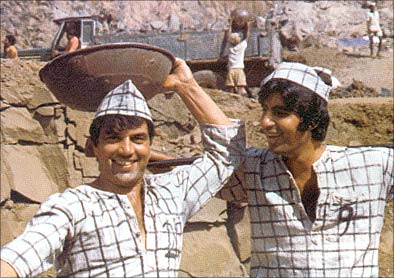
Image: Dharmendra and Amitabh Bachchan in Ramesh Sippy's 1975 blockbuster, Sholay
 Advertisement