Hesh Sarmalkar knows a lot about the history of Indian cinema. After all, he grew up in the company of one of its pioneers.
Grandnephew of the legendary filmmaker V Shantaram, this Indian American has dabbled in cinema too. He played a Bihari immigrant in the short film Sangam. These days, he continues to spread the good word in his capacity as director of events at the Asia Society in New York.
In his own words, then, a quick look at Bollywood's colourful past, and equally exciting present:
The first exposure to motion pictures that India received was when the Lumiere Brothers' Cinematographe unveiled six soundless short films, on July 7, 1896, at the Watson Hotel in Mumbai. The first exposing of celluloid in a camera by an Indian and its consequent screening took place in 1899, when Save Dada shot two short films and exhibited them under Edison's projecting kinetoscope. As the early 1900s rolled in, with the country poised for major social and political reforms, a new entertainment form dawned in India -- the cinema.
Dadasaheb Phalke -- a man of versatile talent, who had a varied career as a painter, photographer, playwright and magician before he took to film -- was responsible for the production of India's first fully indigenous silent feature film, Raja Harishchandra, adapted from the Mahabharata. The film had titles in Hindi and English, and was released on May 3, 1913 at the Coronation Cinema in Mumbai. This laid the foundation of what, in time, would grow to become the largest film producing industry in the world.
After stepping into 1920, Indian cinema gradually assumed the shape of a regular industry, producing silent films and also coming within the purview of the law. The new decade saw the arrival of many new companies and filmmakers. Directors such as Dhiren Ganguly, Baburao Painter, Suchet Singh, Chandulal Shah, Ardershir Irani and V Shantaram were among the early pioneers. The increased profitability of the cinema enabled filmmakers to reinvest their gains in new productions and additional infrastructure such as studios, laboratories and theatres. By 1925, Mumbai had already become India's cinema capital.
The most remarkable thing about the birth of the sound film in India is it came with a bang and quickly displaced silent movies. The first Indian talkie, Alam Ara (1931) was a 124-minute feature produced by the Imperial Film Company in Mumbai and directed by Ardershir Irani. Advertised as an all talking, all singing, all dancing film, it brought revolutionary changes in the whole set up of the industry.

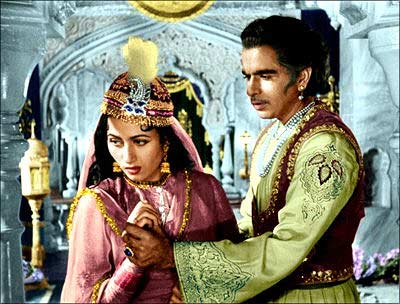
Image: Madhubala and Dilip Kumar in K Asif's 1960 classic, Mughal-E-Azam
 Advertisement