

'The definitions in the Act are so wide and so vague that they can be easily misused to target individuals who may not be conducive to the present government in power.'
Supreme Court Senior Advocate Dushyant Dave delivers a scathing critique of the Maharashtra Special Public Security Act, 2024 in this extensive two-part interview, describing the legislation as both unnecessary and constitutionally problematic.
Dave argues that existing laws are sufficient to tackle genuine security concerns, while the new Act's vague definitions create dangerous opportunities for misuse against dissenters, academics, journalists, and lawyers.
"I'm too busy doing nothing these days," Dave, former president of the Supreme Court Bar Association, who retired after 48 years at the Bar, and who recently celebrated his 70th birthday, says in lighter vein before he sets on to begin his serious critique of the Maharashtra Special Public Security Act, 2024.
In this first part with Prasanna D Zore/Rediff, Dave examines the Constitutional flaws in the Act and explains why he believes it will fail judicial scrutiny under Articles 14 and 21 of the Constitution.
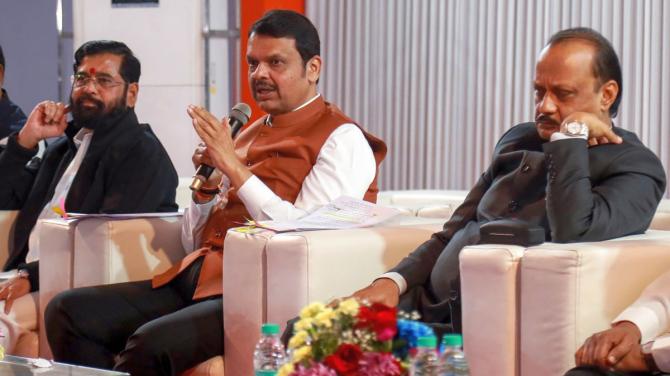
The Maharashtra Special Public Security Bill, 2024 was enacted by the Maharashtra legislature on July 10, 2025 with Chief Minister Devendra Fadnavis allaying fears about its misuse.
What in your view are the most Constitutionally troubling aspects of the Maharashtra Special Public Security Act, 2024?
Such laws are really not required because existing laws are sufficient to tackle this problem. These existing laws, or even ordinary criminal laws, are adequate to address any genuine concerns.
The problem is that these laws are being introduced under various names, and if you examine the statement of objects and reasons, they are really designed to terrorise people.
Frankly, there is no evidence of any widespread Naxalism in urban areas. A few individuals may have come and stayed in urban areas, but that doesn't constitute a widespread situation requiring new legislation.
The real difficulty is that the definitions in the Act are so wide and so vague that they can be easily misused to target individuals who may not be conducive to the present government in power.
The whole purpose of bringing these laws raises serious doubts about the bona fides behind such legislation.
Do you see them as a repetition of earlier draconian laws that have failed judicial scrutiny?
Yes, of course. There is no doubt that this law will also have to be tested before a court, and I don't think it will pass muster as far as Articles 14 and 21 are concerned.
Under what Constitutional premise can the Maharashtra Special Public Security Act, 2024 be challenged?
Essentially, it can be challenged on the ground that it violates Constitutional guarantees under Article 21 (Article 21 of the Constitution guarantees the fundamental Right to Life and Personal Liberty) and Article 14 (Article 14 of the Constitution guarantees the Right to Equality, stating that the state shall not deny to any person equality before the law or equal protection of the laws within the territory of India), because it confers unguided, unbridled executive power.
Though the Statement of Objects and Reasons frames the law as targeting the extension of urban Naxalism -- specifically groups that offer logistics and refuge to armed cadres, and claims existing laws are inadequate -- the actual text is vague and overbroad.
It criminalises not only violent or extremist conduct but also speech, protest, association or dissent that allegedly disturbs 'public order', without due process.
1That mismatch -- the law's broad reach versus its stated purpose -- is precisely why the Act is both vague and unnecessary, and can legitimately be challenged as unconstitutional, especially since existing laws already address the declared problem with appropriate safeguards.
I believe that even if courts don't strike down the law entirely, they will have to read down many provisions, including the definitions.
The Act seeks to criminalise 'Urban Naxalism.'
How do you interpret this term, which has no legal definition but has immense political currency?
It can be easily politically misused. This government wants to label many people with various names, and this is one more phrase they have coined. They want to target people using this vague term, and the kind of allegations they make against people are horrendous and very unfortunate. This is a big problem with the government today.
Does this vagueness make it ripe for misuse against dissenters, academics, journalists, and lawyers?
There is no doubt that it is capable of being misused and abused.
The government and legislature both know this law (the Maharashtra Special Public Security Act, 2024) can be abused and misused, and it will be abused and misused. Yet they pass it because that's how the government wants to create fear in people's minds.
Many observers have pointed out that the Opposition in Maharashtra did not utter a single word opposing the provisions of the Maharashtra Special Public Security Act, 2024 or express opposition as part of the committee that scrutinised this law.
The Opposition is not hand in glove with the government. The Opposition is inept.
Unfortunately, they are incompetent. They really don't understand their role. The Opposition exists only in drawing rooms now, on social media, and in photographs standing in front of Parliament.
The Opposition has not understood that in a democracy, they have a much bigger role. They must be vigilant about everything happening and go to people to explain and help them understand the seriousness of these challenges. But that's not what they want to do. They prefer to remain in Delhi and enjoy a luxurious life. The Opposition really has no idea about these things, and I'm sorry to say that.
- Part 2 of the interview: 'Citizens Are Safe From The Government Only When...'






 © 2026