

'It is high time to recognise that this is the greatest issue India is confronting.'
'Even the BJP should be raising concerns because polluted air suffocates everybody's child.'

On Sunday, November 9, hundreds of Delhi residents gathered at India Gate in the national capital demanding urgent action against the toxic air pollution, only to be detained by police within minutes.
Environmental activist Vimlendu Jha, founder of Swechha, an organisation mobilising youth for environmental action, was among those forcibly removed and detained for nearly five hours.
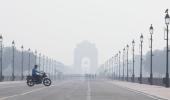
Delhi's air quality had reached catastrophic levels, with the AQI touching 1,200 on November 12, making it the world's most polluted city.
In this interview with Prasanna D Zore/Rediff, Jha describes the police crackdown on peaceful protesters, including children, and explains why Delhi's air pollution constitutes a public health emergency that authorities are attempting to conceal rather than combat.
How severe is the air pollution situation in Delhi presently, and what do the current AQI readings signify for the average citizen's health and daily life?
The principal irony and unfortunate reality is that we do not even know precisely how polluted the air has become, because citizens have largely lost confidence in Delhi's air quality monitors.
According to submissions made to the Supreme Court, most air quality monitors are shut down, typically during peak pollution periods.
Furthermore, numerous visuals have emerged through various media platforms showing water being sprinkled near monitoring stations in different areas.
Even by the government's own monitors, the AQI has exceeded 400 across many locations.
Therefore, despite all efforts to artificially suppress the readings, they are manipulating data, concealing information, or suppressing data rather than addressing pollution itself. They are not tackling the fundamental issue.
Consequently, the situation is extremely dire. This constitutes a public health emergency, yet we hear nothing from either the ministry of health, the ministry of environment, or the local government regarding the immediate and long-term impact upon Delhi's citizens, particularly children and the elderly.
What purpose would it serve for the Delhi government to suppress this data? After all, people will still experience the pollution's effects.

It is primarily about image preservation. They are engaged in perception management rather than pollution management. The people of Delhi elected its government not merely for excellent public relations and imagery, but for effective action.
By concealing the data, they are attempting to demonstrate that they have actually worked and that pollution levels are low. However, the reality is that pollution levels are not low; pollution metres are displaying low numbers. That does not signify that actual pollution levels are low.
Why does Delhi experience such extreme spikes in pollution following the monsoon season and during winter's onset? Are these patterns predictable, and could more preventive measures have been implemented?
Indeed, there exists what is called the Decision Support System, which analyses data to identify the principal sources of pollution and how it occurs. This system has been operational for several years, so there is a degree of predictability.
We are essentially addressing two factors. Firstly, there is the meteorological and geographical disadvantage that Delhi faces. With winter's onset, wind speed and direction change substantially, causing local pollution to settle rather than disperse, thereby increasing AQI numbers.
Secondly, this period coincides with two significant episodic sources of pollution: Diwali celebrations and stubble burning, which occurs for approximately four to six weeks.
While Delhi's geography cannot be altered, the sources of pollution can be modified. Therefore, the government must address the sources of pollution rather than merely treating the symptom -- the haze.
Sprinkling water over trees, roadsides, or even air quality monitors is not a solution. The proposal for artificial rain was similarly misguided -- headline management designed to create the illusion of action.
Firstly, it did not work, and secondly, even if it had worked, it would have been extraordinarily expensive and ineffective. There is no scientific evidence to demonstrate that artificial rain can successfully address air pollution.
As winter fully descends upon north India, how severe do you anticipate pollution levels will become? Are we confronting a possible public health emergency in the coming weeks?

It already is a public health emergency.
Private air quality monitors are displaying readings exceeding 800 in numerous areas, sometimes even higher. According to all global standards, this already constitutes a health emergency. Senior physicians in our country have documented the increased number of admissions of patients with pre-existing conditions such as asthma and cardiovascular ailments, predominantly affecting children and the elderly.
We have witnessed increased sales of nebulisers and numerous families suffering from coughs, eye irritation, and other ailments. Therefore, it is already a public health emergency.
You urged the government to declare a health emergency in Delhi and close schools immediately. How serious is the threat to children's health at present?
While adults can manage to some extent, children are considerably more vulnerable for several reasons.
Firstly, substantial research demonstrates that children born in Delhi or residing there have compromised lung capacities due to air pollution. Various health studies have confirmed this finding.
Secondly, given their limited or stunted lung growth, children's per-body-weight average consumption of air is significantly higher than adults, making their vulnerability to polluted air considerably greater.
Thirdly, consider children's exposure: Travelling to school early in the morning, engaging in physical activities, and participating in outdoor activities -- all increase their vulnerability.
In summary, the combination of pollution-related stunted lung development, biological factors meaning children consume more oxygen than adults, and their exposure to physical activities while travelling to and attending school makes them particularly vulnerable.
You have characterised this as a 'civil disobedience' movement for parents and children. What prompted this call, and what public response have you received thus far?
This is more of an emotional response. As a father of a four-and-a-half-year-old daughter, witnessing her cough and requiring a nebuliser is extremely painful.
Therefore, I am urging parents that if the government refuses to close schools, it should be voluntary -- people should stop sending their children to school. At least that is the minimum one could do. At least, the police will not arrest you for this form of disobedience, as they arrested many of us.
Could you describe what happened during the protest at India Gate?
How were you and other demonstrators, including children, treated by the police (Video: Kind courtesy Vimlendu Jha)?
It was an entirely peaceful protest on one of the lawns at India Gate, a public space that typically accommodates thousands of people on any Sunday afternoon or winter evening. The gathering was proceeding peacefully, but the entire area was overwhelmed by the Rapid Action Force, riot control police, and regular Delhi Police officers.
Within approximately 20 to 25 minutes -- around 5.30 pm -- the police began charging at the protesters. They did not beat us with sticks, but they certainly manhandled us, treating us as though we were sacks of rice.
We were thrown into buses, and if you examine the visuals, you can hear people shouting. That included children and minors.
One video I recorded from inside the bus went viral. I was able to protect one particular child, who was eventually released and not shoved into the bus. However, while I was detained for four to five hours, several minors remained in the bus and were also detained. This is absolutely disgraceful -- even minors were taken.
We were transported to Bawana, an isolated industrial area on the outskirts where there was no transport available. Somehow, people managed to return home. I returned home at 1 am.
Why were the protesters detained? Were any specific charges cited, or was this purely an attempt to suppress dissent?
I believe it was precisely that. Their justification was that it is a high-security area and therefore any form of protest should not be permitted. However, the irony is striking: It is essential to understand what this protest was about. This was not political in any manner whatsoever.
Children, families, mothers, and fathers were asking for fresh air for their children because the pollution is killing them -- it is deadly, it is criminal.
Secondly, it was demonstrably a peaceful protest. There was nothing violent about it. A relatively small number of people were protesting. Yet the State determined that this should not be allowed.
Rather than the State or government working to clean the air, they sought to suppress voices demanding clean air, and they did so violently.
All the visuals and videos reveal that protesters, including ourselves, were treated as criminals, as though we were committing a crime by requesting clean air -- a right that the Constitution of India provides.
The State is supposed to be the custodian of our Constitution, yet it did nothing about this. To the contrary, it violated the fundamental rights of our country's citizens.
How have political parties reacted to this crisis and the protests? Do you observe genuine concern from any quarter, or merely political opportunism?
I believe it is imperative that all political parties unite and express their concern. Even the BJP should be raising concerns because polluted air suffocates everybody's child, not merely those of a particular political party.
This is not a government scheme that one can choose to decline or selectively access. It is air. Whether you approve or not, it is the same for everyone, or virtually the same for everyone.
It is high time that all political parties -- because today or tomorrow they will be in power, or they have been in power -- realise the importance of environment, public health, and governance in public health matters.
I hope that this issue is amplified not merely for tokenism or electoral opportunities, but as a genuine commitment. Those who seek to govern, to be in power, to lead the country, must lead healthy citizens. They cannot lead sick, vulnerable people and youth.
What should citizens and parents do now, beyond protests and social media outrage? How can individuals protect themselves?

What you witnessed was a cry for help. Ultimately, how many people can actually afford to purchase air purifiers? The government can issue tenders and acquire air purifiers for themselves. How many people in India can actually afford to purchase air purifiers for every corner of their house?
We have no choice but to demand clean air from the government. That is the only option citizens possess.
One often wonders, particularly those who live away from Delhi, why politicians do not protest as vigorously as ordinary citizens? Do they not breathe the same Delhi air?
There are more than 540 Lok Sabha MPs, Rajya Sabha MPs, Delhi MLAs, plus diplomats from around the world residing in Delhi. Why do they not protest? Do they not breathe the same air?
They absolutely should. Some do not because it is their own doing, misdoing, or failure to act. Ultimately, they are the ones who are supposed to be enacting laws and implementing those laws concerning clean air, clean water, clean environment, and the right to life. Yet they themselves are preoccupied with politicking rather than fighting for genuine issues. That is why we observe the situation as it is.
As a parent and as someone fighting pollution in Delhi, what would be your appeal or message to India's politicians who are in Delhi and possess the power to effect change?
My appeal to the political class would be this: It is high time to recognise that this is the greatest issue India is confronting. Nothing kills more people in our country than air pollution.
Everyone must unite, transcending political divisions, and find a solution to this crisis. We must do this because otherwise we can be a wealthy nation, but we will be a weak nation and a dying nation.









 © 2026