'Besura hai, sur me lana hai'
Archana Masih in Bombay
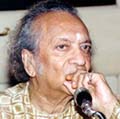 Anoushka Shankar winced at the thought of crawling lizards. Listening
to Pandit Ravi Shankar recount the difficulties of
the gurukul system -- a rigid riyaaz, discipline,
sleeping on coir mats, crawling lizards -- got too creepy at times.
Anoushka Shankar winced at the thought of crawling lizards. Listening
to Pandit Ravi Shankar recount the difficulties of
the gurukul system -- a rigid riyaaz, discipline,
sleeping on coir mats, crawling lizards -- got too creepy at times.
Her riyaazin the US under her legendary father's guidance
is definitely cosier. The sixteen year old
is here to accompany her pa and Ustad Zakir Husain in a landmark
concert celebrating India's 50th year of Independence.
But it is the maestro that people seek -- applause and dazzling
camera flashes. The ovation is not unusual. Ravi Shankar
has lived with it for over 50 years now. From those small
baithaks as a 24 year old to a truly global performer,
the sitari has never had a dearth of magical experiences
which provides inspiration for many artistes.
 "I was in Bombay when India won Independence and remember
listening to Nehru's speech over the radio," he recalled
looking at the solitary paper flag, stuck into a vase full of button
roses on the table. "I even heard the speeches of Mountbatten.
Freedom brought such a great sense of relief," he continued.
"I was in Bombay when India won Independence and remember
listening to Nehru's speech over the radio," he recalled
looking at the solitary paper flag, stuck into a vase full of button
roses on the table. "I even heard the speeches of Mountbatten.
Freedom brought such a great sense of relief," he continued.
The 77-year-old maestro also revealed that he wrote the score for Iqbal's Sare jahan se achha in 1955.
"Iqbal's original tune was not catchy, it sounded sad. So
I thought of giving it a livelier tune," he said, adding wistfully, "But those days there was
no copyright."
Often criticised for commercialising Indian classical music,
Ravi Shankar explained that classical
music was always meant for a select audience, and both in India
and abroad the genre has always had few connoisseurs. He was,
however, optimistic about the emerging talent in Indian
classical music. "Our music takes time to mature, it definitely
takes time."
Speaking about his involvement in the famed Woodstock concert, he confessed he was not too happy about it. "With half a million people and mud
it was like a picnic, where music only seemed incidental. I felt
no contact." After a long and fruitful association with George
Harrison which has yielded many albums, the musician will release
another album, Chants of India, produced by the former Beatle.
 Commencing his foray in film music with Satyajit
Ray's Pather Panchali, on to Dharti ke Lal, Anuradha
and Attenborough's Gandhi, he disclosed he did not compose music any more for the movies. "Earlier, I could be contacted easily
and was not travelling so much. Later, it was not possible," he
said.
Commencing his foray in film music with Satyajit
Ray's Pather Panchali, on to Dharti ke Lal, Anuradha
and Attenborough's Gandhi, he disclosed he did not compose music any more for the movies. "Earlier, I could be contacted easily
and was not travelling so much. Later, it was not possible," he
said.
One journalist asked about the greater popularity of classical Indian instrumental music
over vocal music. This phenomenon, Ravi Shankar said, could
be seen elsewhere as well. "If you listen to an opera singer
in Vienna and Salzburg, or the Japanese Kabuki, in all probability
you'll feel like running away," he said imitating their foreign
singing styles.
 En route from London, Ravi Shankar will travel to Spain after
his concert in India. The musician plans to release an autobiographical work, Rang Mala, to be printed in a limited edition.
En route from London, Ravi Shankar will travel to Spain after
his concert in India. The musician plans to release an autobiographical work, Rang Mala, to be printed in a limited edition.
In India to celebrate the golden jubilee of its Independence,
Ravi Shankar steered clear of any assessments about
the condition of the country today. Whatever he felt, he said, would
be expressed through his music at the concert. Finally, he gave in
and summed it up the state of India in an appropriate musical metaphor: "Besura hai,
sur me lana hai." (Presently, things are out of tune
and need to get tuned.)
EXTERNAL LINK:
The Artistry of Ravi Shankar
|