How does one reach that era without constitutional reforms?
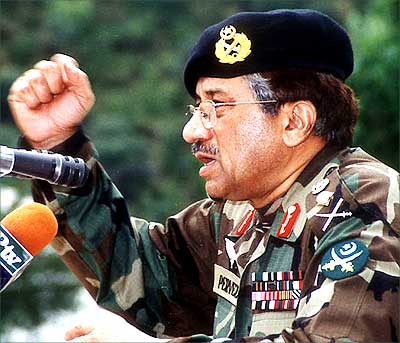
Musharraf assures us that he wants Parliament to have all the powers. And he says he does not want any powers himself. But there is dichotomy because the constitution actually gives all the key powers to the presidency. So this is an issue on which the discussions are still on-going. Because Musharraf seems unwilling to give up the presidential power to dismiss Parliament.
But we agree, both sides agree, that the reforms should be implemented for fair elections, both sides agree that the ban on the twice-elected prime minister should go, both sides agree that the moderate forces should come together, both sides agree that there should be a level playing field and an end to motivated litigation.
So there is a lot of agreement, apparent agreement on a lot of issues while one or two still are outstanding. But right now the issue is when is the implementation going to take place and in which phase is this implementation going to take place.
To complicate the issue, the ruling party has been saying that nothing will change and that they are not really negotiating with the PPP. They are just giving PPP a dheel, which in our local language means long rope. They keep talking about how they are going to impose emergency. So some people have cynically remarked that the Red Mosque incident in Islamabad was actually cooked up by elements of the cabinet to provide a pretext for emergency, but their plan failed when the presidency decided to take action against the militants.
So you know we are talking here about a country from which many key Al Qaeda suspects and terrorists have been arrested like Abu Zubeida, and Khalid Sheikh from Pindi (Rawalpindi), Ramzi bin al Shihab from Karachi.
So we must remember that this not just a war for Pakistan's heart and soul; this is something that will have far-reaching ramifications on militant struggles across our borders.
We in the PPP are very determined to build peace. In fact, we say that the message of Islam is peace. And we want peace for our citizens inside our country, we want an end to the attacks on NATO and Afghan troops in Afghanistan. And we want an end to the militants who tried to hijack our foreign policy by conducting attacks on the Indian Parliament and on other sites in India.
So our world vision collides rather dramatically with the world vision of the extremists. Musharraf has said he is for moderation, so we hope that he can do something upfront that can facilitate moderate forces coming together.
You can see a street protest of the type that we saw recently involving the chief justice, perhaps even bigger with the participation of political parties?
That's right. I very much can see that happening. I would like to see it happening, but I don't think Pakistan needs anarchy or civil strife or bloodshed. But both sides have a responsibility to prevent that. And the elections now give Musharraf and the presidency an opportunity as well as the military establishment an opportunity to take Pakistan safely from one phase of governance to another phase of governance. The spoilers are there.
After all, why would those who have politically benefited from firing the shots from the shoulders of the military want to have fair elections which will see them give up power and go into opposition.
So I understand that there will be elements like the ruling PML-Q (Pakistan Muslim League (Qaid-e-Azam)) which will do everything to scuttle a process of reconciliation and resolution, moving Pakistan to a moderate course.
But I think it is important for Musharraf and the military establishment to stay the course, not to defer the elections, not to impose the emergency and to make sure that those elections are credible and satisfy the public.
We need international observers. Otherwise, there would just be name calling. So we need a third party that can certify whether the elections are going to be fair or not.
Part II: 'I hope to return and build a peace treaty with India'
Nayan Chanda is director of publications and editor of YaleGlobal Online. His most recent book Bound Together: How Traders, Preachers, Adventurers, and Warriors Shaped Globalization was published by Yale University Press in May 2007.
Also see: 'I felt I was a victim of a conspiracy'
 Advertisement