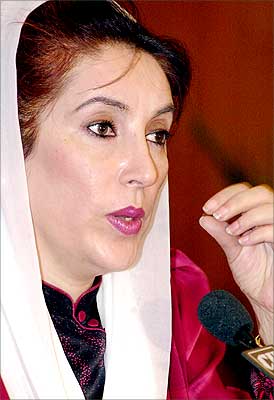
Former Pakistan prime minister and Pakistan People's Party chief Benazir Bhutto, in exile, is among the candidates ready to return to Pakistan before the general election scheduled to be held later this year.
YaleGlobal Editor Nayan Chanda questions her about a power-sharing deal with Pakistan President Pervez Musharraf, the dangerous advantages militants might have if street protests erupt into the color revolution of the type seen in Ukraine, the demands for free elections, as well as the need for pragmatic policies including an end to Pakistan's "traditional tit-for-tat approach" with India.
Bhutto confirmed her intention to return to Pakistan "for saving my country from a militant takeover, (and) God forbid, disintegration."
Politics is as far removed from poetry as possible so I cannot resist reading a little poem that you wrote some years ago: 'One has might, the other right. One has the sword, the other the pen. Guns rust and fall apart. Ideas live forever.' So do you think President Musharraf's guns are rusting and that is why he is turning to you to do a deal?
Certainly there has been a degree of unease within Pakistan; General Musharraf had given a charter where he wanted to take the country, which was toward a true democracy and a moderate society. However in the last six years, we've seen that the extremists have spread throughout the country. We used to think it was just in the tribal areas, but indeed the Red Mosque incident in our capital city of Islamabad showed that the tentacles of extremism were spreading and that poses great challenges to Pakistan from within as well as complicates the external picture.
So the reason why he's now willing to sit down with you is because he's feeling that he's no longer in full control?
I see it differently. I think after 9/11, when the first general elections were held under Musharraf, it was less then a year later, and he was seen very much as a strong ally of the West on which the international community could depend, to reform the madrassas and to constrain and restrain the terrorist elements within the country.
But unfortunately since then, there has been the rise of suicide bombings. Innocent people in Pakistan like our women and children are being killed, and I think now the international community has started supporting the democratic process. Within Pakistan, we've had a pro-democracy movement which has gathered strength as poverty in the country increased and people's needs were neglected.
So this confluence has made the elections of 2007 very important. All the independent polls show that the Pakistan People's Party (PPP) and I would go on to win any fair election. So I think that this is what the need of drawing people together.
In Pakistan, we have different fault lines. We have one on dictatorship versus democracy, and we have a second one on moderation versus fundamentalism or extremism. So I think that Musharraf is trying to seek a way out by having these contacts with the PPP.
Interview courtesy: YaleGlobal Online | Photograph: John Macdougall/AFP/Getty Images
Also read: 'Zia wanted to defeat America'
 Advertisement