



|
|
|
|
|
| HOME | NEWS | SPECIALS | |||
|
ELECTIONS '98
|

|
|
The Rediff SpecialIt is all about Access
In such a situation, the key to all decision-making becomes information. A PM can only act on what he knows. And information becomes the preserved of the handful that have free access to the prime minister. Two instances. One: in the run-up to the decision on the Tata airline, almost everybody who met Vajpayee suggested that Singapore Airlines was still part of the proposal. The prime minister asked for a further investigation on the basis of this information. In the meantime, the Tatas withdrew the proposal. Two: when the Air India-Indian Airlines board was sacked, Civil Aviation Minister Ananth Kumar neglected to tell the prime minister that chairman P C Sen's term was expiring in two months anyway. Instead, he buried this crucial information in a dense five-page memo, hoping that the prime minister would not read it too carefully. (It worked.) Some prime ministers become prisoners of their PMO. In the later phase, Rajiv Gandhi was prevented from meeting people who would give him accurate feedback. And P V Narasimha Rao actively shunned human company, preferring the chamchas who worked for him. Vajpayee is more accessible than most. He is also a listener, so he gets the benefit of varying points of view. But inevitably, the greatest influences on him are those he sees the most. On governmental matters, Shakti Sinha's input is crucial though he rarely pushes his point of view. Brajesh Mishra sees the prime minister twice a day -- before the first appointment and after the last appointment. Every major issue that has come up in the course of the day is discussed at one of those two meetings. Others see Vajpayee on a need-to-consult basis. The exception is Joint Secretary Ashok Saikia who is the only official other than Shakti Sinha who can walk in and out of the PM's room at will. Vajpayee trusts Saikia because his is almost always a dissenting view. If the principal secretary and Cabinet secretary have agreed on something, the chances are that Saikia will have an original take on the situation. Because Saikia is not scared to speak his mind and is quite willing to rock the boat of consensus if he thinks an issue is important enough, his is perhaps the single-most powerful voice in the PMO. It helps also that he is even more low profile than Shakti Sinha -- even within government only a handful of people recognise how important he is. All other officials -- including N K Singh -- will see Vajpayee only when Shakti Sinha allots them time. Fortunately, Sinha is eager to expose Vajpayee to differing views so access is not a problem. Even the traditional rivalry between all principal secretaries and Cabinet secretaries has been well managed in this PMO. Brajesh Mishra personally called Cabinet secretary Prabhat Kumar and told him to deal directly with the prime minister. As is common with all prime ministers, there is the usual speculation about how much influence his family has on decisions. But the truth seems to be that the one member of his adopted family that Vajpayee is closest to has the least interest in politics -- his grand-daughter Niharika. His foster daughter, Namita, and her husband Ranjan Bhattacharya, have the advantage of proximity, but have zero input in policy matters. Aap bhi is chakker mein phas gaye," laughed former prime minister I K Gujral when he ran across Vajpayee in Parliament. The chakkar in question was the prime minister's Junta Durbar -- an occasion for the PM to interact with the public. Initially, in his enthusiasm, the PM met the public twice a week. But even this was not often enough. For instance, there was the case of a retired railway employee immolating himself because he could not meet the prime minister. Later, some sort of a system was established. For one, the darshans petered down to twice a month (speaking as someone who had 'been there, done that', this was apparently part of the advice that Gujral gave to his successor), And all those who had already met the PM once, were not allowed to push their way in a second time. "Otherwise we had people coming in to follow up on their requests, while others did not get a chance," said Delhi MP Vijay Goel, who plays an unofficial role in handling the Durbar. And officials are now working on a system which will enable people to send their grievances by writing to the PMO so that the PM can act upon them. This will enable officials to sift through the grievance and separate the 'genuine' cases. "Otherwise, the PMO was in danger of becoming an employment agency as most of the people came in asking for jobs," said a concerned official. "The maximum request were in the form of job applications or transfers," he added. But no system prepared the team at the PMO for singer Parvati Khan's visit. "Mr prime minister," she cooed softly as she sidled up to a hapless Vajpayee and said, "I want to do a number on you." As the prime minister stared at her blankly, she explained, "Hame patriotic numbers bahut acchhe lagte hain… Aapki kavitaon ka bhi ek number produce karna chahti hun. (I love patriotic songs and I want to produce one of your poems into a song)." Clearly, as prime minister of India, you get to meet all sorts. Kind courtesy: Sunday magazine |
||
|
HOME |
NEWS |
BUSINESS |
SPORTS |
MOVIES |
CHAT |
INFOTECH |
TRAVEL
SHOPPING HOME | BOOK SHOP | MUSIC SHOP | HOTEL RESERVATIONS PERSONAL HOMEPAGES | FREE EMAIL | FEEDBACK |
||

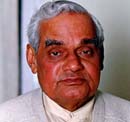 Prime ministers lead unnatural lives. They are shepherded from appointment to meeting, read briefs that have been carefully vetted and meet only those who others regard as important enough to gain an audience with the prime minister.