Capital Buzz/Virendra Kapoor
Foreign affairs and Kesri
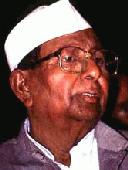 Congress president Sitaram Kesri is not exactly known for his expertise in foreign affairs. Never, in his long
political career, has he shown an inclination to dabble in the
art of diplomacy. But, in the ongoing struggle for the complete
control of the Congress party, Kesri is turning the fine art of
diplomacy to his advantage.
Congress president Sitaram Kesri is not exactly known for his expertise in foreign affairs. Never, in his long
political career, has he shown an inclination to dabble in the
art of diplomacy. But, in the ongoing struggle for the complete
control of the Congress party, Kesri is turning the fine art of
diplomacy to his advantage.
An increasing number of foreign dignitaries make it a point to
meet Kesri, much to the chagrin of P V Narasimha Rao
and even Prime Minister H D Deve Gowda and Minister
for External Affairs I K Gujral. Kesri has become
de rigueur on the schedule of visiting heads of governments and
states just like Rajiv Gandhi's widow, Sonia
Gandhi.
The most notable, of course, was his meeting
with Chinese president Jiang Zemin which Kesri
loyalists touted as proof of the final recognition that the power
had shifted in the Congress from Rao to him.
But how does Kesri cope with the foreign visitors? Small talk
isn't enough to see one through a half-an-hour meeting with a
visiting head of state. It seems the foreign cell in the AICC
prepares a brief for Kesri. Invariably, the job is done by former
external affairs minister Pranab Mukherjee.
The other day, Kesri took umbrage at a draft speech which contained
the stock phrase 'fruitful deliberations'. It was prepared for
him in honour of Jiang who was to meet him at the Congress
headquarters at 24, Akbar Road.
"Look, I am a Bihari," he said. "I do
not know English grammar, but one thing I would say - please remove
this 'fruitful deliberations' and 'agent of change' because we
had not been kind to the dignitary; we did not have very pleasant
discussions. Why should we deliberately mention it? Similarly,
the Congress is not an agent of change. The word 'agent' does not
sound well. The Congress was never an agent."
Kesri eventually did not read the speech. Instead, he chose to
say a few words in Hindi which were translated by former minister
of state for external affairs R L Bhatia in English.
If Kesri's visitor left with the impression that he was a bit
of a joke, no one could blame him.
Cho for Rajya Sabha?
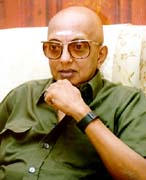 Cho Ramaswamy, Tamil Nadu's eminent editor-actor-political
crusader all rolled into one, might have found himself nominated
to the Rajya Sabha long ago had he not been born a brahmin. This
is the only factor which prevented G K Moopanar's
Tamil Maanila Congress from sponsoring his candidature for the
Rajya Sabha.
Cho Ramaswamy, Tamil Nadu's eminent editor-actor-political
crusader all rolled into one, might have found himself nominated
to the Rajya Sabha long ago had he not been born a brahmin. This
is the only factor which prevented G K Moopanar's
Tamil Maanila Congress from sponsoring his candidature for the
Rajya Sabha.
In the biennial elections to the Rajya Sabha due next April, the
DMK-TMC combine can send six members to the House. The DMK will
take at least four and TMC may get the other two. The TMC wants to
send Cho to Parliament but is afraid that its anti-brahmin and
pro-Nadar image might get diluted if he was elected on its ticket.
Pushing Cho's case is Tamil superstar Rajnikanth,
who argues that Cho has suffered a lot at the hands of the Jayalalitha
regime due to his crusade against her misdeeds. Moopanar has now
suggested that the Deve Gowda government nominate Cho to the Rajya
Sabha. That way, he gets to retain both his seats for non-brahmins
and yet get the credit for doing justice to Cho.
Two-in-one MPs
A look at the official records of the Rajya Sabha would show that
Moopanar, Jayanti Natarajan, Peter Alphons and
Vyjayantimala Bali are all members of the Congress
party in the House.
But didn't all four leave the Congress to float the TMC last June? Yes,
they did and, what is more, they
behave like TMC members both inside and outside the House.
Under the anti-defection law, all four will forfeit their Rajya
Sabha membership if the Congress invokes the relevant provision.
A letter from the leader of the Congress in Parliament would
be enough to terminate their membership.
But, despite the bitterness seen during the recent parliamentary
election, Rao has steadfastly refused to act against the four
rebels. Maybe, he wants to keep alive the chance of a rapprochement
with Moopanar.
When the leadership struggle in the Congress comes
to the crunch, Moopanar cannot be seen to be backing a north Indian
against Rao.
Vyjayantimala's case, on the other hand, is particularly galling.
She was nominated to the Rajya Sabha at Rao's behest. Nominated
members are expected to be above partisan politics.
But she joined the TMC at the first opportunity.
Hawala and Rao
 This column had reported the move to revise the definition of
a public servant in order to exclude members of Parliament from
the purview of the Prevention of Corruption Act. Following premature
publicity and adverse media reaction, key Parliament officials
have developed cold feet.
This column had reported the move to revise the definition of
a public servant in order to exclude members of Parliament from
the purview of the Prevention of Corruption Act. Following premature
publicity and adverse media reaction, key Parliament officials
have developed cold feet.
An early change in the law now looks unlikely. Since the move
was meant to bail them out, the hawala-accused suspect that it
is their bete noire, Narasimha Rao, who had sabotaged it. Given
the fact that Lok Sabha Speaker Purno Sangma
was close to Rao, and the report in a national daily was done
by a correspondent known for her proximity to the former prime
minister, the hawala-accused blame Rao for sabotaging relief to
them.
Why would Rao do so? The hawala victims had their answer ready.
A leading hawala victim told this columnist that "Rao personally
stood to gain nothing from the proposed amendment. All the hawala
cases would be terminated but the cases against him, namely the
JMM MPs bribery case, the St Kitts forgery case and the Lakhubhai
Pathak cheating case, would continue as usual. He did
not want to be left alone in the dock. Hence the sabotage."
In the present day dog-eat-dog politics, anything is possible,
isn't it?
Minister Amar Singh
Now, here is a scoop. New Delhi's most powerful fixer-turned-member
of Parliament, Amar Singh is set to join the
Deve Gowda government as an important minister. The expansion-cum-reshuffle
of the Deve Gowda ministry may take place after the end of the current
Parliament session.
Amar Singh, meanwhile, has undertaken an elaborate exercise to
correct his public image, what with him arranging to be the chief
guest at award-giving functions where a `friendly' press highlights
his new-found identity as an industrialist and political leader.
The other day, he baulked at the description that, with
Chandra Swami's career coming to an end, he was
the new Amaraswamy in the making. "Call me anything but Amaraswamy,"
he protested. "Ten years hence, I don't want to be in jail."
Courtroom wit
Former attorney general G Ramaswamy may be known
for many things, but his courtroom wit is par excellence. Last
week, while arguing a case in the Supreme Court, the presiding
judge cut him short mid-sentence. "Do you think we are fools
that we do not understand what you have said?"
There was a slight pause before Ramaswamay replied, "Your
lordship, that is the most difficult and unfair question I have
been asked in all my years in court. If I say yes, I will be hauled
for contempt of court. And if I say no, I shall be committing
perjury."
Their lordships were remarkably appreciative. Amidst guffaws,
the honourable judge volunteered, "Ramaswamy, you have got
the better of us today..."
|