Benegal, it seemed, knew his audience well -- some were exposed to Indian cinema, but did not know enough to know the difference between Ray and Bollywood.
And so he gave a brief overview of Indian films -- the traditional cinema (as in films with songs, dances, melodrama and comedy) and the non-traditional fare, represented by works of Ray, Mrinal Sen and Ritwik Gathak.
And then Bengal spoke about the parallel cinema of the early 1970s.
"I happened to be a part of that generation," Benegal said, sounding rather humble.
"Actually, I believe you were the father and founder of that movement," Jean-Pierre Gorin added.
Benegal added that Ray had greatly influenced his works. "Without Ray, I do not know which way I would have gone as a filmmaker," Benegal said. "When I saw Pather Panchali, I realised that I could also make my own path."
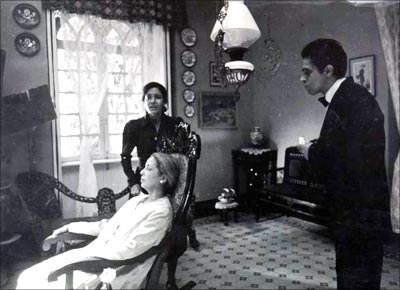
In explaining the context of Ankur, Benegal said that the film was based on a short story he had written while in college. "I make films about poor people because I hope to give them a voice," he said.
He added that the traditional Indian cinema showed women to be victims. "But it does not go beyond victimhood and I can't bear that," he said, as the audience clapped loudly.
Also Read: Of missing elephants and a passion for dance
 Advertisement