In 2007, both the European Union and the United States adopted tough positions on Iran. Economic sanctions from 2006 carried over into 2007, and in several speeches early in the year, Bush outlined three reasons why armed conflict with Iran was an option: 1. Iran looks to upset the balance of power in the Middle East by funding terrorist and anti-government organisations in Iraq (Shiite militias), Lebanon (Hezbollah) and Palestine (Hamas). 2. Iran has a nuclear weapons programme. 3. Iran supports attacks on US troops in Iraq.
Throughout the year, Iran stayed in the news.
First, Ali-Reza Asgari, a top general in the Islamic Revolutionary Guard Corps, disappeared from Turkey in February. There are two disparate explanations. One, propounded in the West, said that Asgari was serving as a spy against Iran and defected to avoid detection. The other story, widely reported in Iran, said Asgari was kidnapped by Western forces.
In March, 15 British marines and sailors were captured by Iranian forces. Iran claimed the group was in its waters, which the UK denied, claiming the crew was on a routine mission in Iraqi waters. They were released safely in April.
Then, in May, Iranian forces detained an Iranian-American academic, Haleh Esfandiari, claiming she was part of a plot to overthrow the government and install democracy. She was finally released, after 'confessing' her role in the alleged coup, in August.
Finally, in early December, the United States National Intelligence Estimate report claimed Iran had stopped nuclear weapons programme in 2003, and is focused only on developing nuclear power for electricity purposes. Bush's handling of this report has led many to question his credibility on Iran.
Recently, Saudi Arabia and other Gulf Cooperation Council nations are trying to extend a hand of inclusion to Iran. Iranian President Mahmoud Ahmedinejad was invited to 28th GCC summit in early December, where the GCC announced it will become a common market from January 1, 2008.
There has also been talk, mainly from Saudi Arabia, of creating an inclusive nuclear programme for the region that will involve Iran, provided Iran is willing to be transparent in its nuclear plans.
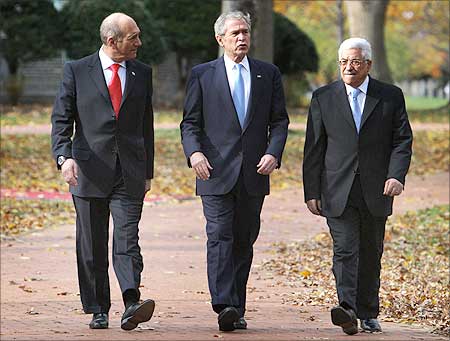
Image: US President George W Bush (centre) walks with Israeli Prime Minister Ehud Olmert (left) and Palestinian President Mahmud Abbas, November 27, 2007 during the Annapolis Conference at the US Naval Academy in Annapolis, Maryland. The Annapolis conference is aimed at restarting the stalled Middle East peace process.
Photograph: Mandel Ngan/AFP/Getty Images
Also read: India backs US-sponsored West Asia peace meet
 Email this Page |
  Write to us
 Advertisement