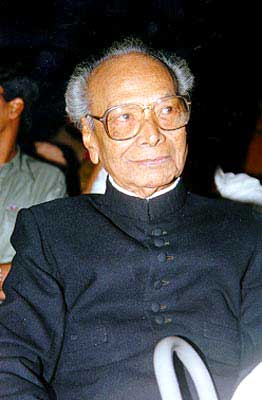
Regarded as one of the greatest music composers of Indian cinema, Naushad's was literally a journey from the footpath to the recording studios.
Born on Christmas day in 1919, he spent several nights on the streets of Bombay (now Mumbai) in the late 1930s to try his luck as a musician.
After studying under Ustad Ghurbat Ali, Ustad Yusuf Ali and Ustad Babban Saheb, Naushad repaired harmoniums and composed for amateur theatre in Lucknow. Parental pressure to wean him away from music compelled the future maestro to run away to Mumbai in search of his dream.
He assisted Khemchand Prakash, whom he considered his teacher, for a few years, and got his first break with Prem Nagar (1940). However, he was first noticed with Sharda (1942), where a 13-year-old Suraiya did the playback for heroine Mehtab. Rattan (1944) took Naushad to the top and enabled him to charge a princely Rs 25,000 a film in those days.
Naushad's forte was Hindustani classical music. His professional training enabled him to make swift adaptations of ragas into film music. This led to his coming out with major hits including Mughal-e-Azam, Mother India and Baiju Bawra. His other hits included films like Shahjahan, Dard, Dillagi, Dulari, Anokhi Ada, Barsaat and Andaaz.
Lata Mangeshkar, India's greatest playback singer -- whom Naushad gave an opportunity to sing in the early days -- once remarked that the music he composed for Baiju Bawra had surprised her. "It was entirely different from what he had done before. Different ragas were used for different situations and the purity of the ragas was maintained to the maximum possible extent," she had said.
Who are the people you will miss the most? Tell us!
Naushad had wept when Baiju Bawra was premiered at Mumbai's Broadway theatre. When the late producer Vijay Bhat asked him why he was crying, Naushad told him he was sleeping on the footpath opposite the theatre when he had dreamt of seeing his music brought to life here. 'It took me 16 long years to cross that footpath,' he had said.
He was awarded the Dadasaheb Phalke Aware in 1981 for lifetime contribution to Indian cinema.
Naushad was the first to combine the flute and clarinet, sitar and mandolin. He was also one of the first to introduce song mixing and separate recording of voice and music in playback singing.
The 86-year-old's last composition was for Taj Mahal - An Eternal Love Story, directed by Akbar Khan, which was released in 2005.
Also read: Naushad's story: From rags to riches
 Advertisement