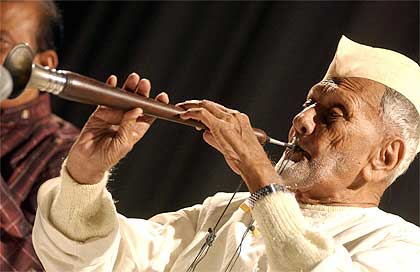
On India's first Independence Day, Ustad Bismillah Khan enthralled audiences with a sterling performance from the ramparts of Delhi's historic Red Fort.
The Ustad, who mesmerised generations of Indians with his music, was single-handedly responsible for making the shehnai a classical instrument to be reckoned with.
Khansaab was born on March 21, 1916, his ancestors court musicians in the princely state of Dumraon in Bihar, and he trained under his uncle, the late Ali Bux 'Vilayatu', a shehnai player attached to Varanasi's Vishwanath Temple.
Where others saw conflict and contradiction between his music and his religion, Bismillah Khan saw only divine unity. A devout Shia, he was also a staunch devotee of Saraswati, the Hindu goddess of music.
In 2001, Khan became the third classical musician to be awarded the Bharat Ratna, India's highest civilian honour.
Who are the people you will miss the most? Tell us!
The maestro has played in Afghanistan, Europe, Iran, Iraq, Canada, West Africa, the US, the USSR, Japan, Hong Kong and almost every capital city in the world.
In Ustad Khan's modest words, music was an ocean and he had barely reached its shores even after 91 years. Despite his fame, Khan's lifestyle in Varanasi retained its old world charm and he continued to use the cycle-rickshaw as his chief mode of transport.
Khan was a flag-bearer of communal harmony. The maestro remained firm to his roots and fulfilled his commitment to live and die in Varanasi. He passed away on August 21.
Photograph: Sajjad Hussain/AFP/Getty Images
Also read: Remembering Ustad Bismillah Khan
 Advertisement