Caparisoned elephants, fireworks, processions, conch music...
... Puram is here
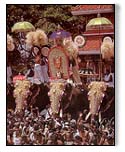 Puram is the most famous of Kerala festivals. It celebrates the impending monsoons. And it is said to be in celebration of the local deity of each town passing by the houses of all the devotees, to exorcise spirits, ghosts and other supernatural worries. Puram is the most famous of Kerala festivals. It celebrates the impending monsoons. And it is said to be in celebration of the local deity of each town passing by the houses of all the devotees, to exorcise spirits, ghosts and other supernatural worries.
Puram begins in each Kerala hamlet in the Trichur area, with the deity being taken out atop an elephant. The elephants wear a frontpiece with a spectacular design, plated with gold. It was originally intended to change every year, but the first design was found so attractive, the style hasn't been changed since.
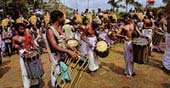
The elephants are preceded by an orchestra of over 50 musicians armed with conches, different kinds of drums and a trumpet. The identity of the deity changes depending on where the Puram is taking place and each town in central Kerala honours its own particular diety.
Though derived from the Carnatic style of music, the musicians employ rhythms that have a very local flavour. Called the panchavadyam, the orchestra consists of players of various instruments hese instruments are very particular to Kerala and include a bronze metallic drum called the elathalam, a trumpet, the thimila, played with the hands, the eddaka, similar to the thimila but which calls for the use of a small drumstick, and a conch. Many locals who understand the music can be seen standing around the musicians, shaking their heads, eyes shut in concentration, keeping time with the beat. It is quite unbelievable that so many people fall trance-like under the thrall of music.
After the deity withdraws into the temple by evening, there is a giant fireworks show, the most spectacular one being at Trichur. The city of
Trichur is built around a circular temple which is surrounded by a circular patch of land. This is where 15 elephants from each of the two competing temples, Thiruvambadi and Parmekavu, face off for a musical contest. Earlier the vibrations from the explosions during the fireworks show used to cause the glass in the buildings around to shatter. Complaints and an accident caused a reduction in the scale of the programme, which is still very impressive and dynamite is used regularly. The climax of the show is when a wall of fire runs around the temple with the deafening sound of explosions. It is a chastening experience even as the flakes of soot descend on you from the smoke-streaked sky.
 The Trichur Puram is the most famous of Purams, though the biggest Puram is at Aratupuzha where almost a hundred elephants line up. The Trichur temples also used to contest at Aratupuzha long ago till, one year, unseasonal rains saw streams swell and made the route there impassible. The next year, the temples were banned from appearing at Aratupuzha and so had to set up their own Puram at Trichur. The Trichur Puram is the most famous of Purams, though the biggest Puram is at Aratupuzha where almost a hundred elephants line up. The Trichur temples also used to contest at Aratupuzha long ago till, one year, unseasonal rains saw streams swell and made the route there impassible. The next year, the temples were banned from appearing at Aratupuzha and so had to set up their own Puram at Trichur.
In the midst of the contest, the Thirvambadi and Parmekavu teams display umbrellas of different hues. Earlier the umbrellas, though beautifully decorated, bore some rather lurid colours. Now, with generous donations from expatriates some of the umbrellas are being designed abroad, using modern technology.
Purams are probably only an excuse to celebrate at a time when the harvest has been reaped and the fields are lying dry and vacant, providing plenty of space and time for some sanctioned revelry. The money collected by the temples at this time also helps fund repairs and is income for the priests.
The morning's show especially at Trichur, with elephants clad in their ethnic best and the indigenous music is worth seeing if you like culture; if you go for the awesome, check out that firework show at night!
|