|
|
||||

|
Mandu slide show
Meet the people
Trip planning
|
|||

Popular attractions:
There are three clusters of temples in Khajuraho. We headed out for the western group of temples. Maps of Khajuraho should be
easily available from any of the hotel lobbies. The western cluster has the famous Khajuraho temples built during the Chandela
period. These are beautiful temples and inspire a feeling of pride. If ever there were a site that pays homage to temple
architecture and their majesty... Khajuraho would have to be the place.
Parking was no problem. There is a parking lot opposite the temple complex. While I waited for Nikhil to park the car, was
approached by a man offering his services as a guide. Was very impressed with his English diction and would've been sold on
taking him till he told me about the standard charge of Rs 250. A better option is the headset developed by MP Tourism at Rs 50.
The headsets cover two of the 12 temples in the enclosure, but was well worth the money.
Some of the carvings seem to have been more common, such as the depictions of women removing thorns from their feet, or applying makeup.
The tour took us to the most famous Khajuraho
temple,
the Kendariya Mahadeva temple-- the biggest, most complete,
and most ornate temple in Khajuraho.
It was blazing hot, so by 10 am we were dripping in sweat, grimy and tired. So we decided to head back to the hotel and wait out
the sun. During summer, the locals recommend getting an early start (7am at the latest) and heading back to the hotel by 10 am.
Then set out again after 4:30 pm until the temples close, which is at about 7pm. We found this routine to be adequate to cover
most of the temples over a day and a half.
All that heat and 'templing' got us feeling thirsty. A beer seemed most inviting. There are a number of little 'cafés' around the
western group temples. Warning: all of them are infested with flies! We settled for an open air restaurant called Rim Jhum, where
we had our first taste of a strong beer, Kingfisher Strong. For some strange reason the restaurant seemed to want us to drink and
told us that strong beer was all that was available! Later they tried to charge us Rs 90 for a beer, that was already exorbitant at
Rs 70. We found the wine shop next to the Rim Jhum café they had quite a selection, and all at above market rate.
In the evening we attended the sound and light show. The show itself was well produced, with the narration being performed by
the 'master carver' of the temples. Nevertheless, while I found the production good, I thought the content was a little too
melodramatic and repetitive after the audio guide we had heard in the morning. I would not consider the sound and light show a
'must see' but is a nice way to spend the evening in a town with few night attractions.
Coming up: Orchha
Log 1 |
Log 2 |
Log 3 |
Log 4 |
Log 5 |
Log 6 |
Log 8 |
Log 9 |
Log 10 |
Log 11 |
Log 12 |
Log Seven: Khajuraho

 Location:Madhya Pradesh.
Population:6,500
Altitude:257m
Temperatures:
Summer: Max 47C Min 21C; Winter Max 32C Min 4C
Temples built during the 10th century AD, on the World Heritage List
.
Accommodation
Eating/Drinking:
Khajuraho has no shortage of cafes around the western group of temples. However, the food there is nothing to write home about.
Internet connectivity: Not available
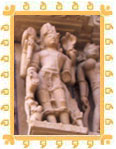
We drove into Khajuraho expecting to find temples, amidst dense forest... that came from reading all those
history books about temples that were saved from destruction because they were tucked away in the forest. We were therefore
surprised to find a dry countryside!
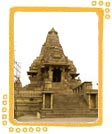
The guided tour took us around the Lakshmana and Viraha temples. The Lakshmana temple
is one of the earliest and sets the tone for many of the other Khajuraho temples. The friezes have battle, daily life , and (as is
famous)
erotic depictions. Some of the carvers evidently had a sense of humour in their depictions.
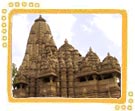
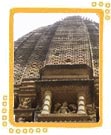 After an afternoon rest we headed out to see the eastern group temple. These Jain temples seemed to be the best preserved of
the temple groups and had some of the most intricate carving. The Jain temples were
definitely worth seeing. Some newer, far less elaborate temples built in the last 100 years by philanthropic Jains, have now joined
the older temples.
After an afternoon rest we headed out to see the eastern group temple. These Jain temples seemed to be the best preserved of
the temple groups and had some of the most intricate carving. The Jain temples were
definitely worth seeing. Some newer, far less elaborate temples built in the last 100 years by philanthropic Jains, have now joined
the older temples.
Meet the people |
Trip planning
|
Route map |
Message board |
Write to us |
Post a travelog |
Travel home
HOME |
NEWS |
BUSINESS |
MONEY |
SPORTS |
MOVIES |
CHAT |
INFOTECH |
TRAVEL
SINGLES |
NEWSLINKS |
BOOK SHOP |
MUSIC SHOP |
GIFT SHOP |
HOTEL BOOKINGS
AIR/RAIL |
WEATHER |
MILLENNIUM |
BROADBAND |
E-CARDS |
EDUCATION
HOMEPAGES |
FREE EMAIL |
CONTESTS |
FEEDBACK