



|
|
|
|
| HOME | TRAVEL | TRAVELOG | ||
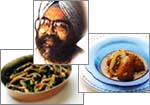
Food for the Soul ... a feel good food festival
How many times can one ingest those tired-looking potatoes garnished with sickly cherries and slopped over with congealed cream. Or those endless permutation-combinations of karhai paneer, paneer karhai tikka masala, paneer pasanda, palak paneer pasand... He's bored of eating it. Bored of seeing it being served all over the countryside. Especially when it isn't a cuisine truly representative of our country. That's why he decided, many years ago, to work on offering a different cuisine -- a Hindustani nouvelle cuisine. And his latest project, in July at The Oberoi, Bombay, is a food festival of "FEEL GOOD" Hindustani nouvelle cuisine. Like saalan taal makahana... makahana or lotus puffs and raw bananas in a saalan gravy. Or makai shazadi..."princess corn made sweet 'n' sour with a honey-shilajit majoon, and emerald spinach, flirt in a karhai, while the quartet of musq-e-daana, kebaba, nutmeg and black cardamom play a tantalising serenade." Feel good is the key word here. Word has gotten out that it is going to be feel good food as in the US $ 7-a-pop-Viagra-feel-good. And that Kalra is offering deshi Viagra-laced khaana or meals. "It is a festival of wellbeing. Of ecstasy. It is sheer coincidence that this has happened post-Viagra. We had planned on it from a long time before. And we have spent a long time -- four years -- doing research. And if the truth be told we have just scratched the surface. But Ayurveda is the science of life. We are not looking at substitutes for Viagra. While there is ecstasy, there is wellbeing. Lest anybody thinks they are coming here for instant fixes they won't find it. We are looking at it from the culinary point of view. It is not an event for those with sexual problems. It is a feel-good festival. I don't think sex is the be all and end all of life. A feeling of longevity is more important. And this is that kind of food. " Sure, some of the foods on Kalra's menu are said to have aphrodisiacal properties. Like coral and mushq-e-daana which brings on a sexual flush. Or the shell fish entrees for instance. "Lobsters are known to act as aphrodisiacs. And, well, a seekh kebab would seem like a phallic symbol." Or the Cupid's Quiver, adish of asparagus that is reference to the voyeur. But that is just a small part of the feel good package being offered. Kalra goes on to explain that for centuries Indian cooks and vaids have flirted with adding special -- today rare -- ingredients that provide a tangible sense of wellbeing. No strong uppers and downers. Mild ingredients that make a person feel good about himself. A bit like the feeling of satisfaction a paan (the typical Indian ) produces at the end of a good meal. He discovered on repeated trips to Lucknow and consultations with well-known vaids that there is a whole school of thought that has existed from well before the middle ages that believes in adding a pinch of this or a dash of that to pep up a person's dinner. Medicinal food? Not quite. More like an-apple-a-day-keeps-the-doctor-away food. However, it is a very personalised science. And the punch a pinch of x gives to one person may just not work on another. A vaid's prescription depends on each person's body makeup and current or long-standing ailments. The family vaid merely had to feel the patient's pulse to able to rattle off a string of pick-me ups and curatives/palliatives. These ingredients are fortunately still available but very hard to come by. And expensive. But a few vaids still stock these unusual potions. "Like shilajit which is basically the sap of a mineral ore. Bitter as hell. And then there are pearls and coral. Or ambar, a fossil from the deep ocean. And there are very exciting spices that have gone out of vogue like mushq-e-daana, gul-gurlah, chail-chabila, zarraqoosh. These are tonic ingredients. The first lot is very expensive and difficult to find. About 1.2 kg of a combination of these ingredients has cost us about Rs 100,000. We have consulted doctors of the indigenous school and we will be using minuscule proportions, less than the quantities prescribed." At the festival, which will take place at the Kandahar, nine different menus will cater to different humours. Kalra doesn't anticipate that the menu will be priced much higher than it is for other food festivals. "Maybe 20 per cent more expensive." Interestingly, Kalra has added these rare spices and ingredients to his nouvelle cuisine. Though the food will contain health-boosting properties, the first criterion of Kalra's make-you-happy food is that it must taste good too. "Here in Bombay our cuisine will be catering to the corporate warrior. We are not offering tamsik or satvik food. Tamsik food is for the labourer. And satvik food is for the nubile, for the youth. We are offering subtly balanced rajsik food. Rajsik food allows one to work after lunch. It doesn't make you burp." In the Oberoi kitchens, fragrant rajsik food is being stirred up in a whole flotilla of copper handis and karhais. Grated paneer and boiled doodhi are being moulded into koftas by deft hands. In the centre of each kofta is an almond stuffed prune. Makahana is being lightly braised in a saalan or gravy by Chef Ilyas Mohammed. Another young cook dips -- "bathes bridally" -- slices of brioche (ghee-fried bread) in flavoured milk for a shahi tukra type sweet dish. And Raminder Malhotra, Kalra's right hand man, fusses over a dish of arbi ki seekh, "fashioned from colocasia, paneer, pomegranate and pistachio, laced with a trace of shilajit, the aphrodisiac that is said to turn soft ore to steel". The food -- cooked in Avadhi style -- does taste good. But this is just a dress rehearsal. The food has been cooked minus the 24 carat ingredients, which are probably locked away in some safe almira or cupboard. How much better it will taste, after their addition, can be checked out after July 13. Kalra believes that it is important that Indians remember once again -- as they did in the olden times -- to "eat sensibly" and "within the parameters of Ayurveda". He feels that any individual must eat at the right time and in balance with his environment. The Ayurvedic concept of desh kaal is of paramount importance. The amount/type of meat (protein) and fat consumed must depend on the climate and the type of occupation a person is in. "Why are Westerners petrified of using spices?" he cites as an example. Spiced food, Kalra elaborates, is not the ideal component, given the deshkaal compulsions, of a Westerner's diet. Important too, explains Kalra, is the traditional Indian concept of eating seasonal vegetables. Certain vegetables are meant to be eaten during certain seasons. There were so many sound ideas of eating and nutrition in the days gone by which have been forgotten and Kalra is happy to preside over an Indian food renaissance... a period of new creativity in cooking where new ideas are given their chance and old ideas revived. "If this festival arouses interest I am more than willing to turn this into a road show" Much of Kalra's research has taken place in Lucknow. In the four years that they have been working on this project, he and his colleague, Dr Pushpesh Pant, professor of international relations, Jawaharlal Nehru University, New Delhi, have managed about 60 days of concentrated work. "We do not have a Ford Foundation or Rockefeller Foundation backing us." Much of it has involved tracking down skilled vaids who still practise the trade of eat-better- to- feel-better medicine. And vast amounts of time went in hunting down the rare ingredients required to fill these vaid's prescription. These medicinal ingredients and rare spices, Kalra explains, have vanished from markets mainly because hardly anybody knows how to use them anymore. "The profession of chefs has changed. They are illiterate. And not aware of the use of these spices. The traditional cooks are too poor to be able to stock these ingredients. And catering school chefs haven't the faintest. Part of the problem is that many hakims and vaids themselves have stopped promoting these remedies. Some of the b------- are using steroids for instant cures. Take zarraqoosh. It is a blade of a grass. But nobody knows how to use it anymore. And so it is hard to find and therefore it has become expensive."
In the food 'designed' by Kalra he has eschewed garam masala, chaat masala. And the favourite kitchen concept of 'mother gravies is banned. Over spiced food is out too. Visual appeal is high on the list. As too is incorporating the five Indian flavours -- bitter, astringent, sweet, sour and salty. Apart from the novel new ingredients, Kalra's culinary promise is a chance to try a new style of cuisine. A pleasant change after the lack of variety available elsewhere except in a few favourite restaurants. Kalra mourns the fact that the cuisine available is not representative of the rich regional variety of India "Where is the great Punjabi restaurant? There is not a single Sindhi restaurant. Why haven't the Sindhis promoted their cuisine the way the Shettys have promoted Udipi food or the way Malwani food has been promoted. What about Gujarati food. What about a Gujarati restaurant? I am not talking about these thali places. They are very tiring. Where is the freedom of choice in these places. They inflict food on you. Ask a Bengali why there is no good Bengali food available. And he'll give you some wah-wah-wah. Surely a man like Rabindranath Tagore did not write poetry on an empty stomach. " Dinners and lunches at Kandahar, Kalra promises, shall be quite something out of the ordinary this month. In fact Jiggs Kalra has moved in for good. And even after his feel good festival is over, Kandahar will continue to serve light, delicately- spiced, unusual, rajsik food -- his trademark.
|
|
|
|
|
|
HOME |
NEWS |
BUSINESS |
CRICKET |
MOVIES |
CHAT
INFOTECH | TRAVEL | LIFE/STYLE | FREEDOM | FEEDBACK |
|
