


|
|
|
|
| HOME | TRAVEL | TRAVELOG | ||
Splendid China ... a journey across the mainland Photographs and text: Nilesh Korgaonkar
I had the option of taking the daily flight to Chengdu, the capital of Sichuan province from Lhasa. A quick survey of my finances revealed that flying was out of the question. So the journey had to be made by road. The bus depot in Lhasa gave me a seat on the bus to Golmud. It is possible to travel all the way from Lhasa to Xining, beyond Golmud, by bus and buy a single ticket at Lhasa for the entire journey.
My companion and I had bought our tickets for Xining at Lhasa for a whopping 828 yuan (Rs 4,140) each! We arrived in Golmud in the wee hours of the morning on the third day after two minor breakdowns. Anxious to get to Xining, we began to enquire when our journey would resume. After much sign language -- pointing to the most appropriate lines in the phrase book and gesticulating at the wrist watch -- we got the impression that we would be starting again at four in the morning, three hours hence. But come 4 am and we discovered that we has mistaken am for pm! We were instructed by one of the drivers to spend some time in the town and return to the bus station at 3.30 pm. He said he would guide us to the bus which would take us to Xining. We somehow killed time in the bleak and depressing town of Golmud. At 3.30 pm our friendly driver tried his best to get us on to a bus to a Xining. No luck. The buses were full. By 5 pm we decided to take matters in our own hands and take the 6.18 pm overnight train to Xining. Our driver friend genuinely believed we did not deserve any refund or compensation. The concept was probably alien to him.
Traveling by train in China is a treat compared to the chaotic system that we have in India. The strict discipline of the Maoist era is still evident and the systems run smoothly. Unlike India, there is no ticketless travel. Tickets are available when you want them and clean bedding is available even in the "hard sleeper" class (comparable to our three-tier sleeper). Lanzhou was basically only a rest-up halt for us. Our bones were still aching after the journey from Lhasa.
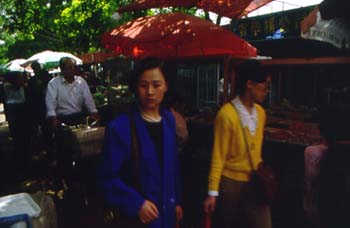
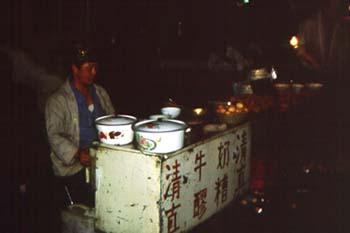
When you travel through China, you have to learn to overlook the strange things. I gorged on the kebabs grilled over a slow charcoal fire by Chinese Muslims. And the wonderful roujiabing -- lamb or pork fried with onion, capsicum and a dash of paprika served inside a pocket of flat-bread -- and finished off with tianpeizi, lightly boiled highland barley kernels served with a sour-sweet milky-white sauce. It has a delicious, aromatic flavour. In Lanzhou it was evident that the Chinese economic boom had not been restricted to the southern provinces. Construction was going on everywhere and the people sported the latest fashions from Hong Kong. Japanese cars and the latest Chinese cars (the offspring of various joint ventures) zoomed through the streets. Downtown Lanzhou resembles any other Western city, rush hour traffic jams and all.
Sichuan is the largest province in China, and also the most densely populated. Roughly the size of France, it is rich in natural resources. Its wild mountainous terrain and rivers kept it relatively isolated until recently and much of its western fringe is still remote. Its inaccessibility has given it a special place in Chinese history. Sichuan was always a breakaway kingdom and it was here that Chiang Kai-shek's vanquished Kuomintang forces sought refuge before fleeing to Taiwan.
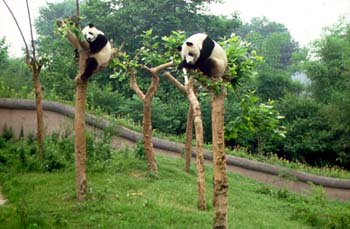
At Chengdu I checked in at the Traffic Hotel. It was cheap, clean and very well maintained. It had common toilets and shower; clean and spotless and maintained that way through the day. Located bang on the Jin river, one had easy access to a neighbourhood of riverside restaurants. The travel agents at the hotel were a good source of information and organised day trips to the Panda Research Station for 80 yuan.
Early morning walks along the river outside the hotel was an interesting experience. The old people of the area gathered in orderly groups and either practised taichi or a strange version of ball-room dancing. It was a daily ritual and as the sun rose further, the groups would break up and the old folk would return to their daily chores.
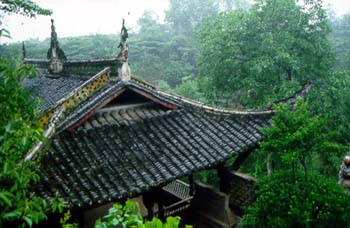
I did not get to see the mountain locked region of Emeishan which is a pilgrimage site for the locals. Emeishan is said to be particularly atmospheric with its misty mountains, sombre Buddhist monasteries, clouds of incense and the tinkle of temple bells.
|
|
|
Continued
|
|
|
|
|
|
HOME |
NEWS |
BUSINESS |
CRICKET |
MOVIES |
CHAT
INFOTECH | TRAVEL | LIFE/STYLE | FREEDOM | FEEDBACK |
|