
US President Donald Trump in an exclusive interview to Axios on Wednesday, said that he would continue to keep the naval blockade until Iran agrees to deal with the United States by addressing America's concerns about the nuclear programme.

The US military is considering a new wave of military operations in Iran, including potential strikes on infrastructure and securing Iran's stockpile of enriched uranium, amid a fragile ceasefire and stalled nuclear talks.

US President Donald Trump stated that military strikes against Iran could resume if they 'misbehave,' even as he reviews a new proposal from Tehran aimed at ending the paused conflict.

US Vice President J D Vance is expected to travel to Islamabad for peace talks with Iran to end the seven-week war, amid a fragile ceasefire and ongoing tensions.

In a significant diplomatic manoeuvre aimed at de-escalating regional tensions, Iran has reportedly submitted a "new proposal" to the United States through Pakistani intermediaries.

Donald Trump has extended the deadline for Iran to reopen the Strait of Hormuz, amid escalating tensions between the two countries. Trump issued a harsh warning to Tehran, threatening to target Iran's energy and civil infrastructure if the Strait is not opened.

The United States Central Command (CENTCOM) has announced that American forces are maintaining a strict maritime restrictive operation in the region, continuing to enforce a blockade against Iranian ports.

President Trump has been briefed on potential military actions against Iran, including strikes on infrastructure and control of the Strait of Hormuz, even as negotiations continue. He maintains economic pressure is the primary strategy, while legal questions arise over war powers.

Iran has submitted a fresh proposal to regional intermediaries offering to cease its military operations in the Strait of Hormuz, contingent upon a complete cessation of hostilities and the removal of the US blockade on Iranian maritime hubs.

He also criticised the possible succession of the son of the late supreme leader of the Islamic Republic, Mojtaba Khamenei, who is widely viewed as a leading contender for the position.

A new assessment by the Institute for the Study of War (ISW) reveals that a power struggle within Iran's leadership, with hardliners gaining influence, could significantly impact future negotiations with the United States.

Uncertainty surrounds the US-Iran talks as a two-week ceasefire approaches its end. Pakistan is attempting to mediate, but tensions remain high after a recent naval incident.

Iran's state broadcaster denies sending a diplomatic delegation to Pakistan for talks with the US, despite reports suggesting otherwise. This denial comes amid escalating tensions and aggressive rhetoric from Washington, even as signs of potential diplomatic movement emerge.

US President Donald Trump stated the war with Iran would end 'soon,' citing significant military gains and minimal remaining targets. This contradicts earlier administration statements about an open-ended timeline.

A top Iranian intelligence official was killed in an attack, with the Revolutionary Guard blaming the United States and Israel. The incident occurs amid escalating regional tensions, including IDF strikes on Hezbollah infrastructure and ongoing operations in Lebanon.

The naval command underlined recent regional developments, which have now established a new reality in which extra-regional powers, led by Washington, DC, can no longer dictate terms or project unchecked influence in Iran's immediate maritime environment.

United States President Donald Trump on Friday declared that there would be 'no deal with Iran except unconditional surrender' amid the escalating West Asia conflict, asserting that Tehran must capitulate before any diplomatic negotiations can proceed.

The White House has responded cautiously to reports of Pakistan offering to mediate between the US and Iran, amid ongoing tensions and potential talks.

US President Donald Trump threatened to bomb Iran if a deal is not reached before the ceasefire ends, while Pakistan urged both sides to extend the truce and pursue diplomacy.

US President Donald Trump has announced plans to clear the Strait of Hormuz to secure the vital oil corridor, citing risks to global energy supplies and criticising other nations' inaction.

An Iranian missile strike on Haifa has resulted in casualties and intensified conflict between Iran and Israel, prompting search operations and ceasefire discussions.
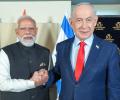
The Congress party has criticised the Indian government's diplomatic strategy, claiming a 'severe setback' if reports of Pakistan mediating between the US-Israel and Iran are accurate. The party alleges Pakistan's diplomatic engagement has surpassed India's, despite military successes.

US President Donald Trump has asserted that the destruction of an American military aircraft will have no bearing on diplomatic discussions with Iran, according to a report by NBC News.

US forces have launched search and rescue efforts for a US fighter jet, which several news outlets, including the Wall Street Journal and CNN, said had been shot down over Iran.

The United States and Iran, with regional mediators, are reportedly discussing a potential 45-day ceasefire to prevent further escalation of conflict, including strikes on Iranian infrastructure and retaliation against Gulf states' facilities.
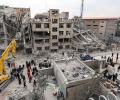
The call came before Iran's new supreme leader Mojtaba Khamenei vowed vengeance and urged citizens to continue their fight against the attacks by US and Israel.

Iran has formally turned down a proposal from the United States for a 48-hour ceasefire, according to Al Jazeera, citing reports from the semi-official Fars news agency.

Iranian state media reports that Ayatollah Ali Khamenei's son, Mojtaba Ali Khamenei, has been appointed as Iran's new Supreme Leader by the Assembly of Experts, a move criticised by US President Donald Trump.
The United States Special Forces have rescued the second F-15 crew member alive, who went missing after Iran downed the jet amid the West Asia conflict, President Donald Trump has confirmed.

...is a way out, notes Prem Panicker in his must read blog on the Iran War. What the indefinite extension produces is a prolonged condition of not-war-not-peace, in which oil markets cannot stabilise, Asian refineries cannot plan, European governments cannot stop subsidising consumption they cannot afford, and the next flashpoint -- a seized tanker, a miscalculated drone strike, a Truth Social post that claims too much -- is one news cycle away.

The ministry of interior of Bahrain on Sunday claimed that Iran attacked civilian targets in a water desalination plant after a drone attack.

Amidst ongoing conflict, Iranian President Masoud Pezeshkian signals a potential de-escalation by apologising to neighbouring countries while firmly rejecting US President Donald Trump's demand for unconditional surrender.

Saudi Arabia and the UAE are actively pushing Trump to take the war to its bitter finish and 'erase' Iran's presence in the geopolitics of the region. Simply put, the two most powerful Sunni Arab oligarchies are on the same page as Israel. Such interference increases the risk of a breakdown in dialogue between the US and Iran, points out Ambassador M K Bhadrakumar.

Iranian President Masoud Pezeshkian maintained a stance of defensive necessity, noting that Tehran is "forced to retaliate to attacks" but clarified that this does not imply a dispute with neighbouring countries

This weekend, Donald Trump has begun to say the quiet part out loud -- that he wants to take control of Iran's oil, a formulation more in line with his robber-baron style of international relations.

The 'rescue' operation occurred within kilometres of Iran's underground tunnel complex at Isfahan, assessed by the IAEA and US intelligence as holding a substantial portion of the country's 60 per cent enriched uranium stockpile. Retired senior US military officers have highlighted that the mission's footprint -- hundreds of special operators, multiple heavy-lift aircraft deep inside Iran -- appears outsized for recovering a single airman. Prem Panicker continues his must read blog on the Iran War.

Egypt, Pakistan, Saudi Arabia and Turkey met in Islamabad in what analysts say is the formal opening of a new diplomatic formation that could reshape the post-war regional order. Their immediate goal is a ceasefire; their larger ambition is to ensure that neither Iran nor Israel emerges from this war in a dominant position. Pakistan's foreign minister then flew directly to Beijing and mooted a Chinese role as guarantor of any eventual agreement. Prem Panicker continues his must read daily blog on the Gulf War.

The India-US ties witnessed a major downturn after President Trump slapped a whopping 50 per cent tariff on Indian goods, including a 25 per cent punitive levy over Russian oil purchases.
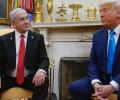
United States President Donald Trump has denied that he recently told Israeli Prime Minister Benjamin Netanyahu to stop being so 'f***ing negative' and 'take the win' after Hamas accepted parts of Washington, DC's proposal for ending the Gaza war, while saying that it would have to hold talks regarding other portions of the plan, The Times of Israel reported.
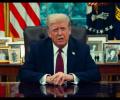
'What the US appears to be doing is to force India to be "the buyer of last resort", on whom their products can be dumped, 1.4 billion people have to eat something, so why not eat American corn?' 'What is exercising the Trump lot is the fact that most of the farms are in solidly Republican Midwestern states: Illinois, Indiana, Kansas, Michigan, Minnesota, Missouri, Nebraska, North Dakota, Ohio, South Dakota, Wisconsin,' points out Rajeev Srinivasan.
 © 2026 Rediff.com - Advertise with us - Disclaimer - Privacy Policy - Sitemap - Feedback - About us - Terms of use - Grievances