



|
|
|
|
|
| HOME | CRICKET | DIARY | L SIVARAMAKRISHNAN | |||
|
October 30, 1997
NEWS
|

The Cricket Column/L Sivaramakrishnan
Of the media, for the media...
It's come to where, any time Australia goes into a game, the focus invariably is on the man with the magic fingers -- Shane Warne. The soft-spoken 27-year-old has created quite an image for himself -- or had it created for him. Because if Warne, with his beach boy looks and charisma is a natural for the media, then in turn, the media, especially the Australian media, has done lots to build, around him, that aura of unplayability. None of which is to discount the fact that Warne can turn the ball on the deadest track, mind. Warne is easily the most successful leg spinner of the decade, coming it at a time when everyone thought leg spin had been dead and buried. He made his debut against India -- and the only memorable thing about the game was Ravi Shastri's double century, a good few of which runs came against Warne himself. Warne really hit the big time with that "ball of the century" -- with his instinct for drama, Warne pitched his first ball in an Ashes series outside the leg stump of Mike Gatting, and turned it in viciously to hit off stump. And from that point on, as they say, he was made in the shade.
As a leg spinner myself, I feel the best strategy to adopt is to make the batsman play forward. More so in the case of Warne, because he has the formidable flipper in his repertoire. The flipper skids on to the batsman, tempting him to play on the back foot. It the batsman succumbs to the temptation, he will most probably be out LBW -- and the only way to avoid this untimely demise is to come forward to the leg spinner. Warne has the added advantage of being well built, unlike most spinners of the past who were either slight in frame, or not as tall in height. With his body weight fully behind the ball, Warne can be vicious. His is a smooth approach -- a few short strides, before delivering the ball at a slight angle rounded off by a strong follow through that has him running half way down the track, or more. Warne uses his powerful fingers to give the ball that extra tweak, and his shoulders and body weight to impart the pace that has the ball hurrying off the wicket -- and together, that makes for a lethal cocktail. A good proportion of Warne's wicket are LBW, caught in the close positions, or stumped. And the most frequent victims are batsmen who cannot use their feet to play spin -- and England batsmen are notorious for this inability, so it is hardly surprising that Warne reaps rich harvests whenever he goes up against them. I don't know what it is about Englishmen and spin bowling -- when I used to play club cricket in England, they always thought that leg spin was something like the Indian Rope Trick. Some kind of magic to which they had no answer.
The Australians have perfected this into an art form -- the use of the media to add to pressure felt by opponents. This has not always been the case -- I mean, the Chappell brothers hardly had the media screaming that they were the best batsmen, or captains, in the world. But then again, we cannot forget that the media has never been this powerful before. As the communication networks make the world smaller, information has become more accessible. We have live telecast of matches with a band of experts analysing the game as it is happening and dissecting it further after. It does not hurt that most of the experts we have today are Australia-based. Nor that sensational headlines always make for better print runs. So the thing acquires symbiotic overtones -- you build up a figure who plays well on your sports pages, and each success of that player feeds the hype, while the odd failure is glossed over with talk of how the bowler in question is practising a new mystery ball. All this image building, of course, is naught if the player does not lend credibility to the headlines with good performances. It certainly helps to have the batsmen under pressure, but pressure alone won't get a batsman out, you also have to bowl well. Mark Taylor, as Warne's captain, has always been supportive and the team has backed him to the limit. For a leggie, field support is very important and can often make the difference between a wicket and a four. Taylor has always told Warne to go in there and attack. No defensive fields for him, even if he gets hit around a bit. This kind of positive beginning always does wonders for a bowler's morale. We cannot however ignore the fact that Warne has never been very successful against nations like India, Pakistan and Sri Lanka who are comfortable playing spin. These batsmen love to use their feet, and having been more exposed to spin bowling, know how to treat each ball on its merit.
To my mind, among leg spinners in international cricket today, Warne is far and away the best. And he has proved this in both one-dayers and Tests, and shown the world that he can turn the ball even on a good batting wicket. Know what I am waiting for? His visit to India with the Australian team, later this year. Warne against Tendulkar, Azharuddin, Ganguly, Kambli and Dravid -- now that's something I'll pay good money to watch.
Way cool Warne links
Unravelling the wiles of Warne
|
|
|
Mail to Sports Editor
|
||
|
HOME |
NEWS |
BUSINESS |
CRICKET |
MOVIES |
CHAT
INFOTECH | TRAVEL | LIFE/STYLE | FREEDOM | FEEDBACK |
||
 Warne is here- Be Warn-ed! goes a newspaper headline, rather heavy-handed on the pun. Shane Warne takes England for a spin, goes another.
 Warne has had great contemporaries in Anil Kumble and Mushtaq Ahmed, each hugely successful in his own right -- and yet it is Warne who has carried the mantle of invincibility. People do wonder just how much is talent and how much, media hype -- I guess with the right combination of the two, a cricketer can and, in this case, does, rule the world.
 Warne took wickets, and the Australian press built him up larger and ever larger. And don't ever underestimate the power of the media -- they go on about the "mystery ball" that a bowler has just added to his repertoire, and you can bet opposing batsmen read this stuff and in the backs of their minds, they wonder, hey, just what is this mystery ball? So next time they go up against the bowler concerned, they are waiting, warily waiting, for this mystery ball, poking hesitantly at everything and, like as not, getting themselves out to a half volley.
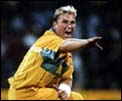 The good thing about Warne is his keenness to learn, to improve. During the recent Ashes, he flew back to Australia in between Tests to meet with his coach, Terry Jenner, and get some flaws corrected. Then he came back, and in the next Test read the riot act to the England batsmen. That was quality bowling -- not newspaper headlines.
