
The GSAT-31 is a 'high power' communication satellite going to serve and replace some of the satellites that are going to expire soon.

On Thursday, the four-stage, 44.4 metre tall PSLV-C53 that blasted off from the second launch pad of Satish Dhawan Space Centre and placed the three Singapore satellites--DS-EO, NeuSAR and SCOOB-1 in intended orbit.

The approved proposals included "procurement of night sight (image intensifier), light vehicles GS 4X4, air defence fire control radar (light) and GSAT-7B satellite," it mentioned.

On Sunday morning, in its mission to place an earth observation satellite and students satellite into the low earth orbit, the SSLV-D1/EOS-02 blasted off precisely at 9.18 am amid cloudy skies from the first launch pad at Satish Dhawan Space Centre in this spaceport.

A truly 'made in India' satellite that will empower a digital India.
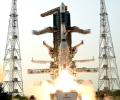
Over 32 missions -- satellites and rockets -- have been planned for the year.

India's heavy-lift rocket GSLV MkIII, carrying communication satellite GSAT-19.

The 3,423 kg GSAT-29 carries Ka and Ku band high throughput transponders intended to meet the communication requirements of users, including in the North East and in Jammu and Kashmir.

The 43.43 metre tall rocket lifted off at 5.28 pm from the second launch pad at the Satish Dhawan Space Centre in Sriharikota

A key feature of the satellite is providing mobile communication to India through multi beam coverage facility.

The earth observation satellite would provide real-time images of the country and also be able to quickly monitor natural disasters.

The launch of the crewed space mission, Gaganyaan, is being planned before the next Independence Day and this will be proceeded by two uncrewed missions, Lok Sabha was informed on Wednesday.
The satellite will enable a full range of services to neighbours including the areas of telecommunication, television, direct-to-home, VSATs, tele-education and tele-medicine.

Indian Space Research Organisation is using the most powerful configuration of its rocket Polar Satellite Launch Vehicle to launch a communication satellite from Sriharikota on July 15, as it braces for the nearly Rs 200 crore mission.

The mission life of the 2,250kg GSAT-7A, built by ISRO, is eight years. It will provide communication capability to users in Ku-band over the Indian region.

Devas Multimedia has seized $87,457.47 cash that ISRO's commercial arm Antrix Corporation held in the US as it looked to enforce a $1.2 billion compensation it had won over a cancelled satellite deal, its lawyer said on Wednesday. Devas Multimedia America Inc had sought seizure of $145,000 but the actual recovery was $87,457.47 (a little less than Rs 70 lakh). This came after it secured a favourable order from the Eastern District Court of Virginia, Matthew D McGrill said.

Out of its 47 operational satellites, India currently has six to eight satellites which are used entirely for military purposes.
Enthused over its successful launch of GSLV D5 with GSAT-14 communication satellite from Satish Dhawan Space Centre in Sriharikota on Sunday, the Indian Space Research Organisation is planning a series of GSLV launches and an experimental launch of the advanced version GSLV Mark III soon from the spaceport.
India is planning two rocket launches next month that would carry on board homemade communication and remote sensing satellites, along with a Russian payload and a Singaporean micro spacecraft.

The Mars Orbiter Mission (MOM) is among the most-tracked satellites in the world, according to N2YO, which provides a web-based real-time satellite mapping website.

Thursday's launch is the last one of 2020 for ISRO.

If the April launch of the Chandrayaan-2, the country's second mission to the Moon, is not possible, then the ISRO will aim for a launch by October.

The primary goal of HysIS, whose mission life is five years, is to study the earth's surface in visible near infrared and shortwave infrared regions of the electromagnetic spectrum.

Indian Space Research Organisation's second mission of the year to place an earth observation satellite by a GSLV rocket faced a setback as the mission could not be accomplished fully due to performance anomaly in the cryogenic stage of the rocket, the space agency said on Thursday.
ISRO officials said GSAT-4 is a technology demonstrator. Its communication payload comprises multi-beam Ka-band beam pipe and regenerative transponder and navigation payload.

India will appeal against the verdict of the Hague tribunal in Antrix-Devas deal case, in which the international court had declared the annulling of the contract as "unfair" and "inequitable" and asked it to pay huge amount as compensation.

The Chandrayaan-2 will conduct the next level of scientific studies on the Moon, writes T E Narasimhan.

The Indian Space Research Organisation successfully put India's heavy rocket Geosynchronous Satellite Launch Vehicle-Development 5 (GSLV-D5) into orbit from the spaceport at Sriharikota, Andhra Pradesh at 4.18 pm on Sunday.

Except Pakistan, seven SAARC countries are a part of the project.

There has been no loss of revenue arising out of the Antrix-Devas deal as the agreement has been annulled, the Lok Sabha was informed on Wednesday.

The Indian space agency has already begun work on the third generation of the earth observation satellite -- the first of which will be ready by 2018 and boost the capability to generate digital maps.
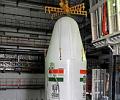
The launch of a Geosynchronous Satellite Launch Vehicle was called off by the Indian Space Reasearch Organisation at the eleventh hour on Monday due to a fuel leak in its second stage -- in a setback to the mission to test its homegrown cryogenic engine -- after its failure three years ago.

In the years to come, India's space assets will play a much bigger role if and when hostilities break out on our borders, says Pallava Bagla.
Besides Nair, others named in the charge sheet include the then K R Sridhar Murthy, Ramachandra Vishwanathan and M G Chandrasekhar.

'We are looking at a joint venture between ISRO and a few companies to assemble the PSLV and launch it from Sriharikota.' 'In a month or two, the vehicle assembly building will be ready.' 'After that, we could see 13, 14 launches a year.'
The Indian Space Research Organisation, which had a recent setback with the failure of its latest communication satellite GSAT-5P, is planning three major satellite launches in the first quarter of this year.
Describing the failure of the GSAT-5P communication satellite launch on Saturday as 'very tragic', India's top space scientists and strategic thinkers said the launch vehicle going up in flames soon after the lift off was 'a major setback' for ISRO. Senior space scientist Professor Yashpal, in his first reaction to the failure of the satellite launch, said, "It is very tragic. I think something has happened in early stages. I have never heard of such a thing."
Chief of the Indian Space Research Organisation K Radhakrishnan, while commenting on the failure of the latest communication satellite GSAT-5P onboard homegrown GSLV-F06 powered by a Russian cryogenic engine, said that the vehicle faced problems 50 seconds after its launch."The command for aborting the launch was issued when the vehicle was at an altitude of 8 km and 2.5 km away from Sriharikota," said the ISRO chief.
Launch of India's latest communication satellite GSAT-5P onboard homegrown GSLV-F06, powered by Russian cryogenic engine, failed on Saturday when the rocket developed a snag soon after lift-off from the spaceport in Sriharikota.
Indian Space Research Organisation is preparing to launch a geosynchronous satellite launch vehicle (GSLV-D3), powered for the first time by a home-made cryogenic engine, from Sriharikota spaceport this month, its chief K Radhakrishnan said on Friday.
 © 2026 Rediff.com - Advertise with us - Disclaimer - Privacy Policy - Sitemap - Feedback - About us - Terms of use - Grievances