
Names and names and names and names...
329 in all.
Some Indian. Some Canadian. Some British.
Berry. Gupta. Jain. James. Bhatt. Beauchesne. Chatlani. Enayati. Lougheed....
Vaihayasi Pande Daniel visits Ahakista, Ireland, home to the memorial for the worst terrorist atrocity in India's history.
It is a long bumpy ride out to this lonely Irish peninsula.
We see all of three people there, apart from the bus driver.
From Dublin, a train brought us to Cork and from Cork we had taken a two-hour bus ride to Bantry on the southwest coast of Ireland.

And then for another 40 minutes, we are on a second bus, travelling along the remote finger projection of land called Sheep's Head, that is one of the westernmost parts of Ireland.
Then you reach Ahakista.
It looks out to Dunmanus Bay and the moody Atlantic and is a place as pretty and poetic as the musical sound of its name.
A place where land, sky and sea meet and merge harmoniously.
A place where history unfolded 40 years ago and I am merely following in the footsteps of hundreds of people who flocked here during a fateful week in June 1985.
A place that four decades earlier did not resemble anything like what I am seeing today.
Why?
It was no doubt as wonderfully beautiful and silent then too. But for a brief few days it became hell on earth.
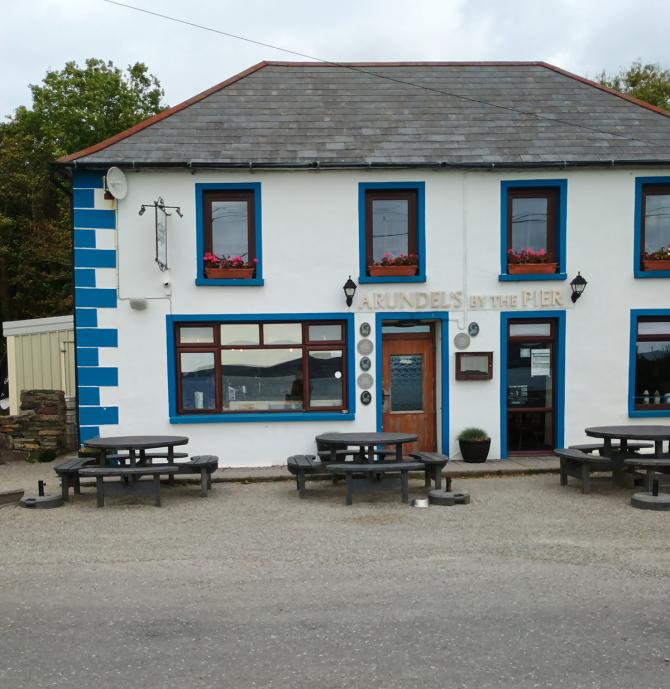
We get off the bus -- my daughter, grandson and I -- at the one and only village pub named Arundel's By The Pier, which is the stop for Ahakista. Ahakista's Irish name is Átha an Chiste, meaning ford of the treasure.
It's a cold late September day. A little past 4 pm. A brisk breeze blows.
In summer, the marina opposite must be a place of boating, fishing and sailing, especially in June, 40 years ago.
But today it is deserted, the boats all tied up, some covered with tarp and not a soul in sight.
No one is inside the locked pub either, although there are lights on and somebody must be around.
We are not sure which direction to go. And decide to plant ourselves down at the black picnic tables in front, wondering what to do, waiting.
The return bus TFI 232, the last bus of the day, will be back in about an hour (64 minutes or maybe earlier since Irish buses often come early) and we cannot be stranded here, which feels like the middle of nowhere.
Finally, a young woman in an apron pops up behind the bar counter at Arundel's.
I knock on the window, and when she comes to the door, I ask her in which direction is the memorial.
She says it's up the road, about a kilometre away.
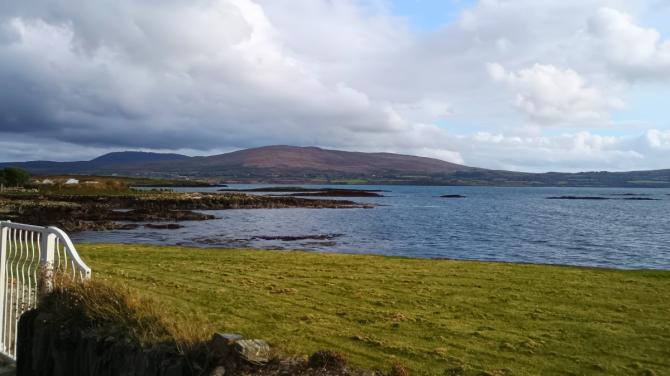
We quickly trot off at a brisk pace (after all we have to be back at Arundel's pretty soon to get that bus; cabs don't seem to exist on this wild, windswept peninsula).
Around several bends, past sea-facing homes, with not a single person visible in them, desolate boats, a herd of munching cows, we bump into a black Labrador retriever and his owner tramping through the marshy grass.
He says, in an Irish accent I am actually able to understand, that the memorial is just a little ahead. "You can't miss it. There's a car park in front."
And, no, he was not here 40 years ago and does not know anyone who was.
We pass peaty bog kind of stretches and we can see a skinny smidgeon of land wandering out to the ocean.
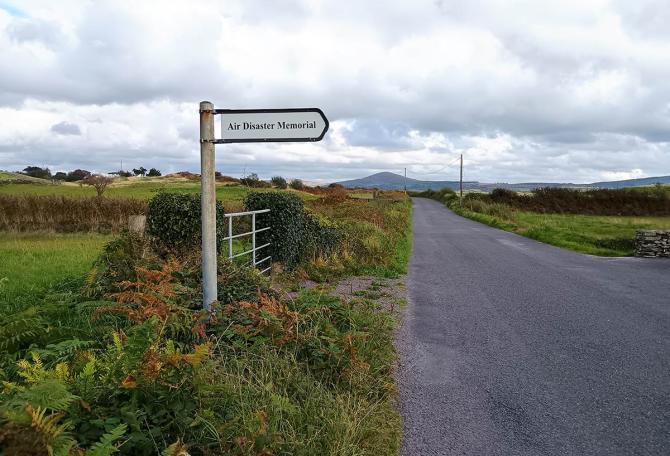
Sure enough, there's a car park and a forlorn sign: Air Disaster Memorial.
Beyond the parking lot (just a three-slot bit of parking tarmac) is a long, beautiful manicured garden in full glorious bloom, even in chilly September.
At the approach to the garden is a small plaque:
Memorial
To all those who died in the Air Disaster 1985. Erected by the people of Canada India & Ireland.
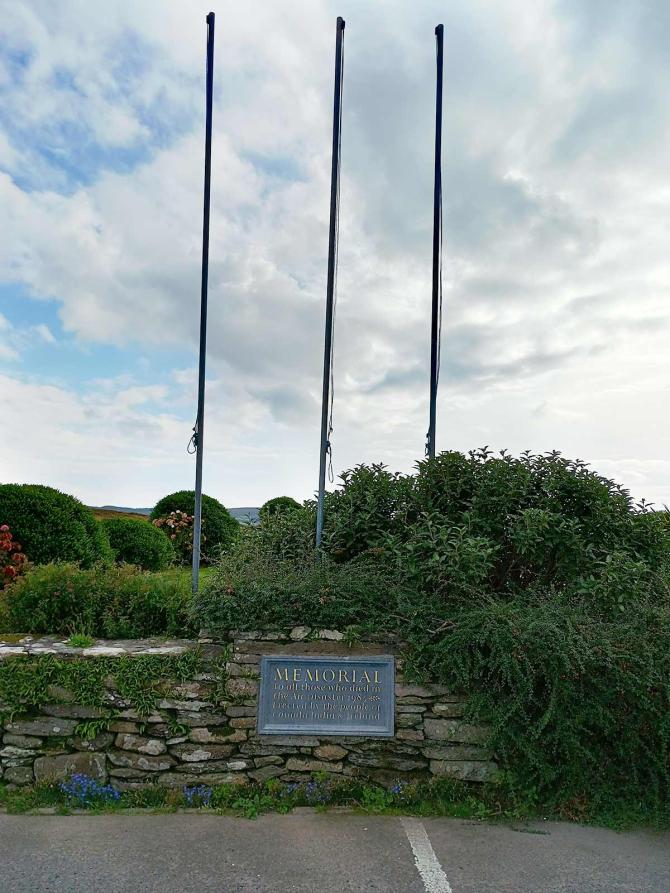
There are three flagpoles, probably for the flags of each country.
Ahead is a sun dial kind of sculpture and then we come to the wall of names.
Names and names and names and names...
329 in all.
Some Indian. Some Canadian. Some British.
Berry. Gupta. Jain. James. Bhatt. Beauchesne. Chatlani. Enayati. Lougheed...
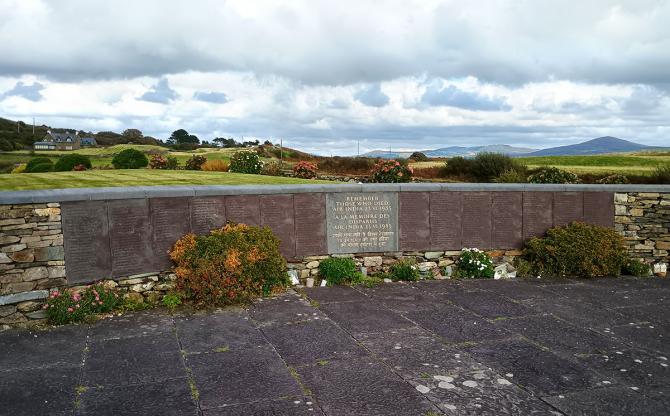
Now you are looking at history. Facing it.
And a mixed bunch of feelings sweep in.
Pensive. Sad. Peace. Littleness.
Deep empathy.
This is the memorial at Ahakista, for the Air India plane Emperor Kanishka that went down off the coast of Ireland on a summer morning, right near here, killing 329 people on June 23, 1985, 40 years ago.
The terrorist bombing of AI Flight 182 remains the worst terrorist attack in India's history, Canada's history, Ireland's history.
It was also the deadliest episode of aviation terrorism globally until September 11, 2001.
As Daniel Rogers of the Canadian Security Intelligence Service recently said in his annual speech, 'It was truly a terrible moment in Canadian history and serves as an important reminder of the consequences of violent extremism.
'The threat of violence motivated by extreme religious, ideological or political views has changed significantly over the last 40 years, but it persists as one of Canada's most significant national security concerns.'
The Air India Boeing 747 had taken off from Toronto Pearson international airport on June 22, stopping at Montreal and was enroute to London Heathrow, from where it would travel on to the then-called Palam international airport, Delhi and Sahar international airport, Bombay.
On the morning of June 23, at 8:14:01 am, Irish time, flying at 31,000 feet, the Boeing 747 was nearing the picturesque southern coast of Ireland, 180 km from Ahakista.
It had exchanged messages with nearby Shannon airport, five minutes before. From its position, close to Ahakista, it would have continued eastwards, crossed the Irish Sea, near St George's Channel, and headed to London.
Instead, it vanished off radar screens at Shannon, without a Mayday call, as the bomb that was kept inside an electronic Sanyo FMT 611 K stereo tuner, in a suitcase in the forward hold, went off and broke up the plane into hundreds of pieces midair, leaving no survivors.
Your mind starts to do a contemplative rewind, now that you are here in Ahakista.
What a shock it must have been that wet day in June for this sleepy little Irish village in West Cork. They probably heard nothing because the explosion was too far away, 9.4 km upwards and about 180 km westwards.
But the emergency rescue crews might have come tearing in from Cork and probably Dublin too (given Cork must have been a tiny town then) and then barrelling down this country road.
All sorts of craft probably were bobbing in the choppy waters nearby, as rescue operations for the bodies of the dead began. The Irish Naval Service, Royal Air Force and even merchant vessels got into the act, sending out dinghies to rescue corpses, before they sank, and retrieving the airplane parts that had rained down too.
Grimly they realised they were not searching for survivors. And 80 of the bodies were children.
The air above may have been thick with the heavy noise of helicopters as Britain's Royal Navy choppers and a US helicopter joined the search, 10 in all.
Maybe a few ambulances and hearses had headed the other way from Ahakista to the Cork Regional Hospital, carrying the remains of the victims. 131 bodies were recovered and most of them were brought ashore at Cork by helicopters and ships.
And then the relatives came. Hundreds of them.
From Canada. From India. From England. From America.
Government officials, airline personnel and investigators too.
Tearful relatives. Devastated folks.
Stunned. Disbelieving. Horrified. Shattered. With torn hearts.
Looking for their departed.
According to an account by Bob Rae, former permanent representative of Canada to the United Nations, who acted as an independent advisor to the Canadian government, investigating outstanding issues related to the crash, the grieving families tossed wreaths into the ocean at Ahakista -- the nearest spot on land to the watery crash site.
Ahakista gained a special spot on the world map in those dark days and became the place where relatives congregated in 1985 and sought succour, waiting, and hoping against hope, that the bodies of their lost relatives would be found.
The hamlet of Ahakista, the district of West Cork in County Cork and Ireland all stepped up June 23, and in the days that followed, showcasing the best of that special Irish warmth. The victims' family members, while upset at the apathy of the officialdom of Canada, all remember the complete kindness of the Irish and how well they were taken care of.
Later they asked Ahakista to erect a memorial for their lost ones.
The Cork County Council got to work building a unique and powerful place of pilgrimage that was completed in 1986.
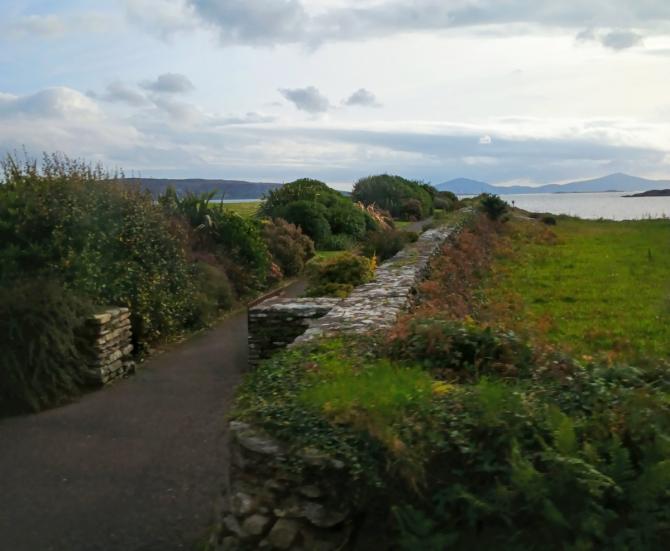
The memorial's beauty exceeded the expectations of the relatives.
'It is the most beautiful and serene of places,' Babu Turlapati told the BBC in 2015. 'The wonderful landscape by the sea and the kind and generous people have been a very big strength for us every year.'
His wife Padma, in the interview to the BBC, added: 'When I stand beside these waters I talk to Deepak, whose body lies in the oceans forever. Deepak runs up to me in the waves and he talks in the wind and the rain. He was a naughty and funny 11-year-old and I can feel his presence. This is why we come back each year.
'I come with all the worries and the pettiness of life and it calms me here. The water has my son in it. It has all the Earth's joys and tears and it replenishes me.'
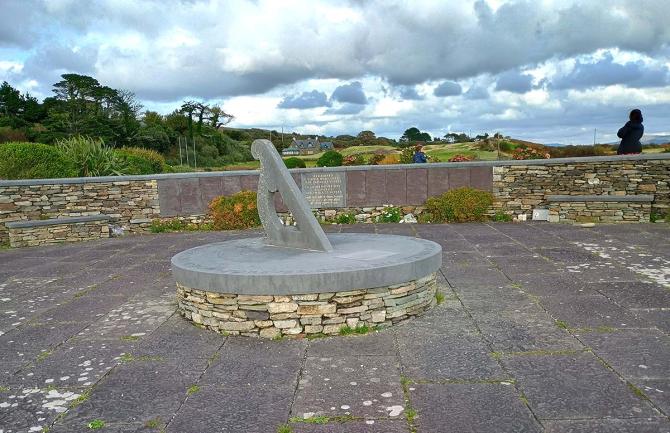
Today the three of us -- my grandson will one day realise that he was gamboling about, at age 2, at a momentous location -- are standing at this memorial, that's a kind of eternal home.
It's a place of utter calm.
The relatives of Flight 182's victims could not have wanted a more tranquil place to remember their deceased by.
The flowers are gorgeous. The sea a deep blue. The vistas dreamy.
The emptiness is soothing and spiritual in a way only Nature can accomplish.
On the 40th anniversary, three months earlier, a commemorative ceremony had been held (there is one every year) and Union Minister Hardeep Singh Puri, leading an Indian delegation, Irish Prime Minister Micheál Martin, Canadian Minister of Public Safety Gary Anandasangaree attended, along with the victims' families.
There are signs of recent visits at the memorial. Either lingering since June or newer.
Candles. Stacks of rocks. Shells. A chit of paper with a loving message. A sign. A photo in a plastic frame.
We read the messages.
And look at the names.
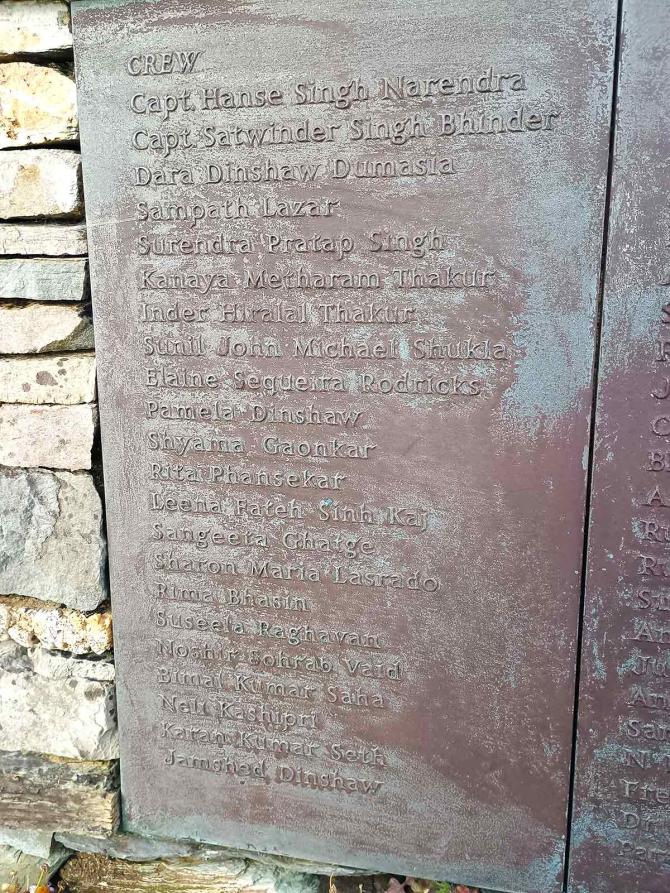
Of the cockpit crew: Captain Hanse Singh Narendra, Captain Satwinder Singh Bhinder, Flight Engineer Dara Dinshaw Dumasia.
And of the 19 cabin crew: Sampath Lazar, Surendra Pratap Singh, Sunil John Michael Shukla, Pamela Dinshaw, Jamshed Dinshaw, Kanaya Metharam Thakur, Leena Fateh Sinh Kaj, Sharon Maria Lasrado, Elaine Sequeira Rodricks...
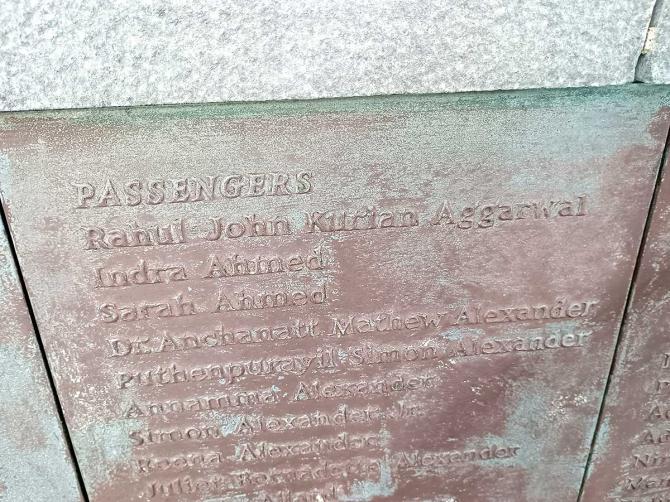
The passengers...
Rahul John Kurian Aggarwal...
Indra Ahmed, Sarah Ahmed...
Dr Anchanatt Mathew Alexander, Puthenpurayil Simon Alexander, Annamma Alexander, Simon Alexander, reena Alexander, Julian Jonathan Alexander... a whole family wiped out or many with the surname Alexander...
Dr Yelevarthy Nayudamma...
Sanjay Turlapati, Deepak Turlapati...
There are, on the Internet, courtesy CityNews Toronto and other sites, tiny vignettes about some of these people's lives, before they were cut down so swiftly and suddenly.
Rahul, 23, with the interesting middle names, was a student of politics at the University of Manitoba, belonging to a family who had settled there. He was making a trip to India after many years.
Serious, studious-looking Dr Alexander, a surgeon, had been the chief of staff at West Haldimand Hospital in Hagersville, a small town on Highway 6 in Ontario.
An advisor to the Government of India and a well-known scientist, Dr Yelevarthy Nayudamma was returning to India after attending a conference. His wife could not handle his death and committed suicide.
The bright, brilliant Turlapati boys, 11 and 14, both excellent students at their new Canadian schools, had migrated to Canada just three years before with their parents, Babu, a chartered accountant, and Dr Padmini, a pediatrician. They were on a trip back to India, bravely by themselves, to see their grandparents.
All the names are engraved in Serif in metal on the stone wall of the memorial, honorary Irish citizens in death, their spirits finding a resting place amidst this greenery, their lives remembered only here and probably in garlanded portraits in homes.
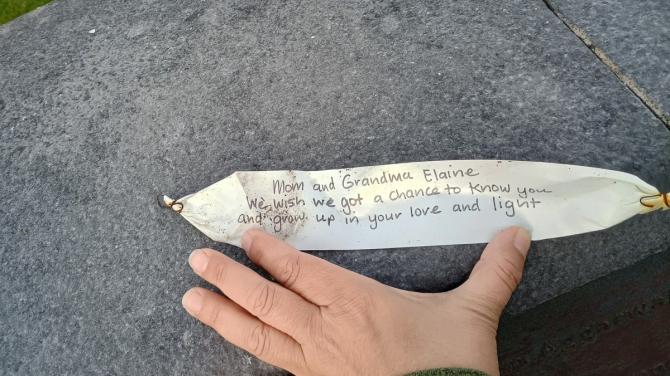
There's a note to Elaine. The rain has crumpled it and rolled it up.
It reads:
Mom and Grandma Elaine
We wish we got a chance to know you and grow up in your love and light
It's probably addressed to Elaine Rodricks, died at 32, of Bombay, and is from her daughter and grand-daughter. Elaine had worked with Air India for eight years till her death in 1985 and left behind a daughter of just 17 months, Kriselle, and husband Christopher.
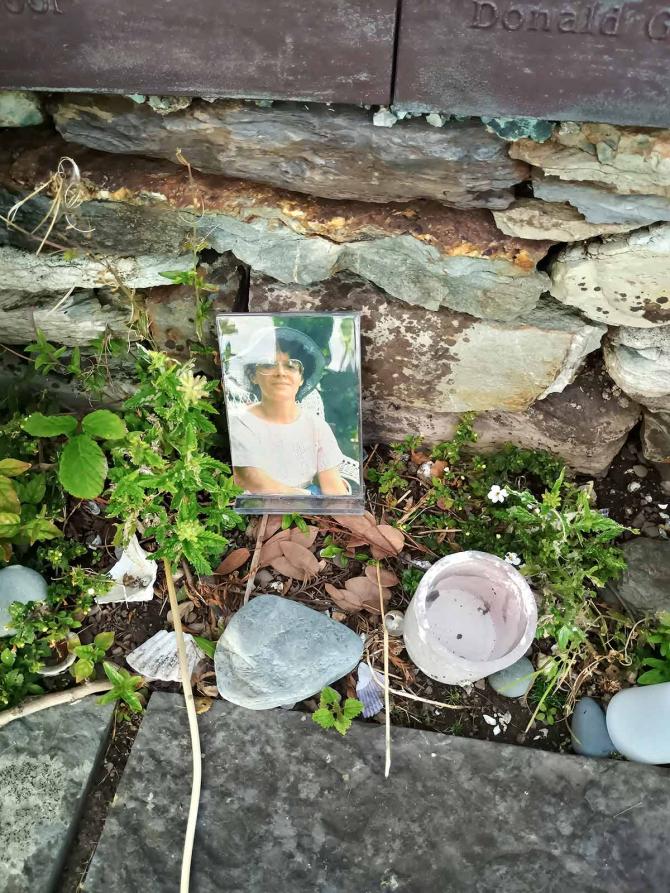
A photo frame nearby has pic of a young woman in a sun hat and over-sized glasses.
And there is a little plastic plaque that someone left: In Loving Memory Wife, A Daily Thought, A Silent Tear...
Each name, each remembrance, also reminds one of how ephemeral our time on earth is... Here today, gone tomorrow. As a Mumbai cabbie once cheerfully and wisely told me: "Char din ka zindagi hai. Let's live it happily."
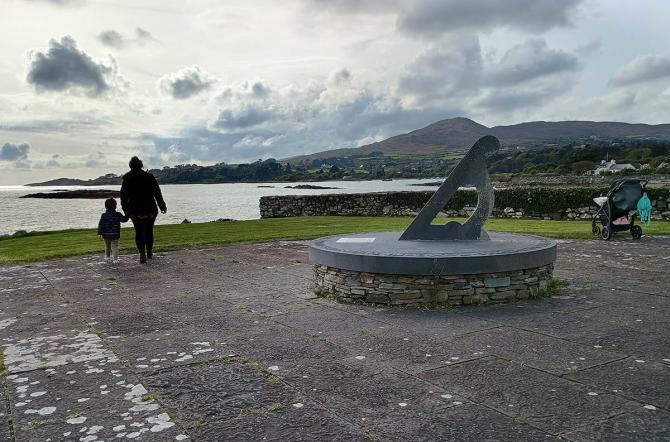
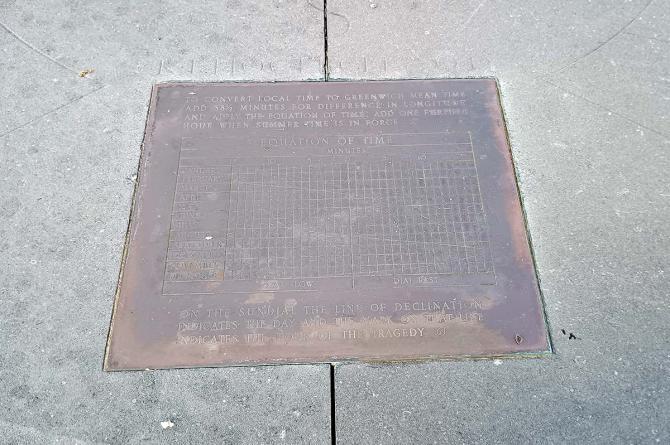
The sun dial has a special significance. Designed by Cork sculptor Ken Thompson, it is the focal point of the memorial. Every day the sun hits this dial at 8 am, the time approximately at which the Kanishka went down.
At its base it reads: Time Flies. Suns Rise And Shadows Fall. Let It Pass By. Love Reigns Forever Over All.
A lovely epitaph for the 329 who unexpectedly died one drizzly, misty summer day at 51°3.6′N 12°49′W, above the Atlantic Ocean, close to their last home, Ahakista.






 © 2025