

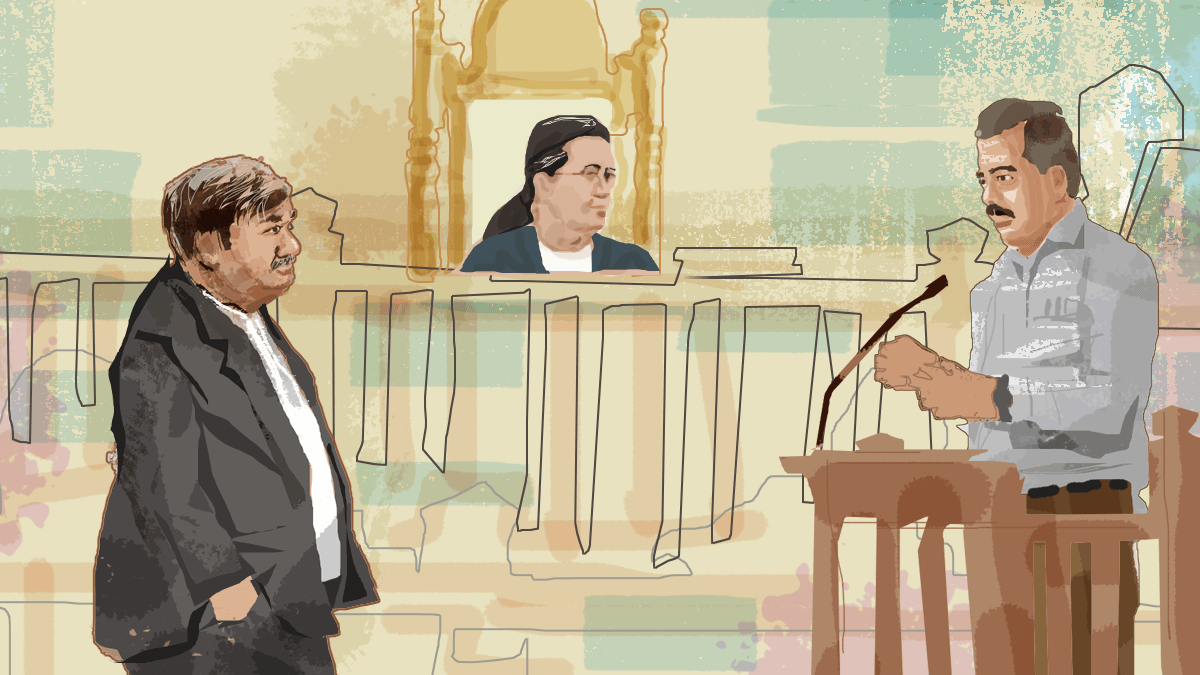
Indrani Mukerjea, in pure white, sporting dancing pearl jhumkas, bobbed about the accused box, occasionally floating up front to whisper urgent suggestions to her lawyer Ranjeet Sangle as retired cop and prosecution witness Dinesh Kadam gave her a long look.
Vaihayasi Pande Daniel returns to cover the Sheena Bora murder trial after 18 months.
Key Points
- Retired police officer Dinesh Parshuram Kadam takes the stand as Prosecution Witness 146.
- The Sheena Bora murder trial has a new judge: Dr Jyoti P Darekar.
- Witnesses and suspects Rakesh Maria had interrogated himself: Indrani Mukerjea, Sanjeev Khanna, Shyamvar Rai, Peter Mukerjea, Rahul Mukerjea, Mekhail Bora, Kajal Sharma, Pradeep Waghmare...
Dinesh Kadam was always called in to handle "gambhir" matters
Probably for the first time, since the Sheena Bora murder trial began, nine years ago, in February 2017, a real cop entered Courtroom No 51, Mumbai city civil and sessions court, Kala Ghoda, south Mumbai.
His name was Dinesh Parshuram Kadam.
Now retired -- enjoying peaceful, adrenaline-free days in Badlapur, southeast of Mumbai, with the family he did not have that much time for when he was with the police, while working on a number of key cases -- Kadam was a senior police inspector with the Mumbai police for many years and in February 2024 retired as additional superintendent of police for the state CID unit in Pune, after 39½ years of meritorious service.
There couldn't be a more representative member of the city's legendary force than Kadam.
He put in sterling investigative work in the Mumbai 1993 serial blast case -- while on his bike late night of March 12, 1993, when he was posted at central Mumbai's Dadar police station, he spotted an abandoned white Maruti Omni van, stacked with arms, in Worli, south central Mumbai, which was traced to the Memon family and eventually led to the unravelling of 'Tiger' Memon's role in the serial blasts.
Details of this case, and several other high-profile investigations Kadam had been the lynch pin for, came up in court on Monday, February 2, 2026, where the officer appeared as Prosecution Witness 146.
Accused No 1 Indrani Mukerjea's lawyer Ranjeet Vishnupant Sangle, on the second day of his cross-examination, walked the court through the main highlights of Kadam's career and the cases to which Kadam had lent his expertise, to help crack them.
The 2006 Aurangabad arms haul case, the 2010 Pune German Bakery bomb blast, Indian Mujahideen's role in the 2012 Jangli Maharaj Road Pune blasts and other crimes, the murder of Congress leader Pawanraje Nimbalkar, the Pune murder of activist Dr Narendra Dabholkar, the 2007 murder of Shiv Sena corporator Kamlakar Jamsandekar that saw Arun Gawli convicted, as well as the investigation into the 26/11 terrorist attack on Mumbai.
Sangle began the cross briefly on Friday, with just a solitary but intriguing question, after the lengthy, many-day testimony of Kadam's came to an end, under the solid supervision of CBI Special Public Prosecutor C J Nandode.
The lawyer's question: "Is it correct to say that after the 1993 bomb blast, during the investigation, when you did not have any money, you sold your watch and similarly (fellow police colleague) Bhosle Patil sold his gold chain to arrange for money to pay for lodgings in Kolkata? And you (later) received an award for (your work) in the investigation?"
Apparently a little taken aback and impressed/touched, Kadam confirmed that the incident was true (and getting the award).
That question set the tone for the cross.
It conveyed to Kadam that Sangle had done his homework well, and also indicated he understood Kadam's mettle.
'Maria's Shadow'
Quite early on, on Monday, it came across that it was going to be a cross of equals, where the opponents were well-matched -- the wily lawyer versus the astute, secretive ex-sleuth. Energetic Sangle, relaxed but pumped up, seemed to be relishing the unfolding of the cross-ex.
Also, at the beginning, it was apparent that the unseen, invisible spectator of these proceedings would be former Mumbai police commissioner Rakesh Maria.
His trim, tall form certainly was seated nowhere in the room. But his shadowy presence was undeniable as Sangle inched closer and closer, circling, closing in adeptly, probing Kadam about his connections with Maria, who had been the prime mover back in mid-2015 of the investigation into the murder of Sheena Bora, the 25-year-old Metro One executive and Indrani Mukerjea's first born.
Called 'Maria's Shadow', discreet, trusted Kadam had allegedly worked closely with the dynamic police officer on several cases.

I was returning to the courtroom after a gap of a year-and-a-half.
In the interim a range of apparently middling witnesses, from PW No 91 to 145, had passed through the witness box. So uninteresting were many of them, that there had been little media coverage of the trial, in between, and most people had lost track of the case.
When I told people I was going to court to cover the trial, many asked, bewildered, "The trial is still on?"
Or "Why is She back in court?" with the She dramatically referring to Indrani Mukerjea, accused of killing Sheena in 2012 but arrested in 2015.
After a six-year stint in jail, Indrani was granted bail in 2022, as were her co-accused second husband Peter Mukerjea, first husband Sanjeev Khanna and driver Shyamvar Rai.
The trial still has roughly a year to go, given there are 237 witnesses in all (many perhaps will not be called) and may wind up in 2026.
Meanwhile at the court, and inside Courtroom 51, some things have changed and some things will always remain the same.
The scene that awaited me as I entered the court building was exactly like it has been ever since I began covering this case in 2017.
Prisoners trudging in or desultorily trudging back to the jail trucks in the courtyard of the court, as relatives, dressed in their dazzling Sunday best, joyfully greeted them or tearfully waved good-bye, many in burkhas, with a gaggle of their children hanging about, eagerly waiting for the first or last glimpse of Papa, as they played cute little games with each other.
Khaki-clad cops, rattling handcuffs, milled about, herding the undertrials back to jail, yelling instructions that ran to: "Eh jaldi jao. Apne ko Akshay Kumar samajh ke rakha hai?!"
Courtroom 51, on the third floor, is a tiny bit more spruced up. The old, drab almirahs have been put out to pasture. Their contents, and the dusty bundles of files, wrapped in cloth, perched on top, have been accommodated into sleek new grey models.
The only forlorn item, still in its usual place on a cupboard in the corner, is the wretched, rather tiny suitcase, an exhibit of this trial -- its exact twin was allegedly utilised to transport Sheena's body to Gagode Khurd, where the corpse was allegedly burned.
The chief agent driving change in Courtroom 51 is the little, almost unnoticeable 24 in x 12 in television screen, up on the wall behind the witness box, on the right as you enter.
Once the toughest part of court coverage was craning your ear to hear what the judge was going to put down on record for a case.
Now it can all be clearly seen on this nifty, new-fangled screen. It connects to the court stenographer's computer and as he types, re-types or crosses out stuff, as the judge dictates, every word can be read and absorbed, making life so much easier for a reporter.
Now the ideal spot to report on this trial is one that gives a close view of The Screen, the witnesses, the lawyers and the accused.
No 51 also has a new judge: Petite, bespectacled Dr Jyoti P Darekar. Soft-spoken, she smiles a lot. When she entered Monday, she did a deep namaste to the courtroom.
After Kadam -- dressed in a grey striped shirt with two pens in its pocket and his glasses, black-belted beige-khaki pants, black shoes, black watch -- got up to take his oath, Sangle began to pepper him with questions about his stints or tenures at various police stations.
Kadam has a calm, quiet mien about him. Not a man of many words. Or booming voice. Very low key.
You would not pick him out immediately for the shrewd policeman he was, and he looks more like "an insurance agent" as my colleague remarked. Kadam, said to be a fine investigator, was so circumspect and reticent while working on his cases, I was told Monday that metaphorically his left hand didn't know what the right hand was doing. He joined the force as a constable but later trained to be an officer.
Sangle, via his line of questioning, traced the logical manner in which Kadam had been officially posted to Yellow Gate, Dadar, Worli, Naigaon, D N Nagar, Tardeo, Byculla, Hinganghat (Wardha) police stations, with in between stints at the anti-extortion cell, crime branch, anti-terrorism squad. And then pointed out how he suddenly, inexplicably landed up at the Khar police station (2015 to 2018), northwest Mumbai, at a time when it necessarily and too conveniently coincided with the investigation into the murder of Sheena Bora that began at that police station.
'CP Sahaban directly supervised the investigation?'
Kadam kept reiterating that police inspectors were often sent on deputation or loaned to other police stations to help and confirmed he didn't have a copy of the official transfer order between Tardeo and Khar on hand or in his possession.
Sangle, speaking Marathi through most of the cross, then suggested, in a complimentary manner, that Kadam was always the person called in to handle "gambhir (serious)" matters relating to terrorism, bomb blasts, "aatankvadis."
When reminded of his role in a slew of important cases, Kadam modestly said he only "assisted" or was "part of a team" and was not "entrusted". And kept reiterating that he was not involved with this investigation or that investigation but only "part of the interrogation".
Sangle sharply asked why he was always the person doing the interrogation.
Kadam smiling: "Because I could do theek thak interrogation."
Laughter, especially loud peals from Sangle.
Sangle: "Rakesh Maria several times, repeatedly chose you as part of the investigative team into sensitive, serious criminal cases. Is that correct?"
While answering, the former police officer waffled a bit, several emotions crossing his face, and finally said that Rakesh Maria was not his "boss" as such, but "I had an opportunity to work on the team of Rakesh Maria."
Sangle also took pains to lay out an interesting path of queries relating to how criminals caught for petty crimes, like wrongful possession of arms -- as happened with "Shyamvar Pinturam Rai (he stressed the full name loudly) in the present case when in police custody" -- ultimately revealed the bigger crimes they were involved in.
"An accused is picked up in a petty or minor offence, like violation of the Arms Act and a larger offence is disclosed?"
Kadam didn't agree. He said during his entire service he had dealt with about the 300 firearms recoveries, and while interrogating the accused, in only 4-5 of the cases were other more serious crimes unearthed.
Sangle established and verified exactly who had been part of the team at the Khar police station that was put together in 2015, or maybe earlier, to investigate the Sheena Bora murder and where these officers had been deputed from.
Sangle, hands in his pockets, rotated towards Kadam: "All of these officers had been hand-picked?"
The quiet-spoken Kadam exclaimed, objecting: "Hand-picked?!" and insisted that police inspectors working in crime were often handed about to help in investigations.
There were further differences in opinion on describing the role Maria had played while the team went about the investigation.
Sangle, with a smile: "CP Sahaban directly supervised the investigation?"
Trying again, Sangle: "Rakesh Maria personally supervised?"
Kadam would not agree and a debate ensued.
Sangle checked who were the witnesses and suspects Maria had interrogated himself. The list, it turned out, consisted of: Indrani Mukerjea, Sanjeev Khanna, Shyamvar Rai, Peter Mukerjea, Rahul Mukerjea, Mekhail Bora, Kajal Sharma, Pradeep Waghmare and probably others whose names were not taken.
Kadam still disputed if that could be called supervision, playing down Maria's role, even though Sangle patiently, without heat, smiling all the time, broke it down, asking if Maria has sought updates on the progress from the Khar investigating team, as well as asked for feedback and checked if proper procedure had been followed.
Kadam agreed he had. But stressed: "I never briefed the CP personally."
At least 10 minutes of the cross was devoted to Sohail and Sameer Buddha, the two brothers, whose strange, not fully fathomable connections with the Sheena Bora murder case keep popping up at intervals through the years, and whose driver was once Shyamvar Rai.
Sohail worked for a time as VP Securities at Star TV Pvt Ltd while Peter Mukerjea was the boss (Kadam said he did not know that) and had then gone onto start his own security agency.
Sohail Buddha, who had been Kadam's batchmate at the police academy in Nashik, had also worked with him at the anti-extortion Cell for two years from 1999 to 2001 and together they had arrested the accused in a counterfeit case.
Kadam adamantly kept refuting any deeper social connection with either brother and also said he did not attend Sameer Buddha's wedding.
The accused have been popping in and out of Courtroom 51 as Prosecution Witness 146 Kadam gets examined.
Peter Mukerjea was not present.
Sanjeev Khanna, looking well and slightly less lean, flew in from Kolkata on Monday and took the Metro to arrive slightly late at the proceedings.
Indrani, in pure white, sporting dancing pearl jhumkas, bobbed about the accused box, occasionally floating up front to whisper urgent suggestions to Sangle as Kadam gave her a long look.
A tidy, prosperous-looking Rai, in jeans, white shirt and a paunch, made an appearance last week and is working as a driver once again. He still has a face and expression as sleek and self-satisfied as a Cheshire cat.
Every day things change, but yet stay the same.









 © 2026