
The BJP had no option but to get Jagdeep Dhankhar out of its way for the sake of the stability of the Modi government, reveals Sheela Bhatt, the legendary political journalist.
In the Indian style of democracy, in the highly important world of the legislature, the control of Parliament runs the government, and it can break the government if the government is not on vigil.
Lately, as Chairman of the Rajya Sabha, Vice President Jagdeep Dhankhar had started asserting himself vis-a-vis the government.
For the last few months, instead of building consensus and working in harmony with the ruling party, the lawyer in him believed he could assert his power merely by quoting a law book.
For the last few months the ruling side was uncomfortable with him and he quite openly expressed his discomfort too.
When he met leaders of the Congress and leaders of regional parties including the Aam Aadmi Party he would share his displeasure about the government quite openly.
He discussed the "status of democracy in India today" and such subjects with Prime Minister Narendra Modi's harshest critics.
In no time these stories reached the ruling party.
In a nutshell, it was all about power. The power to control the Rajya Sabha.
As Rajya Sabha Chairman, Dhankhar wanted full control, and he increasingly showed a rebellious streak in him.
While going against the tradition of such a Constitutional position he wore a political hat quite often.
It was a blatant act to indulge in pure politics when he joined the political discourse of the farmers agitation.
At a public event he challenged the government's lack of action in handling the farmers' issue. It shocked the audience including Agriculture Minister Shivraj Singh Chauhan who was present at the event.
His views on 'how Parliament is supreme and not the judiciary' were ill-timed for the government. It disturbed the government's plans of handling the judiciary in its own way.
The ruling party observed that pressure from the Opposition 'to express no-confidence' in the VP in December 2024 had worked well for the Congress.
Then, the Congress had alleged that Dhankhar was the 'government's mouthpiece'.
The proposed no-confidence move was scuttled by Deputy Chairman Harivansh Singh.
But since then Dhankhar changed his attitude and started tilting the balance.
It created a trust deficit within BJP MPs. There are many events that broke the bridge between him and top BJP leaders.
A communication gap was created. The handling of the case of Justice Shekhar Yadav of the Allahabad high court, the handling of the breach of privilege matter against AAP MP Raghav Chaddha and on many other cases he was not on the same page with the government.
At every little step he could mock or provoke the government because the hidden powers of the Chairman of the House are immense.
He allowed the debate on Operation Sindoor under the clause which would open the sensitive debate quite wide. Normally on matters of defence, Parliament protects the interests of the Indian armed forces and does not allow freewheeling debate.
No government which enjoys a majority can remain passive if the Lok Sabha or House of Elders makes it vulnerable. The insecurity of the government turned 24/7.
Dhankhar too felt the heat. He told one NDA member of the Rajya Sabha, "I am continuing as VP only because of one senior minister."
That revealed he was feeling isolated and knew the government's thinking. Some three weeks ago he called a few persons who are perceived to be close to the government. He regretted the deteriorating relationship between his office and the government. Many anecdotes are coming to light after his resignation that suggests that the pressure has been building up for long.
The tension between the VP's office and the BJP was not reported or discussed much in the open before his resignation by people in the know of things because they thought that these were not unsurmountable problems that could not be resolved.
But none knew that the VP was on a different trip.
Most NDA MPs were under the impression that the differences were not ideological and eventually Dhankhar and the government would come to terms.
Before Dhankhar became VP he was a successful lawyer. He was known in the BJP as a "lawyer of the RSS". It's the RSS who has been credited for his ascension as VP.
Close to the RSS, Dhankhar did not know Modi or Amit Shah well before he became West Bengal governor. Later he got acquainted well with both.
What triggered the resignation?
Dhankhar allowed the notice of motion of Opposition MPs for removal of Allahabad high court Justice Yashwant Verma on Monday. It was a shock for the ruling party.
By allowing the motion signed by 63 Opposition MPs, the government missed the chance to present a similar move in the Lok Sabha. It was planning to form a committee of Lok Sabha members to deliberate on the issue.
Dhankhar knew the government had already initiated the notice in the Lok Sabha. He outmanoeuvred the government.
Being a lawyer himself and having interest in the judiciary he wanted to control the entire proceedings of impeachment against Justice Verma. It would be a historic parliamentary process, and he wanted his stamp on it.
The Constitutional importance of proceeding against the sitting judge cannot be overemphasised. Dhankhar thought he could control and drive the event that would impact the Parliament-judiciary balance. The inquiry could go in any uncertain direction too.
The BJP doesn't have a majority of its own in the Lok Sabha but it would not like to be perceived as heading a weak government.
For the last year Prime Minister Modi has done everything possible to convey the idea of stability at the Centre and has provided strength to his third term in office. He has been successful in creating the perception of a stable government.
But Dhankhar was probably subtly weaving another thread to control legislature business in the Rajya Sabha. His allotment of time and opportunities to non-BJP leaders also became questionable.
Its likely that his talk with Defence Minister Rajnath Singh on Monday gave him the idea that he had lost the government's complete trust after outwitting the government's plan to handle the Justice Verma impeachment issue.
There were serious talk of BJP MPs agreeing to sign a petition against Dhankhar.
Dhankhar's resignation doesn't augur well for the BJP.
After selecting him for the important Vice President's post if the government could not harmonise its working, it speaks volumes against the government.
In the given situation it's clear that the BJP has cut its losses. They didn't want shock or surprise from the House of Elders.
It appears Dhankhar won't turn into a Satpal Malik. He is ideologically inclined towards the RSS.
He will damage the government's reputation but won't go the Malik way.
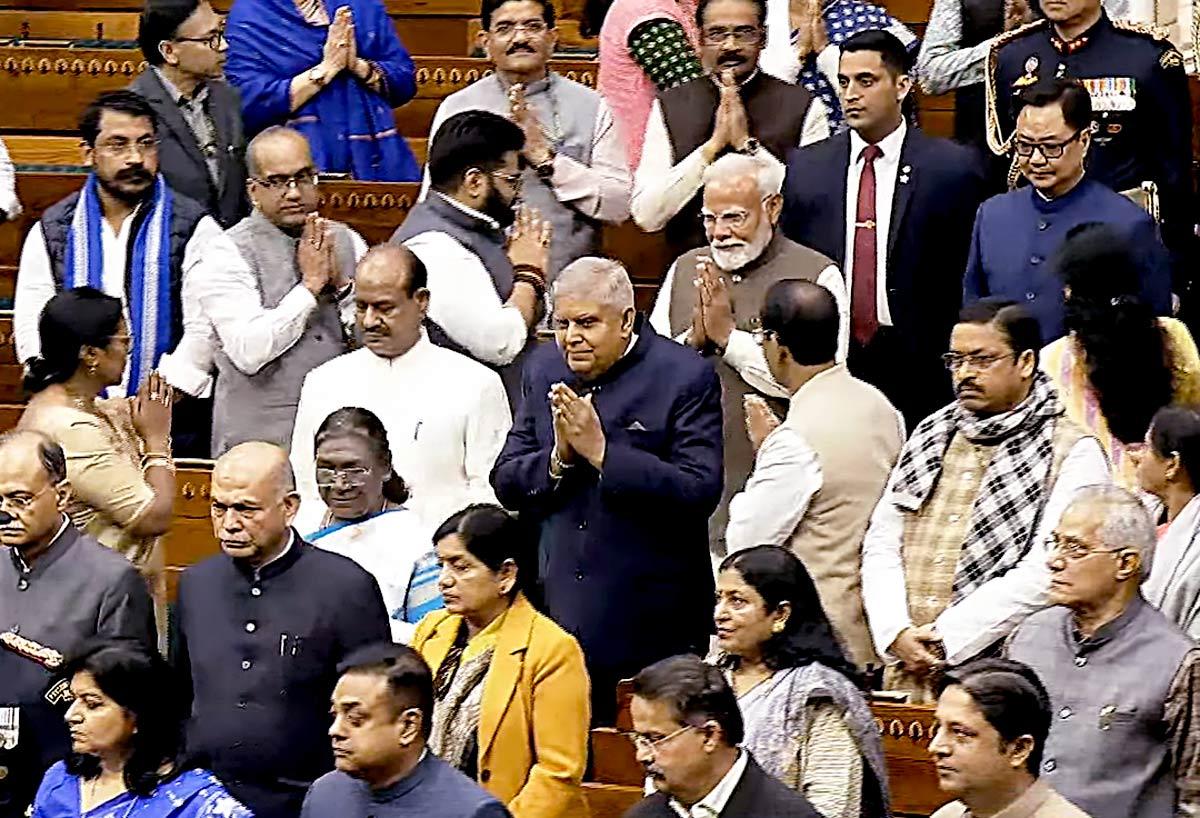
In the India of 2025, nobody, repeat nobody, leaves one of the highest seats of power for small issues.
Jagdeep Dhankhar seems to have got confused in the end.
The lawyer in him, his political instincts, and his instincts fueled by the Opposition to control the Rajya Sabha in his own way led to his resignation.
Nobody will shed tears for him or the government.
The BJP made a serious error in judging Dhankhar when it appointed him, and once in the Rajya Sabha Chairman's seat Dhankhar failed to understand how Narendra Modi handles power.
The BJP had no option but to get Dhankhar out of its way for the sake of the stability of the Modi government.
Photographs curated by Manisha Kotian/Rediff
Feature Presentation: Aslam Hunani/Rediff




 © 2025