

Iran is fighting a different war: Older, slower, and in some ways more dangerous.
Iran doesn't need to shoot down an F/A-18. It only needs to make the Strait of Hormuz feel dangerous long enough for insurance markets, shipping companies, and oil futures traders to do the rest.
Prem Panicker continues his must-read daily blog on the war in the Middle East.

US Relies on Precision Airpower
Seventeen days in, it is becoming clear that the United States and Iran are not fighting the same war.
Washington is fighting the war it knows how to fight: Precision airpower, target sets, degradation of military infrastructure.
By its own metrics, it is winning that war comprehensively.
Seventy percent of Iran's missile launchers destroyed; Iran's supreme leader killed; airspace effectively owned; US Secretary of War Pete Hegseth crowing about 'death and destruction from the sky all day long'.
Key Points
- The US is focusing on precision airstrikes and military targets, claiming significant degradation of Iran's defence capabilities.
- Iran is pursuing economic warfare by disrupting shipping routes and creating risk in the Strait of Hormuz.
- Oil exports from the Middle East have dropped sharply, pushing prices above $90 per barrel amid ongoing conflict.
- European allies have refused to support US naval operations in the Strait, highlighting geopolitical divisions during the war.
- India faces significant energy risks as it depends heavily on Gulf oil and navigates complex diplomatic and trade pressures.

Iran Shifts to Economic Warfare
Iran is fighting a different war: Older, slower, and in some ways more dangerous.
Not a war of armies and airfields, but a war of markets and chokepoints.
Robert Pape, the University of Chicago political scientist who has spent decades studying coercive strategy, laid out the logic with clarity in this post (external link).

Strait of Hormuz Disruption Strategy
Economic warfare, Pape argues, unfolds in three stages: disruption, economic shock, political pressure.
Iran doesn't need to shoot down an F/A-18. It only needs to make the Strait of Hormuz feel dangerous long enough for insurance markets, shipping companies, and oil futures traders to do the rest.

Oil Prices Surge Amid Conflict
The numbers tell that story. Daily oil exports from the Middle East have fallen by at least 60 percent.
Oil is hovering over $90 a barrel -- a 40 percent rise since the war began.
Iran hasn't closed the Strait of Hormuz with mines or blockades.
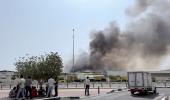
It has simply made the passage feel unsafe through little acts (little, in comparison with the US-Israel blitz): A drone near a tanker off Fujairah, a strike on an oil pipeline at the Fujairah oil industrial zone, a fire at a storage tank near Dubai international airport.
Each incident ripples through shipping schedules and insurance contracts long before it shows up on a military balance sheet.
The 1973 oil shock, when Arab producers cut output after the Arab-Israeli war and oil prices quadrupled, is the relevant precedent Pape cites.
The oil producers paid little or nothing in the way of political price because the world still needed their oil.
Iran is betting on the same arithmetic. [Robert A Pape on Twitter (external link), elaborate analysis on Substack (external link)]

DIMLY, THROUGH THE FOG
The Institute for the Study of War's overnight assessment confirms what the operational picture has been suggesting for days: Iran is not broken, and whoever comes next may be harder, not softer.
The new Supreme Leader, Mojtaba Khamenei, wounded in the strikes that killed his father, has assembled an inner circle dominated by IRGC hardliners who have spent careers suppressing dissent and projecting force beyond Iran's borders.
The composition of the advisers' group tells a story:
Hossein Taeb, who engineered the 2005 Ahmadinejad election and ran the IRGC's intelligence apparatus for thirteen years.
Ahmad Vahidi, sanctioned for his role in the 2022 Mahsa Amini crackdown.
Mohammad Ali Jafari, who treated reformists as 'internal enemies'.
Mohammad Bagher Ghalibaf, a veteran IRGC commander who assumed emergency military command when the June 2025 strikes killed Iran's top brass.
Mohsen Rezaei, the subject of an Interpol Red Notice for the 1994 Buenos Aires bombing that killed 85 people, is now Mojtaba's military adviser.
This is not a chastened leadership preparing to negotiate.
The IRGC is telling Iran's president that American airstrikes have united the population behind the regime the way the Iran-Iraq War once did.
President Pezeshkian, who reportedly asked the IRGC about post-war economic recovery plans, was told, in effect, that national emergency is now the plan.

On the battlefield, the combined US-Israeli force continues to hit deep.
A strike 800 kilometres inland, near Birjand in South Khorasan Province, targeted a drone facility.
This is one of the easternmost strikes of the conflict.
The fact that a jet can operate at low altitude over Chabahar on the Gulf of Oman coast tells its own story about how thoroughly Iran's air defences have been suppressed in the south.
Iran fired six missile barrages at Israel in the past 24 hours.
Fragments reached Jerusalem and Beit Shemesh.
Gulf air defence systems continue to intercept most incoming drones and missiles, but not all: A drone struck Dubai airport, another hit the Fujairah Oil Industrial Zone, a third struck the Shah gas field in Abu Dhabi. [Institute for the Study of War (external link)]
Also read Hamidreza Azizi's update #17 (external link) -- Azizi's posts usually focus on Iranian strategy.
But Al Jazeera takes the opposite view.
In an opinion piece, Muhanad Seloom argues (external link) that to say the United States and Israel have blundered into a chaotic, open-ended war is misleading.
Strip away the cable news framing and look instead at what has happened on the ground to Iran's missiles, its nuclear infrastructure, its air defences, its navy, and its proxy networks, and a different picture emerges: a campaign that is phased, deliberate, and strategically coherent.
Drawing on field experience and years studying how states wage and authorise war, Seloom traces the systematic degradation of Iran's capacity to project power, from collapsing missile launch rates to the dismantling of its command architecture.
The costs of the war are real and immediate, but so too were the risks of inaction, as Iran edged closer to nuclear capability and regional dominance.
This is not a defence of war's human toll, nor a denial of the uncertainties ahead.
It is an argument about how we measure success and failure in real time and why, in this case, the metrics most often cited miss the deeper strategic shift now underway.
- The New Fog of War
- Has US Repeated Its Iraq Mistake?
- Hormuz Crisis Threatens Global Economy
- Iran War Exposes Washington's Strategic Chaos
- Iran Plays Hardball With India's Hormuz Requests
- Trump Is Caught Between Two Bad Options
THE RIPPLE
Trump wants European navies in the Strait of Hormuz. He is not getting them.
Britain, Germany, France, Italy, Poland, Canada (which, not so long ago, Trump said would become the 51st state in the Union): each has, in its own register, said no (external link) to joining active operations in the strait while the war continues.
Germany's defence minister put it plainly: 'This is not our war; we did not start it.'
NATO's former British chief of defence staff went further, noting that NATO is a defensive alliance and that it was not designed for one member to go to war and oblige the rest to follow.
Writing in The Atlantic (external link) on this subject, Isaac Stanley-Becker says Trump is at long last learning that his bullying (of his allies) has consequences. (Even non-NATO nations such as Saudi Arabia, Qatar, Russia, China and Pakistan have clearly stated that they will not join the war).
In tangentially related, the Trump administration has been doing its best to throttle the efforts of US media to report the war as it really is with Trump himself recently suggesting that media houses reporting on American losses are guilty of treason and should be imprisoned.
Pope Leo XIV pushes back (external link): "Always, but especially in the dramatic circumstances of war, such as those we are currently experiencing, the media must guard against the risk of becoming propaganda. And the task of journalists, in verifying the news so as not to become a mouthpiece for those in power, becomes even more urgent and delicate--I would say essential.
'It is up to you to show the sufferings that war always brings to the people; to show the face of war and to relate it through the eyes of the victims, so as not to transform it into a videogame. It is not easy in the few minutes of a news programme and its in-depth segments. But this is the challenge.'
Trump, characteristically, responded (external link) to the European nations' refusal to send warships to Hormuz by simultaneously dismissing the need for allies ("We don't need anybody") and demanding their help with the Strait in the same breath.
Further, in a Truth Social post, Trump blames Obama for starting this war, and says that he will shortly assemble his Board of Peace members to find ways to secure the Strait of Hormuz.
The New Yorker's historical sweep this week is worth reading in full: It traces how every American president since Jimmy Carter has found Iran impossible to simply walk around -- and how Trump, stripped of the hegemonic instincts that both drove and constrained his predecessors, has walked into this with an astonishing absence of what comes next. [Daniel Immerwahr, New Yorker (external link)]
Shut up, already
Belonging as I do to a country whose prime minister hasn't held a press conference (as opposed to 'press briefings' where he talks and everybody takes down his words verbatim), I like that the president of the United States holds regular press briefings, takes calls from journalists, has informal interactions with them on board Air Force One, all of that...
But Trump's recent statements to the media, and responses to questions, are so bizarre that I am beginning to wish he would dial down.
For instance, in one such interaction he says (external link) in dealing with Iran, he is dealing with some very smart people: Something his own advisors have long told him, and he ignored.
In another, he says (external link) he went to war with Iran 'out of habit' and adds that 'it is not a very good thing to do'.
But the really scary comment came in another interaction, where he said (external link) Iran wasn't supposed to hit targets in the Middle East.
'Nobody expected that. We were shocked'.
When asked a specific question, Trump said (external link): 'Nobody. No nonono. The greatest experts -- nobody thought they were going to hit...'
He also says (external link) Iran fighting back is 'a little unfair'.
Really? On February 19, in an official letter sent to the UN Security Council, Iran warned (external link) that it would do exactly that.
The relevant passage (emphasis mine):
'However, in the event that it (Iran) is subjected to military aggression, Iran will respond decisively and proportionately in exercise of its inherent right of self-defence under Article 51 of the Charter of the United Nations. In such circumstances, all bases, facilities and assets of the hostile force in the region would constitute legitimate targets in the context of Iran's defensive response.'
Also, on February 24, four days before the outbreak of war, Nate Swanson in a paywalled piece (external link) in Foreign Affairs literally underlined this possibility.
Here is why Swanson's piece is important -- he was Director for Iran at the National Security Council, and until the end of the summer of 2025, he served on Trump's Iran negotiations team.
He was among several NSC staffers dismissed by Trump last year, reportedly on the urging of the far-right activist Laura Loomer.
Nobody (in Washington) expected that Iran would do exactly what it said it would do?

India Faces Oil Supply Risks
India Watch:
For India, the 60 percent drop in Middle East oil exports is not an abstraction. India imports roughly 85 percent of its crude. The Gulf is its primary source.
Iran has, notably, been allowing tankers carrying oil to China and India to transit the Strait as a source of leverage.
Pakistan's oil tankers have similarly been waved through. This selective passage is a message to New Delhi about the costs and benefits of alignment.

In February 2026, India's Coast Guard had seized three US-sanctioned oil tankers: Al Jafzia, Asphalt Star, Stellar Ruby, linked to Iran's 'shadow fleet' for evading oil export bans.
India's action was in line with Trump's sanctions against Iran.
Now we are told that Iran seeks the tankers' release in exchange for guaranteeing safe passage of Indian-flagged vessels through the Strait of Hormuz, a chokepoint for 40% of India's crude imports.
Two Indian LPG carriers were allowed through the Strait on March 13, but it is worth pointing out that Minister for External Affairs S Jaishankar said, a day earlier, that those were not indicative of a blanket waiver, and that every ship permitted to sail the Strait by Iran would involve a separate negotiation.
This highlights India's delicate balance between aligning with US sanctions enforcement and securing energy supplies from Iran, potentially easing regional tensions while advancing bilateral trade amid global shipping disruptions.
In Bloomberg, a paywalled opinion piece by Mihir Sharma (external link) asks why India has friends everywhere, but leverage nowhere.
The bit that is instructive relates to the 22 Indian ships that are still stuck in Gulf waters. An extended quote:
'But 22 others, according to Reuters (external link), still remain in the Gulf's waters. Nor will anything be released on Modi's word alone; New Delhi might have to prove it is willing to defy some US sanctions. One possible ask is that India return three Iranian ships it had seized; or provide medicines and medical equipment to Iran.'
'To earn trust with Tehran, it will have to burn some bridges with Washington. The Trump administration had announced that India will be permitted to buy some Russian oil to replace its lost supplies from the Middle East. Whether this indulgence will persist if New Delhi defies the sanctions regime is uncertain.' (Related, read this analysis (external link) in The Wire].
Another paywalled Bloomberg piece (external link) makes the point that India, which was enjoying discounted rates for Russian oil, has lost that advantage.
On February 27, a day before the war began, the price India was paying for Russian oil was $58.54.
By March 13, that price had rocketed to $98.93. That price escalation will hit various sectors (external link) of India's economy, already under stress.
CNBC has a piece (external link) on consequences, that links the US and India.
The money quote: 'The connection between a Middle Eastern sea chokepoint and a US pharmacy counter is less obvious than it might seem -- and more direct than most consumers realize. The US gets nearly half of its generic prescriptions from India -- roughly 47 percent by volume, according to Rohit Tripathi, vice president of industry strategy for manufacturing at RELEX Solutions, a Helsinki-based pharmaceuticals supply chain planning software company.'
India, in turn, depends on the Strait of Hormuz for around 40 percent of its crude oil imports.
'That oil ultimately feeds into the petrochemical inputs used throughout pharmaceutical manufacturing. So even though American consumers are not buying medicines directly from the Gulf, they are still at the end of a supply chain that runs through it,' Tripathi said.
And in passing, this think-piece (external link) by Nirupama Rao, a former ambassador and foreign secretary, is worth your while.
Rao places the torpedoing of the IRIS Dena at the centre of India's dilemma: A vessel fresh from the Indian Navy's own MILAN exercise, sunk by a US submarine in the Indian Ocean.
Rao's argument is careful and unsentimental: strategic autonomy is not a slogan, it is a practice, and this war is testing whether India is prepared to exercise it with clarity.
- MUST READ! The New Fog of War
- Has US Repeated Its Iraq Mistake?
- Hormuz Crisis Threatens Global Economy
- Iran War Exposes Washington's Strategic Chaos
- Iran Plays Hardball With India's Hormuz Requests
- Trump Is Caught Between Two Bad Options
Photographs curated by Manisha Kotian/Rediff
Feature Presentation: Ashish Narsale/Rediff







 © 2026