
'... Rahul Gandhi's name came to my mind at that time.'

Former Kerala Akhil Bharatiya Vidyarathi Parishad president Printu Mahadev has found himself at the centre of a political storm after remarks made during a Malayalam news channel debate sparked outrage in the Congress party, which asserted he issued a direct death threat against Rahul Gandhi.
The controversy has now escalated into police cases, political uproar, and a wider dispute over hate speech, free expression and the limits of rhetoric in India's polarised democracy.
Congress sounds the alarm
It was K C Venugopal, Congress general secretary and a close associate of Rahul Gandhi, who first went public on X (external link) with the party's response.
In a strongly worded letter to Union Home Minister Amit Shah, Venugopal pointed out that Mahadev -- now a Bharatiya Janata Party spokesperson -- had said on television that Rahul Gandhi would be shot in the chest.
'This is neither a slip of tongue, nor careless hyperbole,' Venugopal wrote to Shah. 'It is a cold, calculated and chilling death threat against the Leader of Opposition and one of India's foremost democratic leaders.'
Venugopal reminded Shah of the Gandhi family's tragic history: Indira Gandhi was assassinated in October 1984 by her bodyguards and Rajiv Gandhi was killed in May 1991 by an LTTE suicide bomber. Against that backdrop, he warned, Mahadev's words carried not only a personal threat but also the weight of India's violent political past.
'As such, any failure by you to act swiftly, decisively and publicly will be judged as complicity -- a de facto license for the legitimisation of violence against the Leader of the Opposition,' Venugopal declared, demanding 'immediate, exemplary legal action through the state police so that justice is swift, visible and severe.'
'Part of a bigger conspiracy'
At a press briefing, Pawan Khera, head of the party's media department, accused the BJP of orchestrating an atmosphere of menace around Rahul Gandhi.
'A BJP spokesperson said on TV that Rahul Gandhi will be shot in the chest, and no action has been taken so far,' Khera said. He recalled earlier episodes when Gandhi's security details were allegedly leaked and argued that this was not an isolated incident but part of a pattern.
'The country is aware who is hatching the conspiracy and what it is,' Khera added, suggesting that those 'losing the ideological battle' were now resorting to threats and intimidation.
For the Congress, the issue was not just one man's words but a reflection of what Venugopal described as a 'deliberately cultivated, toxic atmosphere of hate' that placed Opposition leaders at risk.
Mahadev pushes back
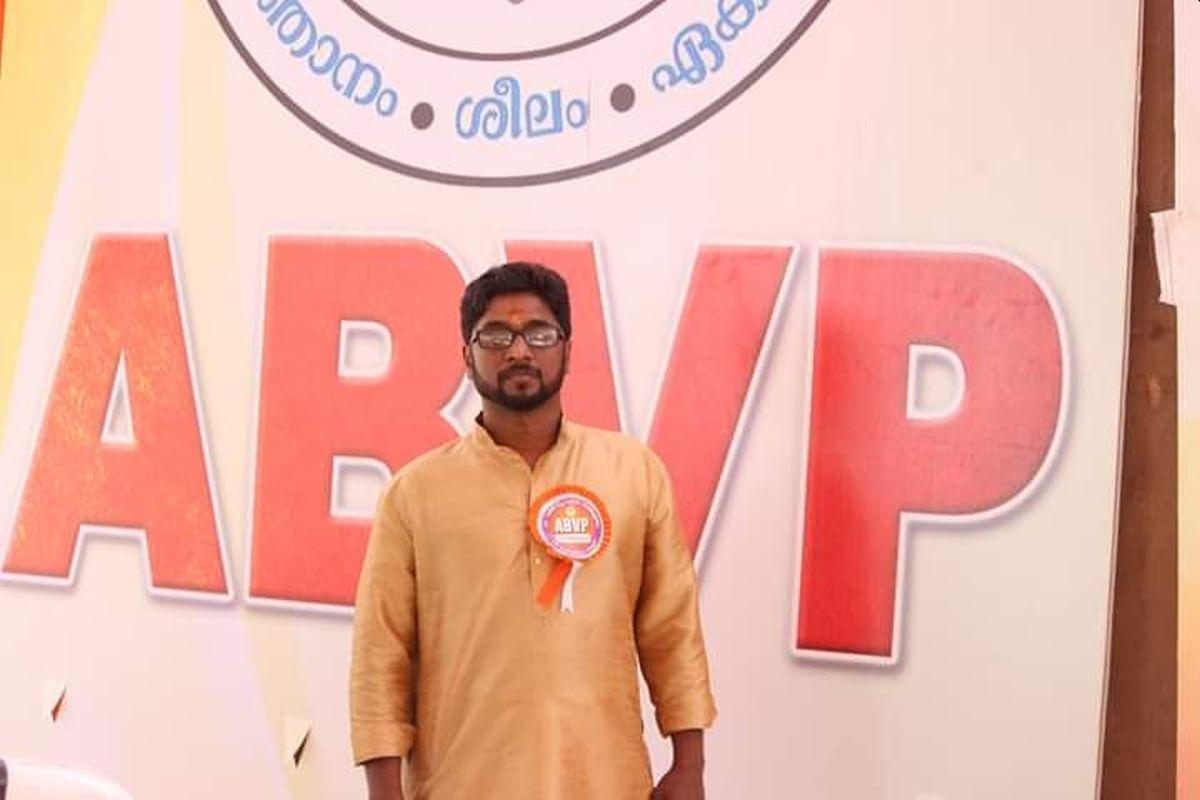
Mahadev, for his part, has consistently denied making any direct threat. Speaking to Rediff, he said his words had been twisted by the media.
"I have not said I will shoot anyone," he insisted. "The media diverted my words. My statement was about national security -- about what the State should do if there is a civil war-like situation. In such cases, police and forces should act against anti-national elements."
But even as he rejected the charge, Mahadev made an admission that muddied the waters: "Rahul Gandhi's name came to my mind at that time (when I said police and forces should act against anti-national elements)."
The contradiction was striking. On the one hand, Mahadev claimed his remarks were abstract and conditional. On the other, he acknowledged invoking Gandhi's name in that very context. He repeatedly urged people and the media to "watch the full video" to understand the nuance, blaming sensational headlines for creating controversy.
A teacher who preaches non-violence -- and force
Throughout the interview to Rediff, Mahadev described himself as a teacher and advocate of non-violence. "I always support non-violence," he said.
Yet in the same breath, he defended the use of force by the State. "That is the role of the military and forces. India has 140 crore people. We need good policy, good military, and good forces," he explained.
For Mahadev, personal non-violence and State violence appear to exist in separate moral spheres: Individuals should remain peaceful, but the State must be willing to act with force against threats to sovereignty.
Who decides who is 'anti-national'?
The controversy raises a larger question: In a democracy, who decides who qualifies as 'anti-national'?
When pressed, Mahadev's answers shifted. At times, he said the "forces will decide based on the situation." At other moments, he conceded that courts must have the final say. "Yes, exactly," he agreed when the interviewer said only courts -- not individuals or police forces -- can determine such matters.
But the damage, the Congress argues, is already done. By even suggesting Rahul Gandhi's name in the context of anti-national activity, Mahadev had crossed a dangerous line.
In India's supercharged political climate, even nuance can be dangerous. Mahadev says he never meant to issue a threat, that he promotes non-violence, that the courts must decide who is anti-national. But his admission that "Rahul Gandhi's name came to mind" ensures the controversy will continue.
Three police cases and political silence
The Kerala police have registered three cases against Mahadev under various legal provisions. He acknowledged them matter-of-factly, saying he would cooperate with the authorities.
Meanwhile, the BJP has maintained silence. Mahadev insisted his views aligned with the party, saying: "My party's stand is always against civil war. We believe in the democratic election system for 2029 (the Lok Sabha election). That is my party's policy, and that is my policy too."
But the lack of any formal reprimand or distancing by the BJP has only fuelled the Congress's suspicions. Venugopal's letter essentially warned Shah that inaction would be read as tacit endorsement.
The broader pattern
For political observers, the Mahadev episode fits into a recurring pattern in Indian politics. Rahul Gandhi and other Congress leaders have long been accused by the BJP and its linked groups of being 'anti-national', particularly when they criticise the government abroad or raise questions about communal violence and national security.
The ABVP, the student wing of the Rashtriya Swayamsevak Sangh, has positioned itself as the guardian of nationalist values on campuses and in public life. Its confrontations with left-wing student groups have often escalated into national debates about patriotism and dissent.
Seen in this light, Mahadev's remarks may not be an isolated slip but part of a broader climate where calling Opposition leaders 'anti-national' has become common political currency.
The road ahead
The controversy is now likely to play out on three fronts: The legal cases in Kerala, the political battle in Delhi, and the media arena where Mahadev insists his words were twisted.
For the Congress, the strategy is clear: Frame the remarks as evidence of a 'toxic ecosystem' cultivated by the BJP. For Mahadev and his party, the challenge is to defend his words as hypothetical, while avoiding the appearance of legitimising threats against a high-profile Opposition leader.
As Pawan Khera put it: 'The country is aware who is hatching the conspiracy and what it is.' Whether Amit Shah and the Union government treat this as a serious death threat or dismiss it as rhetorical excess will determine how long the issue dominates headlines.
For now, three police cases are pending, the Congress remains on the offensive, and Mahadev's words -- whether twisted, conditional, or admitted -- continue to reverberate.





 © 2025