
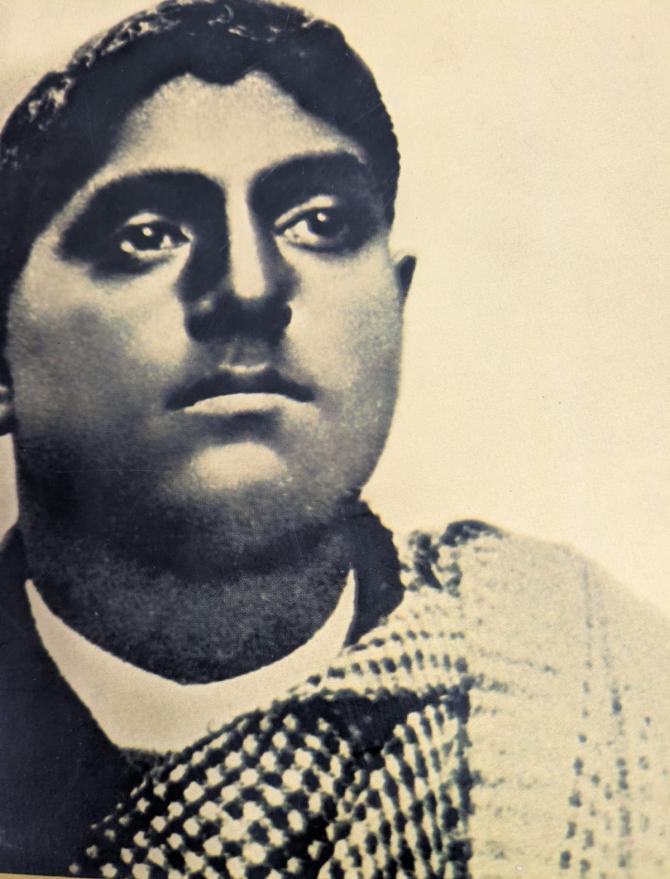
Jyotindranath Mukherjee, popularly known as Bagha Jatin, attained martyrdom while fighting the British in Balasore district on September 9, 1915.
It is unfortunate that the supreme sacrifice made by Bagha Jatin and his associates is little known outside Bengal and Odisha.
Success has many fathers and failure is like an orphan.
This aphorism seems to be the irony of Jyotindranath Mukherjee popularly known as Bagha Jatin who attained martyrdom while fighting the British police in Chasakhand village in present day Odisha's Balasore district on September 9, 1915.
It is unfortunate that the supreme sacrifice made by Bagha Jatin and his associates is little known outside Bengal and Odisha, although there is no dearth of well documented historical records in this regard.
Much before India achieved Independence in 1947, there was an attempt under the leadership of Bagha Jatin, Narendranath Bhattacharya better known as M N Roy et al in 1915 during the First World War to attain Independence through armed insurrection in cooperation with Germany.
In fact, the incident can be considered a precursor of the later attempt by Subhas Chandra Bose in 1945 under the aegis of the Indian National Army during the Second World War with the support of Japan.
Born in 1879 in a village called Koya in Kushtia district in undivided Bengal (presently Bangladesh), Bagha Jatin joined the Khudiram Bose College in Calcutta in 1895 after completion of his school education.
His bravery, valour and daredevil spirit can be gauged from the fact that once in 1904, he killed a tiger in a forest which attacked one of his friends with the help of a dagger after struggling for over three hours.
The incident earned him the sobriquet Bagha (Tiger) Jatin.
Bagha Jatin was greatly influenced by the Bhagavad Gita and Bankim Chandra Chatterjee's writings.
He was also inspired by Aurobindo's Bhavani Mandir and Vivekananda's Present India.
The clarion call of militant nationalism mesmerised the restless youth of the country particularly after the partition of Bengal in 1905, who were disillusioned with the slow and piecemeal pace of progress towards independence and were losing faith in the efficacy of constitutional agitation in the form of protest and petition.
The organisation that galvanised the spirit of strident nationalism was Jugantar and its icon was Bagha Jatin.
Near about 1905, he organised an association called Chhatra Bhandar.
Although it was established as the Student's Co-operative Store Association, it was in reality an outfit of revolutionaries of Bengal.
M N Roy of Comintern fame came to know him in the later part of 1906 and accepted him as his leader. Both men worked together in tandem.
By early 1914, the country was agog with discontent against British rule and what added fuel to the fire was the promise of moral and material support to the revolutionaries in India from revolutionaries fighting for the cause of independence from abroad such as the Ghadar movement in Canada and the USA.
The outbreak of the First World War in 1914 ignited militant nationalism in the country.
Indian revolutionaries in exile looked towards Germany as the land of hope.
Lala Hardyal of the Hindustan Ghadar Party in America carried on similar activities there.
The legendary Rash Behari Bose went to Japan.
By the end of the year news arrived that the Indian Revolutionary Committee in Berlin under the leadership of the redoubtable Birendranath Chatterjee had obtained from the German government the promise of arms and money required to declare a war of independence.
Clandestine conferences led to the formation of a revolutionary outfit with Bagha Jatin as the commander-in-chief.
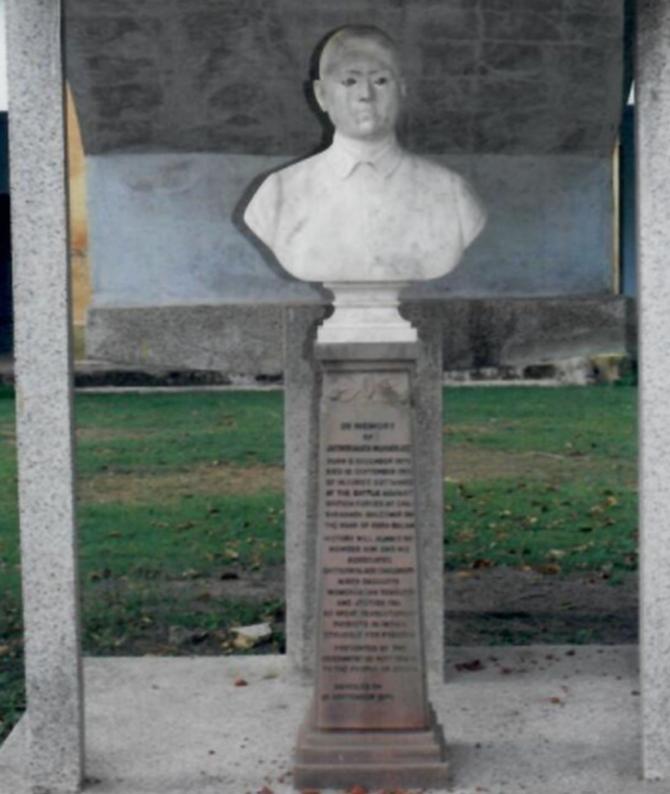
It was in this context that M N Roy left India in April 1915 and proceeded to Batavia (Jakarta) in present day Indonesia where he adopted the name C A Martin.
Bagha Jatin in the meanwhile anticipating the arrival of arms and ammunition and in order to avoid being caught by the police, especially after the Garden Reach dacoity, left for Balasore, not very far from Calcutta, in the company of a few followers some time in April 1915, before M N Roy left for Batavia.
There, he and his loyal followers sheltered in a place called Kaptipada 22 miles from Balasore.
Unfortunately, the entire strategy envisaged for the armed rebellion got leaked and British army intelligence intercepted the ship on its way to India.
The British administration and police cordoned off Bagha Jatin's hideout to prevent his escape.
There was an exchange of fire on September 9, 1915 at Chasakhand in Balasore.
A revolutionary named Chittapriya Roy Choudhury died. Manoranjan Sen Gupta and Niren Das Gupta, two other associates, were captured after their ammunition was exhausted.
Bagha Jatin, seriously wounded, was taken to the government hospital in Balasore for treatment, where he succumbed to his injuries the next day.
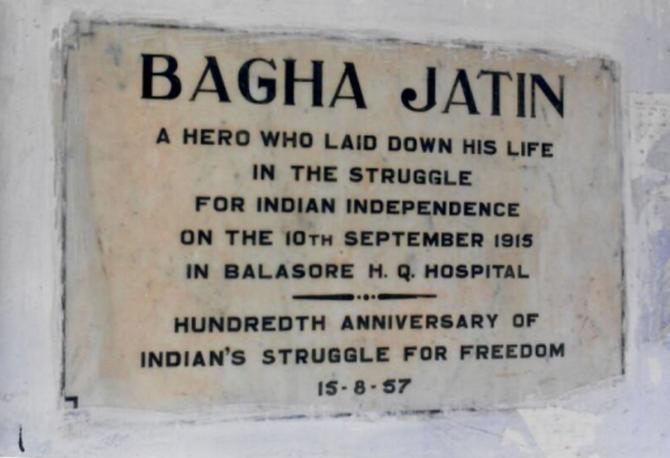
Although the armed uprising could not take off, it was brilliant considering the prevalent world situation in which the stratagem was envisaged.
No wonder, the poet Kazi Nazrul Islam described it as the 'Haldighat of New India' and composed a beautiful poem in Bengali portraying the indomitable spirit of Bagha Jatin and his comrades who laid their lives at the altar of the freedom struggle.
It is worthwhile to recall what M N Roy wrote about Bagha Jatin in this context: 'The time has changed; the man who earned fame as a great conspirator against the imperialist state and extraordinarily bold terrorist is now to be memorialised as a great man in the history of modern India.
'His birthday is celebrated, and biographies written. But since his time, the political stage of India has been crowded with people claiming niches in history, if not places of honour in the pantheon of the great.
'Judged by his actual feats, minus the legends woven around them, Jatinda's name may be crowded out of the list of the national heroes...'
Mentioning his heroic fight in Balasore, Roy wrote, 'There is no doubt that the story of Balasore Jungle can be dramatised, and done by a master artist, it may attain the grandeur of an epic poem..'
'By way of expressing admiration and respect, the imperialist policeman who was in the police party to surround Jatinda's hiding place, said, 'He was the first Indian to die fighting, arm in hand'.

In fact, the great French philosopher Raymond Aron who supervised the thesis of Prithwindra Mukherjee, Bagha Jatin's grandson, on Sri Aurobindo at the Sorbonne University, is reported to have observed that this story (of Bagha Jatin) to be not only the missing link in our official history, but also in the person of Bagha Jatin he saw the 'thinker in action'.
Rup Narayan Das is presently working on a book on Bagha Jatin and is Consulting Editor, Journal of Parliamentary Information at the Lok Sabha secretariat. Views are personal.
Feature Presentation: Aslam Hunani/Rediff






 © 2025