
One of Debashish Bhattacharya's most remarkable contributions is that he has taken the scope and foundation of the slide guitar, improvised it again and again, thereby designing and creating four entirely new guitars.
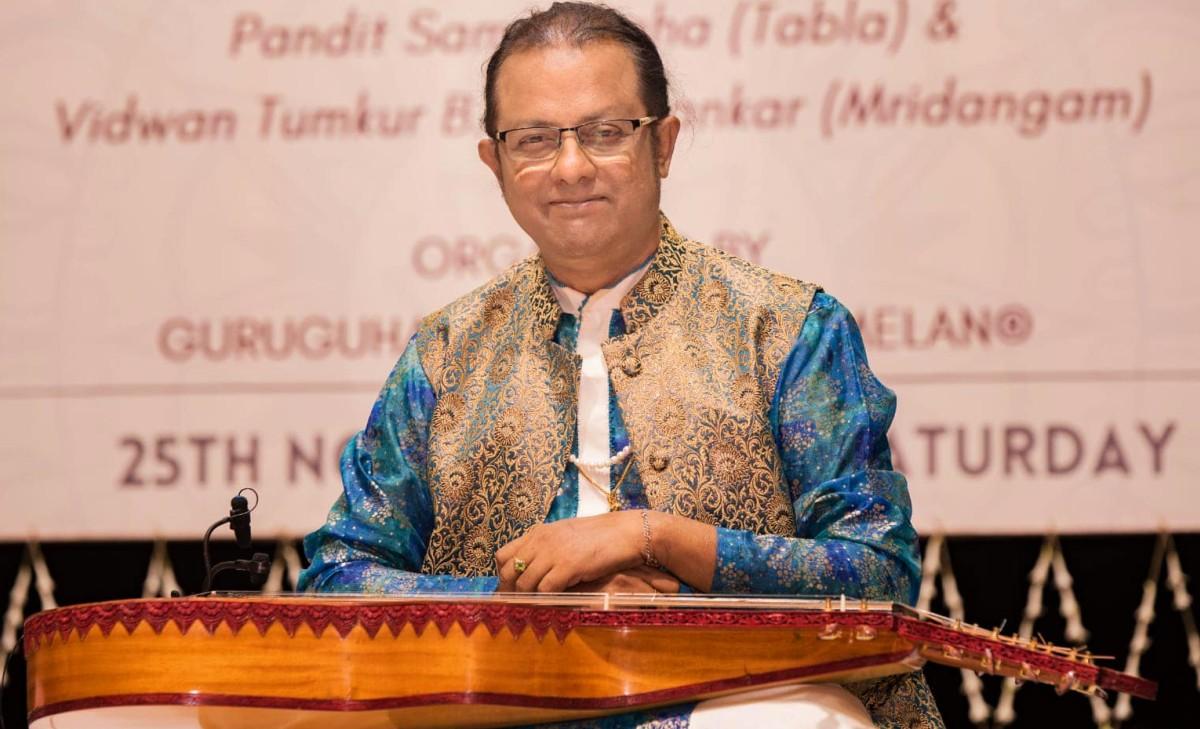
The first things that greets you on his Web site is a short, testimonial by the legendary John McLaughlin that says it all.
It goes like this 'Debashish Bhattacharya is the master of the slide guitar. He has no equal.'
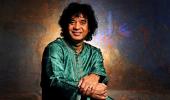
It is with this unequal maestro that I sit across, on a rain-soaked afternoon in the music room of his apartment to talk about his journey, his music and most of all, his musical innovations -- the four slide guitars that have been conceived and designed by him.
But first I take a couple of moments to find a spot where I can sit, converse comfortably and take notes.
That's because the room is littered with his various slide guitars, at least two dozen of them, lying in various supine positions along with a couple of tanpuras and a pair of tablas for good measure.
The maestro meanwhile parks himself at the foot of a large Saraswati murti, no doubt consecrated.
Now on to his 28th album, The Sound Of The Soul, Debashish Bhattacharya settles down to reflect and rewind.
Early days
He shares how he hails from a Bengali Brahmin family that had to escape from East Bengal or today's Bangladesh to settle down in Calcutta in 1939.
Though there was some amount of music in the family, his mother being a trained vocalist in the Gwalior Gharana, there was more emphasis on vocals over instrumental.
This was also something he noticed about Indian listeners who were more drawn to vocal music over instrumental.
From his early days of tinkering with the guitar, he noticed how the west differed substantially in this choice, where every single soloist was a highly prized artist.
Though he was drawn to the slide guitar, he knew it would be hard to truly Indianise it.
What would be even harder, would be for it find acceptance in the strict world of Shastriya Sangeet or Indian classical music.
"In India, if you played an instrument, you could at best be a chosen accompanist. To command the stage entirely by yourself, playing a slide guitar was almost unheard of."
Recalls the Grammy nominee of 2009, how he was paid a princely sum of seventy rupees after playing in a concert at the Minerva Theatre in north Calcutta and had to trudge back home on a wet monsoon evening, balancing an umbrella in one hand and his precious guitar in the other.
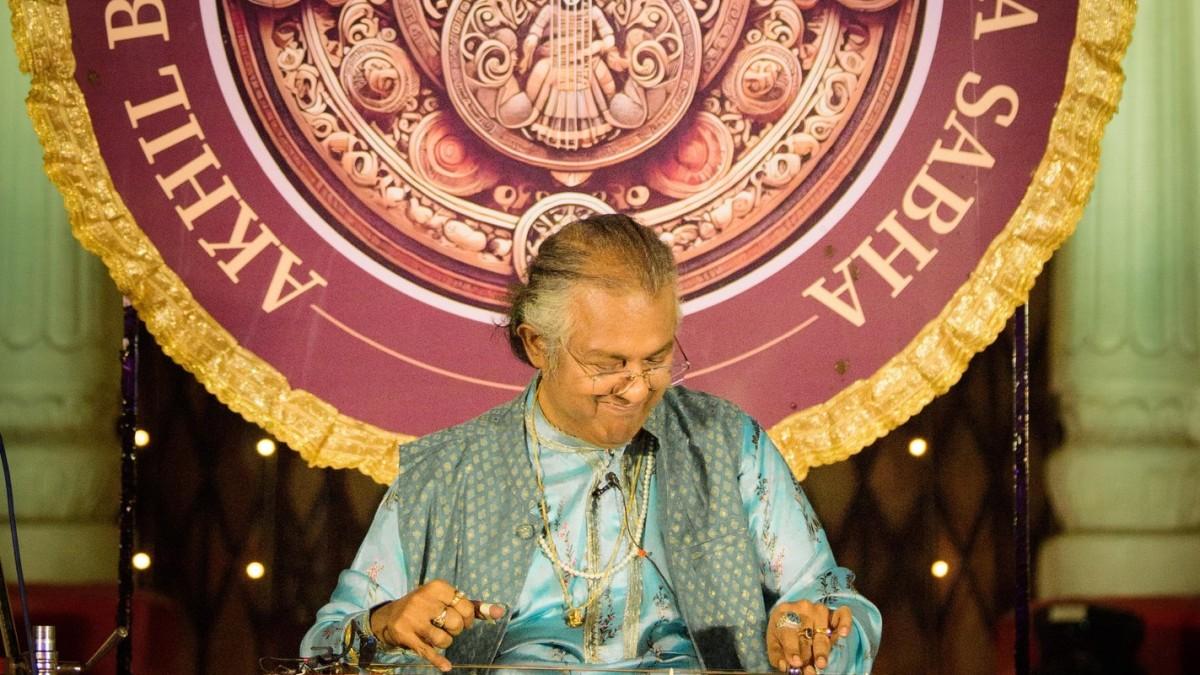
Cometh the hour, cometh the Guru
Fate took a turn one fine day at the ITC Sangeet Research Academy when Bhattacharya was in his 20s.
Pandit Brijbhushan Kabra, known for his virtuosity with the slide guitar and credited as the first Indian musician to play Raag based music on the instrument, happened to be visiting.
Bhattacharya played in front of the supremo.
Witnessing his recital were Pandit Ajoy Chakravarty and Pandit Vijay Kichlu, who both encouraged the young Debashish to learn from Kabra.
A formal meeting at his sister Kamla Somany's residence ensued. After listening to the young, evidently gifted Debashish, Kabra had only three words to say to him. 'Come with me.'
Leave Bengal? Debashish had never stepped out of the state yet and was being asked to move to Ahmedabad if he wanted to come under his tutelage.
"It was a big risk, particularly because I was the oldest of three siblings and the only earning family member at that time, bringing in about four thousand rupees per month."
But Debashish's parents encouraged him. They saw the opportunity and believed it was godsent.
In 1984, Debashish Bhattacharya left Bengal to move to Gujarat.
Guru Shishya Parampara
Debashish spent seven crucial years in Ahmedabad as a ganda-bandh shishya or a formal student of Pandit Kabra.
Completely immersed in the tradition of this tutelage, he not only learnt music from the maestro, but also became a part of his family and life.
"From the very beginning, just like his biological children, I called him Papa." Having meals together, listening to hours and hours of music by behemoths such as Pandit D V Paluskar, Pandit Omkarnath Thakur, Ustad Amir Khan and Ustad Ali Akbar Khan, amongst many others, Debashish's musical sensibilities soared organically.
Travelling with his guru to Jodhpur and Bombay meeting colossal artistes like Ustad Vilayat Khan, Pandit Hariprasad Chaurasia, Ustad Zakir Hussain, Pandit Shiv Kumar Sharma, Pandit Kishan Maharaj and Vidushi Kishori Amonkar.
The exposure to each of these greats left an indelible musical imprint in his heart.
He also witnessed the huge respect each artist had for the other and how despite scaling huge heights in the world of music, they maintained an appetite for riyaz and continuous exploration of sound.
Debashish made a vow to himself then, that he maintains till today, that he would forever remain a student and a framed photograph of his guru finds a spot in his music room.
Making a mark
In 1991, Debashish Bhattacharya wound his way back to Calcutta, as a consummate, confident and complete artist.
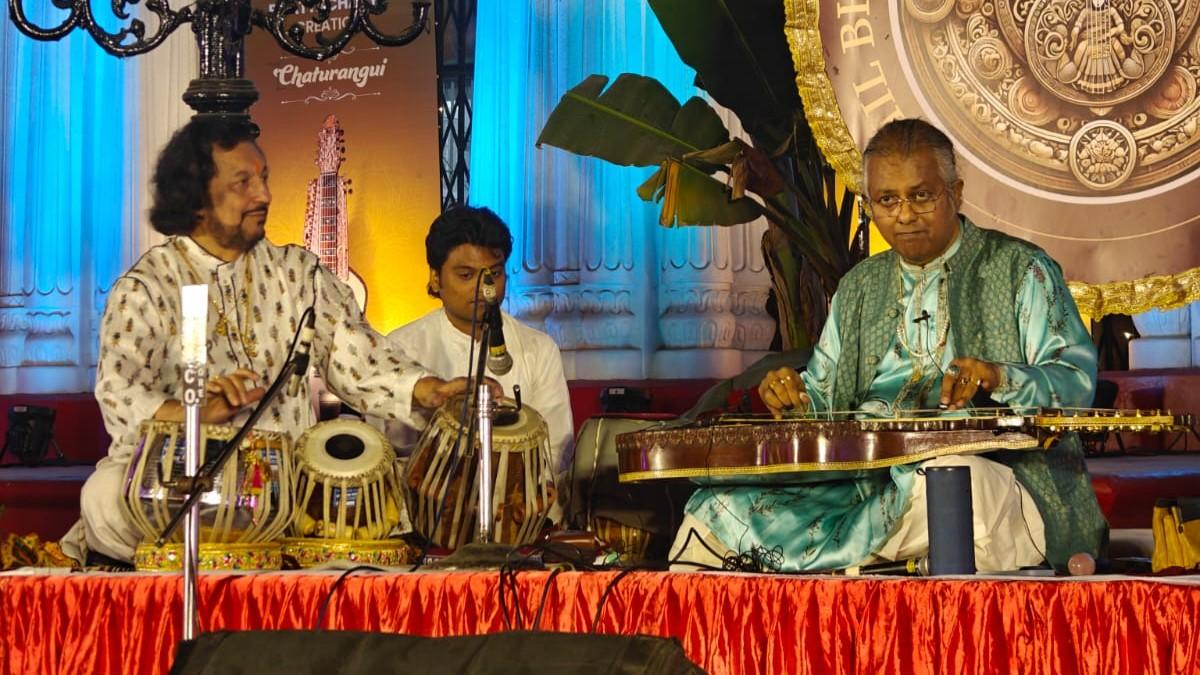
He recalls his first concert with tabla maestro Bickram Ghosh in Lake Gardens followed by another at a cultural institute, Bharatiya Bhasha Parishad with Tanmoy Bose.
Audiences loved the sonorous sound of his Chaturangui, an improvised slide guitar that was played like a slide guitar with a steel bar, but emitted a soundscape that had tonalities of a sitar, a sarod, a violin as well as the human voice.
Since this instrument was not readily available, he trained a violin maker, Lokkhi,to fabricate his 26 stringed, Chaturangui. Lokkhi has been with Bhattacharya ever since.
In 1992, Music Today released his first solo album under its Young Master series. Featuring his renditions in Raag Desh, Malkauns and Shivranjani, the album was applauded by listeners and critics alike.
In 1993, Debashish tasted his first musical tour and concert abroad.
Travelling with a stellar ensemble that comprised Ustad Zakir Hussain, Pandit V G Jog and vocalist Ustad Rashid Khan, they presented the Indian Festival across USA and Canada.
"Even after 30 years, I vividly remember my first solo recital at Harvard and how the audience gave a thundering response to my Darbari Kannada."
Global Crossovers and Compliments
Over the years, besides the USA, Debashish has commanded smitten audiences in Europe, Russia and more.
He has delivered solo recitals in heritage chateaux in France, performed at prestigious venues such as the Kennedy Centre in Washington, DC and Carnegie Hall in New York, the Sydney Opera in Australia and the Southbank Centre in London amongst many others.
His noteworthy international collaborations span jazz legends, flamenco maestros, African kora virtuosos as well as sharing of stages with Indian legends.
A much sought after guru today, Debashish has trained over a thousand students over the years.
Musical innovations
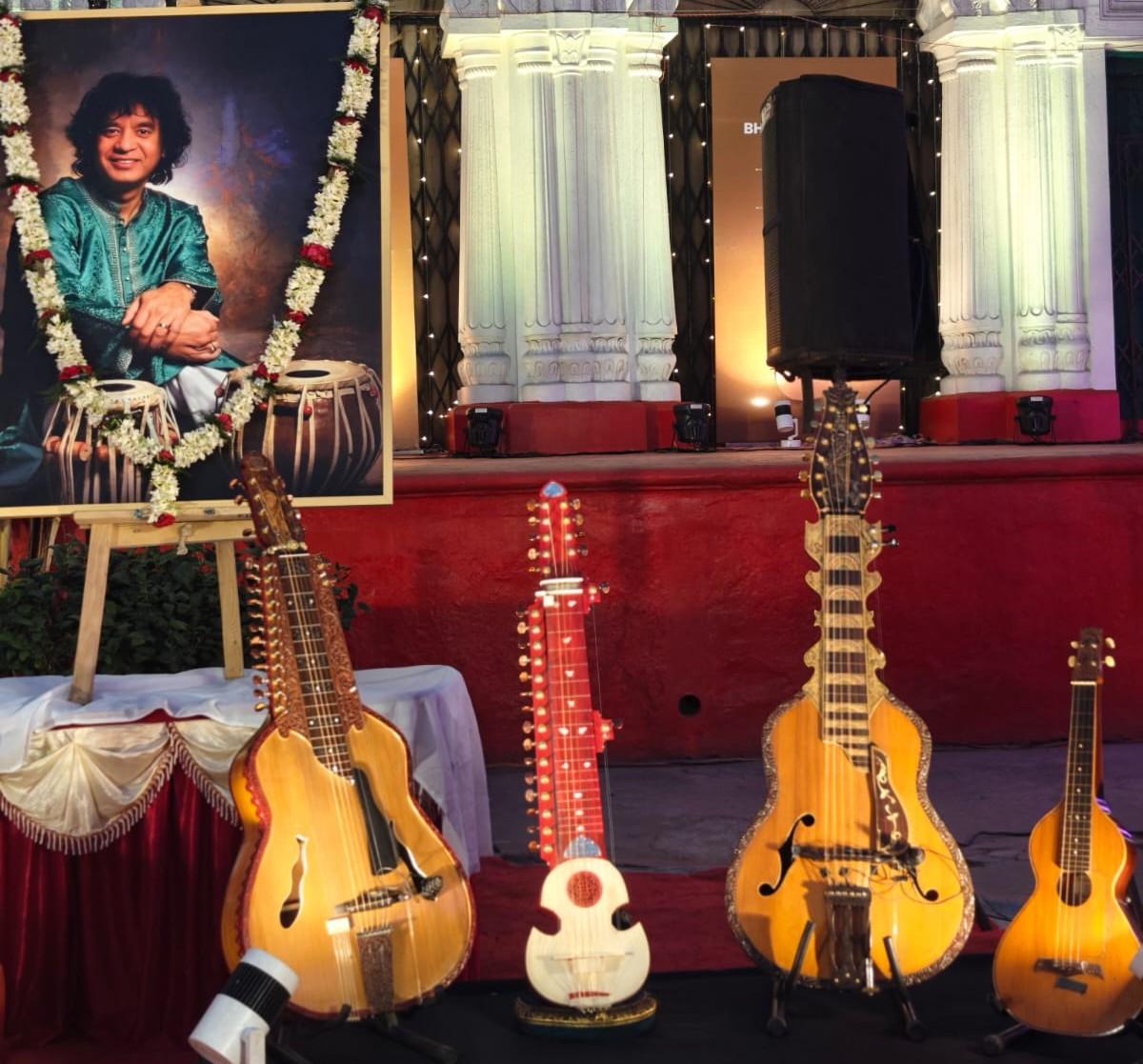
One of his most remarkable contributions is that he has taken the scope and foundation of the slide guitar, improvised it again and again, thereby designing and creating four entirely new guitars.
He has named these Chaturangui, Gandharvi, Anandi and Pushp Veena. Though each of the guitars are played lap style with a steel bar and finger picks, the sound that they produce is unique to each.
Though he plays his signature 26 string Chaturangui set to Scale D the most as it replicates the depth of vocal classical on the guitar, his audiences too have matured to the other three.
Gandharvi is his 12-string ode to the celestial sound or the sound of the Gandharvas and lends a softer tone making it ideal for slightly more lyrical and lighter renditions whereas Anandi, which he has named after his daughter, is much like a ukelele and is of a much smaller built, comprising only four strings.
The youngest in his repertoire is the Pushp Veena, which is named after his mother Pushpa.
Debashish holds a patent for it as the instrument combines wood and leather and carries the fragrance of the rabab and sarod in a slide guitar.
None of these instruments are factory made. Debashish goes to great extent to procure the bar and strings according to his exacting standards from Pennsylvania, USA.
The wood for the body gets imported from Australia and Latin America.
What's next?
What's next for the two-time Grammy nominee and BBC World Music Awardee (2007) after thousands of concerts and over 27 albums?
"None of this was rooted in intention. It has come from inspiration. This music does not belong to me. I have come to believe in the universality of Indian classical music. I must therefore strive to serve whatever I have absorbed and learnt over the years."
Supriya Newar is a writer and poet from Kolkata. Besides being an avid traveller, she is a music aficionado and feels deeply connected to Indian music.
She may be reached on connect@supriyanewar.com. Her website is www.supriyanewar.com
Feature Presentation: Rajesh Alva/Rediff






 © 2025