

Bajrang Singh's name once echoed with reverence -- a former National Security Guard commando and one of the unsung heroes of the 26/11 terror attacks.
For decades, he stood as a symbol of courage, discipline, and unyielding patriotism.
But the medals and glory couldn't shield him forever.
In 2021, after retiring from the NSG, Bajrang returned to his native village in Sikar with high hopes -- he wanted to carve out a new legacy in politics. He got his wife to contest elections, aiming to build a family dynasty.
Yet, politics in his small town was a ruthless game, far harsher than any battlefield, he realised.
Bajrang found himself increasingly isolated, his war chest empty and his influence waning.
With enemies mounting and cash running dry, the pressure mounted.
It was then that a close friend, someone familiar with the underbelly of the region, planted a dangerous idea: Illegal ganja trade.
The promise was simple -- fast money, no questions asked.
Bajrang knew Odisha's forests and hills like the back of his hand.
Time spent in the Border Security Force before joining NSG, when he was engaged in anti-Naxal operations, had given him intimate knowledge of the terrain along the Odisha-Telangana border, a notorious corridor for ganja trafficking.
The network was old, ruthless, and well-guarded. But Bajrang was confident. His training, combined with his local knowledge, made him feel invincible.
What Bajrang didn't anticipate was how ordinary his downfall would be.
His secret weapon -- and his weakest link -- was his Odiya cook.
A quiet man, with little connection outside the household, the cook was a constant presence.
Bajrang enjoyed the familiarity of Odiya cuisine, the cook's meals were comforting, a small anchor in a chaotic world.
But in the world of covert operations and illegal trade, every link matters.
Investigators, tracking the flow of ganja from Odisha into Rajasthan, found themselves repeatedly hitting dead ends -- with only information that an ex-commando was the mastermind behindg the ganja trade in Rajasthan.
With more and more investigation they found out that his name was Bajrang Singh and he had set up operations from Hyderabad to Odisha.
The only clue that the police got was that he was roaming around with his cook who was an Odia.
So instead of tracing him, the police started tracing the cook and finally managed to get hold of some of the cook's relatives with whom he was in constant touch.
The break came from the cook's phone, who was not aware of Bajrang's misdeeds.
The cook's number and location became the thread that led them through a tangled web of dealers and middlemen.
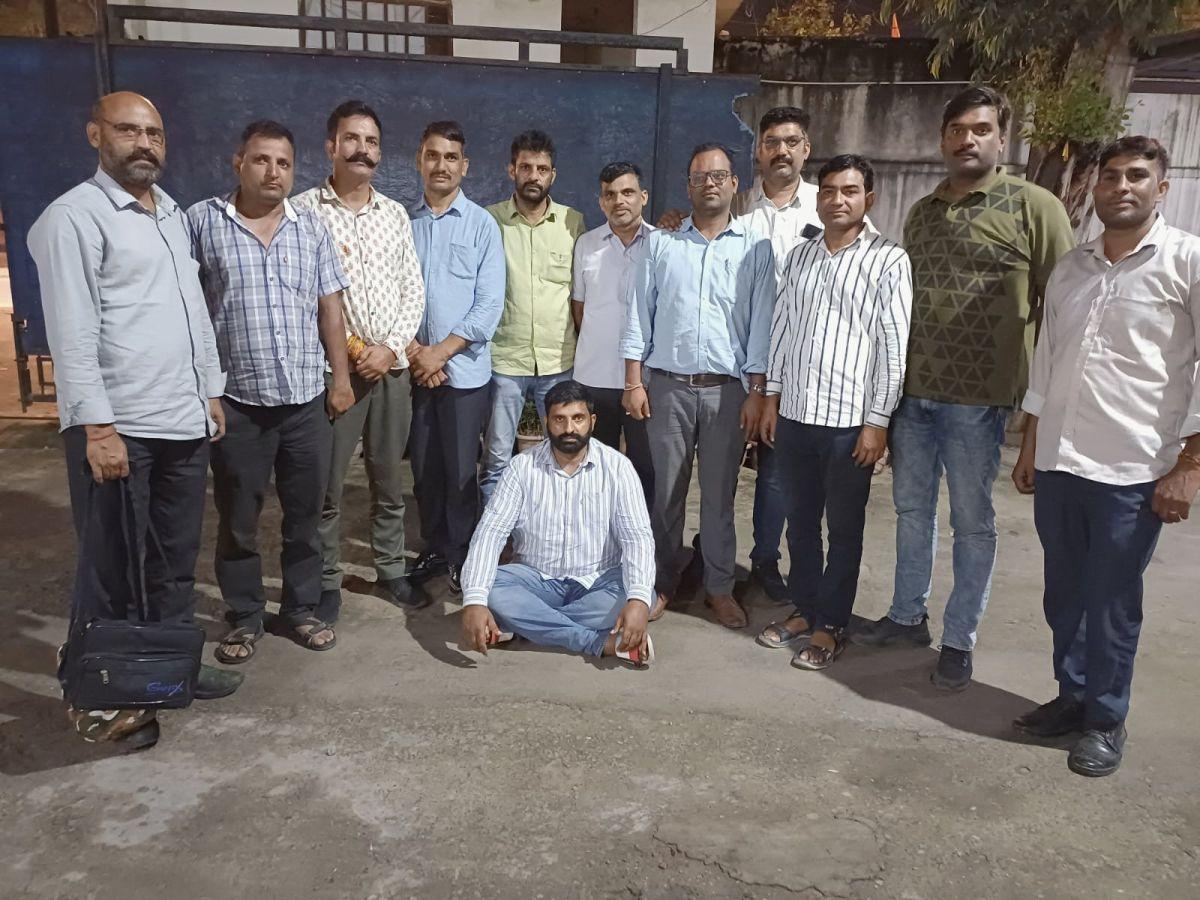
The Rajasthan Anti Terrorist Squad and Anti Narcotics Task Force teams had been monitoring his movements for nearly two months. Despite his attempts to evade arrest, using fake mobile IDs and hiding in remote villages, technical intelligence and ground-level informers helped trace Bajrang to Churu, reports PTI.
Tracing the cook's movements, law enforcement finally zeroed in on Rattangarh, a sleepy town in Churu district.
Surveillance teams watched quietly as the cook went about his routine, waiting for a sign.
Then, one afternoon, Bajrang appeared.
Mounted on a Royal Enfield Bullet -- his preferred ride, a relic from his commando days -- he moved with the ease and confidence of a man who had once faced bullets without flinching.
Towering at 6 feet 1 inch and weighing over 110 kilos, his physical presence was undeniable.
The arrest team, aware of Bajrang's elite training and imposing stature, prepared meticulously.
Eight to ten officers armed and ready, pistols drawn, executed the plan with precision. The commando who had once faced terrorists on Mumbai's streets had no time to react. Surrounded and outnumbered, he was taken into custody along with 20 kg of ganja on him.
The operation to nab him was given the codename 'Gaanjaney', a calculated pun blending Bajrang's name with 'Anjana', the mother of Lord Hanuman -- a subtle nod to Bajrang, combined with the drug trade he had become involved in.
The name was chosen to mask the mission's true purpose, ensuring that even if the operation's name was leaked, its meaning would remain obscure.
In custody, Bajrang's bravado crumbled.
Faced with overwhelming evidence, he alternated between denial and remorse. He blamed political rivals for framing him, claiming the charges were a conspiracy to end his ambitions. But officers were unshaken; evidence tied him not only to local operations but also to the ganja networks extending to Hyderabad and beyond.
Inspector General of Police, Rajasthan, Vikas Kumar told Rediff that "Bajrang did express regret for his deeds but I told him, 'It's too late for regrets. You had the chance to serve the nation in another way. You could have trained young men, coached aspiring commandos, or simply retired with honour."
Instead, Bajrang had chosen a different path, one that would strip him of his legacy.
Bajrang's story is a stark reminder: Even heroes can fall when greed, desperation, and bad company cloud judgement. And sometimes, it's the simplest things -- a meal, a phone call -- that unravel the mightiest of warriors.






 © 2026