

New data shows India's emissions rising faster than its 2030 targets.
The 30th United Nations Climate Change Conference, or COP30, is set to be convened for 12 days in Brazil's Belim from November 10.
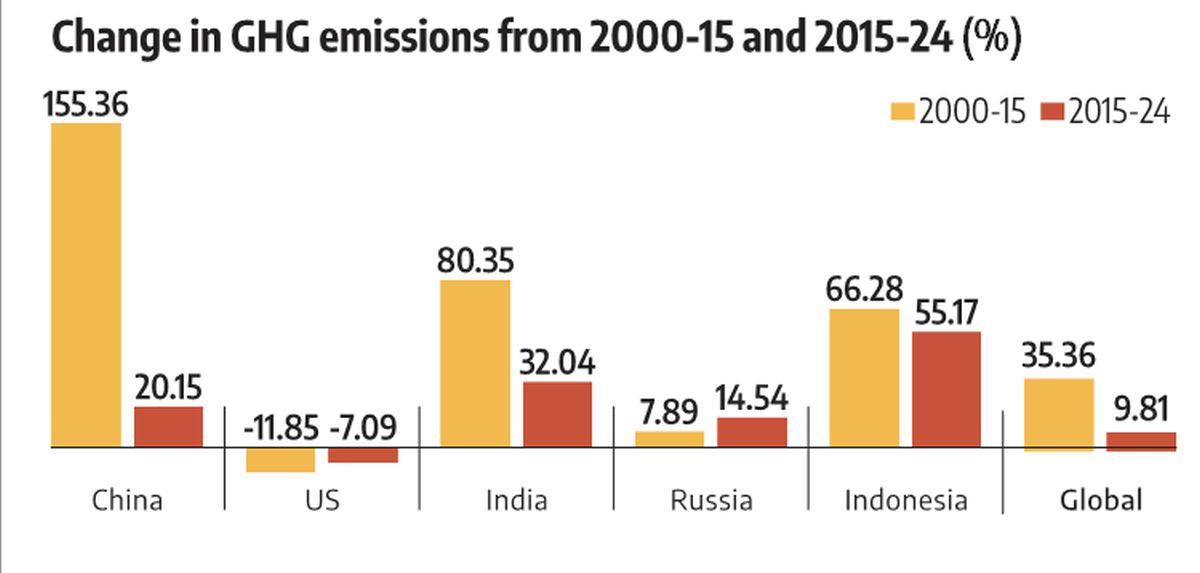
According to the latest data, some major economies have managed to curb their greenhouse gas (GHG) emission, while others continue to see steep increases.
In India's case, the picture is mixed. Its emission has grown significantly over the past two decades, yet remains lower on a per capita basis compared to the other top 4 polluters.
India is also projected to miss its 2030 emissions target by around 8 per cent, according to the United Nations Emissions Gap Report 2023.
Global GHG emission up, but speed slows
Global GHG emission is still rising, but with changes in pattern.
From 2000 to 2015, it surged in developing economies like China and India, which accounted for most of the rise.
They were still the biggest contributors between 2015 and 2024, but the rise itself decelerated to 9.8 per cent.
On the other hand, the US continued to cut emission, but remained a higher emitter in aggregate and per capita terms. along with Russia.
Per capita trends
India's per capita emission has more than doubled since 2000, rising to 3 tonnes in 2024, and is projected to reach 3.1 tonnes by 2030 -- exceeding its nationally determined contribution (NDC) target of 2.8 tonnes per person.
The country missed its target for the first time in 2023.
Still, India's per capita emissions remains far lower than China (10.8 tonnes), Russia (18 tonnes), the US (17.3 tonnes) and even Indonesia (4.69) in 2024.
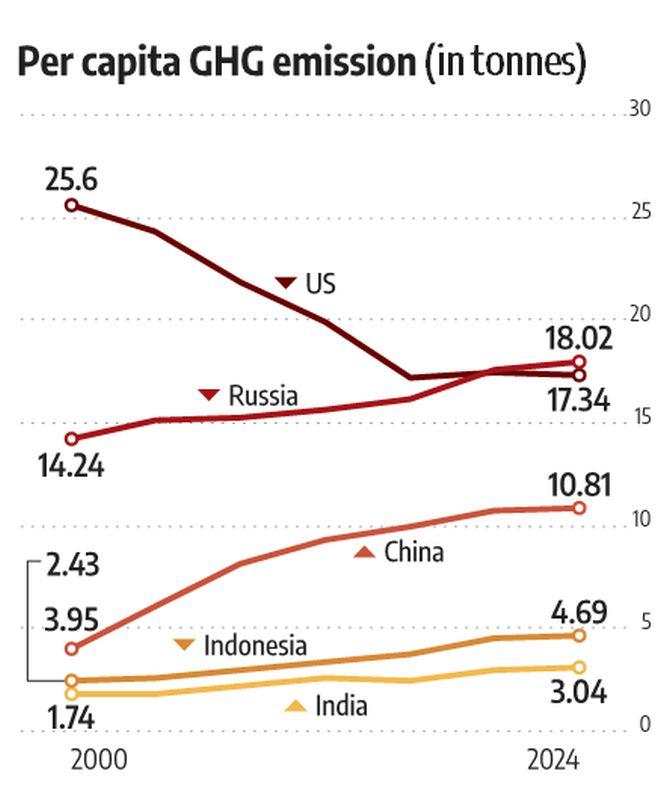
Note: Top 5 countries with the most GHG emissions in 2024 have been considered
Source: Emissions Database for Global Atmospheric Research, BS calculations
Feature Presentation: Aslam Hunani/Rediff










 © 2026