

'Tourists from long-haul markets such as the US, UK, and Western Europe are especially sensitive to such news, and short-term cancellations or postponements of planned trips can be expected.'

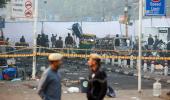
India's travel and tourism sector may face an immediate but short-term impact from Monday evening's blast near the Red Fort in the national capital, after the US and the UK issued advisories urging caution.
Industry insiders said some postponements and cancellations are likely due to security concerns, directly affecting India's travel and tourism market just as the annual peak season begins.
However, they downplayed the possibility of any medium- or long-term fallout.
This is the period when inbound tourism typically picks up, lasting through January and February.
"Tourists from long-haul markets such as the US, UK, and Western Europe are especially sensitive to such news, and short-term cancellations or postponements of planned trips can be expected," said Ravi Gosain, president, Indian Association of Tour Operators.
The blast, which occurred in a moving car, killed 12 people and critically injured several others.
The US embassy in New Delhi warned its nationals to stay cautious.
'While the cause of the explosion is still unknown, the Government of India has placed several states, including (National Capital Territory of) Delhi, Uttar Pradesh, and Maharashtra, on high alert,' the advisory issued on Tuesday said.
The UK's Foreign, Commonwealth and Development Office also warned British citizens against all travel to areas within 10 kilometres of the India-Pakistan border.
It further advised against visiting Jammu and Kashmir -- except air travel to the city of Jammu -- due to ongoing security concerns.
The US and the UK are traditionally large non-resident Indian markets and major contributors to foreign tourist arrivals during the peak season.
At Sarovar Hotels, bookings have dipped slightly.
"The incident in Delhi is deeply unfortunate. From a business standpoint, we have noticed a short-term softening in inbound bookings, particularly from long-haul markets that are more sensitive to security advisories," a company spokesperson said.
"The recent US advisory urging increased caution is understandable, yet it underscores the importance of balanced communication and on-ground reassurance to travellers," the spokesperson added.
For luxury villa rental firm StayVista, occupancies in properties across the Delhi-National Capital Region remained strong.
"Our occupancies remain well above 90 per cent, which signals continued normalcy, and we have not seen cancellations," said Amit Damani, cofounder, StayVista.
"Hopefully, Monday's incident will be seen as a one-off and won't affect travel in the medium or long term," added Damani.
"Domestic travel, too, tends to bounce back quickly, as we've seen in the past. Delhi remains crucial -- both as a destination and a transit hub -- and we foresee only a short-term impact, if any," he stated.
Some industry executives were hopeful that the incident would not dent overall travel sentiment despite its timing.
"While the incident does shake us all and impacts the general scenario, I think it will be seen as a standalone event and should not have much effect, especially on foreign tourist arrivals, as most of these are planned in advance and proceeding as scheduled," said Rajiv Mehra, general secretary, Federation of Associations in Indian Tourism & Hospitality.
"However, this incident underscores the need for enhanced security measures and all-out efforts to prevent such occurrences in future. We are also expecting robust free trade agreements this year," he said.
Industry representatives said tightened security and swift action are the need of the hour.
"What's critical now is reinforcing trust -- through visible safety measures, proactive destination marketing, and close coordination between hospitality players and tourism bodies," the Sarovar spokesperson added.
IATO's Gosain said if no further incidents occur and security communication remains strong, inbound tourism sentiment could recover within a few months.
Feature Presentation: Ashish Narsale/Rediff









 © 2026