

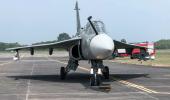
The IAF's future operational concepts could involve indigenous Tejas combat aircraft coordinating in real time with multiple Ghatak RPSAs, each carrying a different mission payload ranging from electronic warfare systems and targeting sensors to precision munitions.

The country should speed up a programme to build advanced remotely piloted strike aircraft (RPSA) that will fly alongside and assist Indian Air Force fighter jets, Chief of Integrated Defence Staff Air Marshal Ashutosh Dixit said on Friday.
He set a 2030 deadline for achieving minimum capabilities to keep pace with 'loyal wingman' programmes in the United States and Australia.
Key Points
- Air Marshal Ashutosh Dixit urged accelerated development of DRDO's Ghatak stealth remotely piloted strike aircraft programme.
- The Indian Air Force wants initial operational capability for the loyal wingman programme achieved by the year 2030.
- Future warfare concepts involve Tejas fighter aircraft coordinating with autonomous Ghatak drones carrying varied combat payloads.
- Ghatak drones are designed for deep-strike missions, precision attacks and suppression of enemy air defence systems.
- The Defence Acquisition Council has already cleared procurement plans for 60 indigenous Ghatak remotely piloted strike aircraft.
Ghatak must be 'accelerated with urgency'
The indigenous Ghatak stealth RPSA programme of the Defence Research and Development Organisation must be "accelerated with urgency", Air Marshal Dixit said at a seminar on unmanned aerial systems and how to counter them, organised by the Centre for Aerospace Power and Strategic Studies in New Delhi.
The IAF's future operational concepts could involve indigenous Tejas combat aircraft coordinating in real time with multiple Ghatak RPSAs, each carrying a different mission payload ranging from electronic warfare systems and targeting sensors to precision munitions.
Pilots will be able to command the RPSAs through their helmet-mounted control display and execute tasks without putting personnel at risk.
"This is how the Indian Air Force will fight going forward," he said.
The concept of pairing conventional fighter jets with autonomous systems is known as manned-unmanned teaming.
IAF's Robotic Warfare Vision

Citing the United States' Kratos XQ-58 Valkyrie and Australia's Boeing MQ-28 Ghost Bat loyal wingman programmes, Air Marshal Dixit said, "India has the Ghatak.
"We must accelerate it with urgency, with a clear operational requirement from the Indian Air Force and with a committed joint programme involving the DRDO, Hindustan Aeronautics Limited and qualified private-sector partners."
Describing the launch of a formal loyal wingman programme as "a very high-priority target", Air Marshal Dixit added that it should ideally achieve initial operational clearance -- military parlance for attaining the minimum required capabilities to be operationally useful -- by 2030.
"UAV warfare is not the destination, it is the vanguard of robotic warfare," he said, referring to unmanned aerial vehicles.
Mission Sudarshan Chakra Focus
Based on a flying-wing configuration, Ghatak is designed for low radar cross-section and internal weapon carriage.
Once operational, it could undertake deep-strike missions, penetrating heavily defended airspace to hit high-value targets without placing pilots at risk.
Operating autonomously or alongside manned aircraft, it could also be tasked with suppressing or destroying enemy air defences -- including radar stations and missile systems -- and striking strategic infrastructure with precision-guided munitions.
In March, the Defence Acquisition Council, the apex decision-making body of the ministry of defence, granted Acceptance of Necessity -- the first step in the acquisition process -- for the procurement of 60 Ghatak RPSAs.
MQ-9B Drone Fleet Priority
Apart from a loyal wingman programme, Air Marshal Dixit underscored four other priority areas: Rapidly operationalising the fleet of American-origin MQ-9B remotely piloted aircraft; urgently building up the air and ballistic missile defence shield under Mission Sudarshan Chakra; creating a national ecosystem for both unmanned aerial systems and defences against them; and developing doctrine and human capital at the same pace as hardware, with tactics updated every six months instead of over years.
Feature Presentation: Ashish Narsale/Rediff









 © 2026