
However, these are understood to be exploratory talks, with an agreement unlikely to be formalised during the current visit.
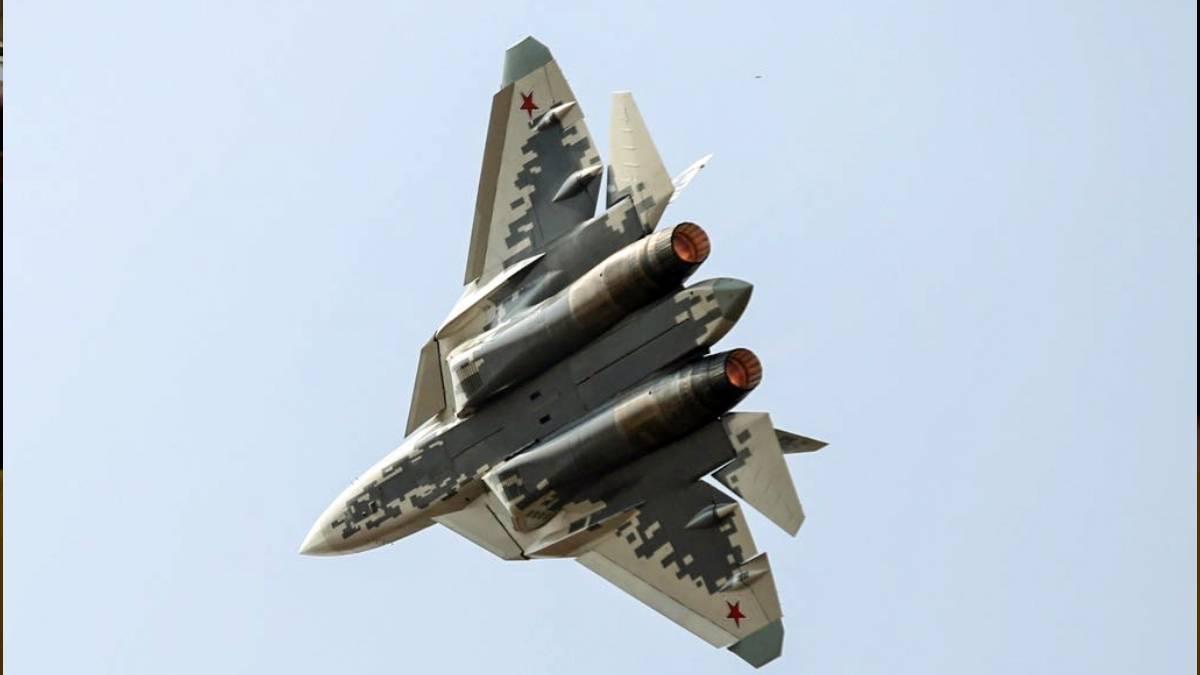
Russian President Vladimir Putin's two-day State visit to India beginning Thursday will see bilateral defence cooperation advance further, with the possible supply to New Delhi of Russian Sukhoi Su-57 stealth jets and additional S-400 air defence units -- used during Operation Sindoor -- expected on the agenda.
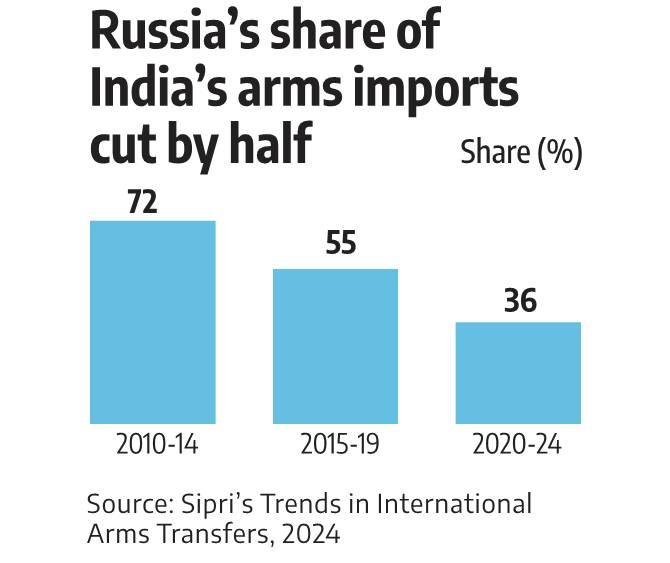
Russia is also being considered a partner for expanded co-production of military hardware, despite its share in India's arms imports halving over the past 15 years, even as it remains the country's largest supplier.
Putin is visiting India for the 23rd India-Russia Annual Summit at the invitation of Prime Minister Narendra Modi.
"The issue of Su-57s certainly will be on the agenda during the coming visit," Kremlin spokesperson Dmitry Peskov said on Tuesday at an online press briefing organised by Russia's Sputnik News, in response to a question on whether Russia had made any offer to India for supplying the stealth jets.
However, these are understood to be exploratory talks, with an agreement unlikely to be formalised during the current visit.
Russia has been exploring the possibility of manufacturing the stealth fighter jets in India, and, according to sources, at least one team has visited Hindustan Aeronautics' Aircraft Manufacturing Division in Nashik (Maharashtra) to assess feasibility.
Peskov also said the supply of additional S-400 air defence systems would be discussed during the visit.
"This issue is top of the agenda, and I have no doubt it will be discussed during the visit... I have no doubt that it will be mentioned also at the highest level," he said in response to a question.
In an apparent bid to address concerns about Russia's capacity to deliver military equipment to export customers, he added that the country's military industry has increased production over the past four years, not only to meet the needs of its own armed forces but also to sustain exports.
At a defence conclave on November 28, Defence Secretary Rajesh Kumar Singh said that delays in the delivery of military equipment were not confined to domestic manufacturers, citing the delayed S-400 shipment due to the conflict in Ukraine as an example.
Speaking later that day at a Federation of Indian Chambers of Commerce and Industry event, Singh said maintenance and support for the considerable volume of Russian legacy equipment operated by the Indian armed forces, as well as the remaining S-400 air defence systems yet to be delivered, would be on the agenda during Putin's visit.
India procured the S-400 under a 2018 deal valued at about Rs 40,300 crore.
Although all five squadrons were originally scheduled for delivery by end-2023, the delivery of two remains pending.
Military jet engines -- a critical gap in India's capabilities -- could be another area of cooperation between India and Russia.
On Tuesday, responding to a question on whether Russia would transfer related technology to India, Peskov said, "There are negotiations."
He also said that Russia was transferring a substantial amount of technology and launching joint production projects in India.
Moscow's push to reinforce its defence engagements comes amid a sharp fall in its share of New Delhi's arms imports.
According to a Stockholm International Peace Research Institute report released in March, Russia accounted for 36 per cent of India's major arms imports during 2020-24, still the largest share but down from 55 per cent in 2015-19 and 72 per cent in 2010-14.
"India is shifting its arms supply relations toward Western suppliers, most notably France, Israel, and the US," the report observed.
Feature Presentation: Ashish Narsale/Rediff







 © 2025