

RSS chief Mohan Bhagwat asserts the organization focuses on individual development to strengthen society and the nation, distinguishing it from Hindutva politics.

Key Points
- RSS aims to build a strong society and nation through individual development, not Hindutva politics, according to Mohan Bhagwat.
- Bhagwat emphasises that the RSS is a social force working to unite people and empower society.
- Devotion to the motherland and acquiring power with restraint are essential principles, according to Bhagwat.
- Bhagwat advocates for 50% women's participation in governance, emphasizing their independence.
- Coordinated policy and local participation are crucial for conserving Uttarakhand's rivers and environment, says Bhagwat.
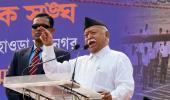
Rashtriya Swayamsevak Sangh chief Mohan Bhagwat has said that the Sangh does not practice Hindutva politics, rather it believes in building a strong society and nation through individual development.
"The Sangh's objective is individual development because only strong individuals can build a strong society and nation," Bhagwat said at a programme to mark the Sangh's 100 years on Sunday, emphasising that the reality of the RSS cannot be understood from the outside.
Some people mistake the Sangh for a paramilitary organisation, others for a service sector body, but the RSS is a social force working beyond these boundaries, he said, speaking on the theme 'Sangh Yatra - New Horizons, New Dimensions'.
"The world now hopes to see India in a leadership role once again," Bhagwat said, as he called upon the gathering to empower society and the nation by joining the Sangh's activities.
RSS on Hindu Identity and Power
Stating that only those who work to unite are Hindus, he said, "Devotion to the motherland is essential. The world understands power more than truth; therefore, acquiring power is essential, but its use should be restrained.
Women's Role in Governance
On the role of women, Bhagwat said they are completely independent and their participation in governance should be 50 per cent, and not limited to 33 per cent.
Environmental Conservation in Uttarakhand
He also emphasised the need for a coordinated policy and local participation to conserve Uttarakhand's rivers and the environment.






 © 2026