
'An HAL-private sector tieup is a possibility.'

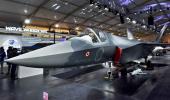
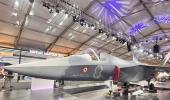
The government is willing to extend targeted assistance to new entrants to create an enabling environment for a second combat aircraft manufacturer -- possibly from the private sector -- alongside State-run Hindustan Aeronautics Ltd (HAL), through the advanced medium combat aircraft (Amca) execution model, Defence Secretary Rajesh Kumar Singh told Business Standard.
This was after a key meeting of the Aeronautical Development Agency (ADA), the Amca's design agency, in Bengaluru on July 4, 2025, which was attended by over two dozen interested companies.
While stating that the government acknowledged HAL's inherent advantage in securing the prototype development tender for India's first fifth-generation fighter jet due to historical factors, the defence secretary said it nonetheless believed there was space for at least two such entities in the country.
"Access to Indian Air Force base and common test facilities, probably at a discounted rate, could be extended to private sector players that qualify as the development-cum-production partner for the Amca prototype, either as a single entity or as part of a joint venture or consortium," the secretary said, addressing a crucial concern of large private companies interested in competing.
The private industry has welcomed the Amca execution model, under which both private and public Indian defence companies have been given equal opportunity to compete for developing the stealth fighter's prototype.
However, there are concerns that a level playing field with HAL might still be some distance away.
One reason cited by an industry insider is that the Bengaluru-headquartered Maharatna's assets, including its own aviation facilities for testing and development, are government-funded -- meaning it bears neither asset-creation nor servicing costs.
Private players argue that replicating such infrastructure independently would be prohibitively expensive.
An executive from a private-sector defence firm who did not wish to be named also noted that HAL, by virtue of its existing and upcoming order volumes -- including nominated orders for the Tejas Mk1 and Mk1A, and those expected for the Mk2 -- was in a position to underbid competitors for the Amca development programme.
In February, the HAL leadership indicated that the company's order book was expected to reach Rs 2.5 trillion in 2025-2026.
Private defence majors like the Kalyani Group, Larsen & Toubro, the Tata group, and Adani Group are keen to participate in the programme.
The defence secretary acknowledged these concerns. "Challenges will be there for any new entrant, but we are trying to at least lift the existing entry barriers."
Under the execution model approved in late May, private and public defence companies can bid for the Amca development programme independently, as JVs, or as consortia.
Bidders must be Indian firms compliant with national laws and regulations.
This marks a departure from longstanding convention, where HAL has served as the default domestic production agency for combat aircraft, and so far remains the only Indian entity to manufacture such platforms.
The move is being seen as the first concrete opportunity to end HAL's monopoly in the field.
In June, the ADA invited expressions of interest (EoI) for Amca's prototype development.
At least some interested private firms have reportedly expressed concerns that the evaluation criteria favour HAL.
However, in a recent interview with Business Standard, HAL Chairman and Managing Director D K Sunil said that certain aspects of the evaluation framework were, in fact, weighted against the defence public-sector undertaking (DPSU).
Whichever company wins the current tender is expected to be the natural choice for series production of the final platform, as indicated by the invitation of EoI requiring the shortlisted entity to possess the capability to establish a manufacturing facility for the purpose.
There is also speculation that an HAL-led JV or consortium involving private firms could be the frontrunner to secure the contract for prototype design, development, and production.
The defence secretary acknowledged that HAL and some private players could tie up, notwithstanding the government's goal of establishing a second combat aircraft manufacturer.
"An HAL-private sector tieup is a possibility, but rather than speculate, I would leave such decisions to the market and the players. Even so, a JV or consortium of this kind could impart a measure of momentum to the aerospace sector."
The secretary also said that some private firms could look to tie up with foreign original equipment manufacturers, adding that his personal opinion was inclined towards permitting minority, non-controlling foreign equity, which should be considered in line with existing 'Make in India' provisions applicable for capital procurements.
Regarding the government's vision to create additional defence production capacity beyond the existing DPSUs, the defence secretary said: "In shipbuilding, we have already created a level playing field for existing and prospective private entrants by ending nominations to PSUs and moving to competitive bidding.
"A similar process is underway in other areas like munitions, small arms, and armoured vehicles.
"The Defence Research and Development Organisation is also increasingly partnering with the private sector for its designs -- the Advanced Towed Artillery Gun System and carbines being the most recent examples."
Feature Presentation: Aslam Hunani/Rediff









 © 2025